
‘They only cut off half my left foot.’ What happens when inmate care goes wrong in Georgia?
Ernest Henderson Jr. had spent two months inside the Bibb County Jail, awaiting trial on felony theft charges, when he noticed a blister on his left foot. So, Henderson, a Macon resident in his early 50s, sought medical care in early February 2018. He didn’t see a doctor at first. Nurses saw him twice a day, changed the dressing, and soaked it in water.
As the weeks passed, and it grew infected, Henderson says he complained about his care. His foot worsened to the point where blood could no longer flow fully through his foot. Gangrene caused his skin tissue to slowly die. Then, it began to rot. But by the time a doctor saw his foot, two months later, Henderson was rushed to Navicent Hospital. The surgeon worried Henderson might need to have his full leg amputated.
“They only cut off half of my left foot,” Henderson told the The Telegraph. “I didn’t know it was going to be that bad.”
Bibb Sheriff David Davis declined to comment on Henderson’s case, citing the threat of litigation. But when inmates like Henderson face problems obtaining jail medical care, they typically don’t have the option of seeing another provider or seeking a second opinion. Their only recourse is to complain. This can happen informally — to a guard or to a loved one during a visit — or formally, through a formal grievance or lawsuit. If medical providers take grievances seriously, like hospitals or other clinics do, they can identify flaws in health care systems. It’s a tool that, like data tracking, audits, and inspections, can keep inmates safe during the course of their medical treatment.
But CorrectHealth’s records show that its staff upheld just one of 600 medical grievances filed at the Bibb County Jail between January 2017 and June 2019. People complained of delays in medication, disrupted chronic care treatment, and disrespect shown toward inmates who asked questions about their medical decisions. The Telegraph found the low rate of substantiated grievances is not limited to the Bibb County Jail. CorrectHealth’s data suggests the company failed to capture medical grievances at all of its jails. At the roughly two-dozen jails that collected such data, the company upheld fewer than 4 percent of 6,000 medical grievances, according to a Telegraph analysis of their data in the first quarter of 2019.
Interviews with roughly a dozen Georgia sheriffs and jailers revealed a variety of explanations for low rates of substantiated grievances. Lumpkin County Sheriff Stacy Jarrard said he’s more attuned to the complaints from inmates’ family members instead of formal grievances. Bartow County Capt. Dean Minter blamed it on inmates who “abuse the system” by lodging false complaints. Davis, for his part, said he was “not aware” of the lack of upheld grievances because CorrectHealth was responsible for handling those complaints.
“If we get a complaint about medical grievance, it’s forwarded to [CorrectHealth] to look at,” Davis told The Telegraph. “They can use whatever criteria they deem necessary and appropriate [for the grievances.]”
Dr. Carlo Musso, president of CorrectHealth, declined to discuss specific patient cases like Henderson’s. He wrote in a statement that grievances aren’t necessarily a sign that treatment was delayed, denied, or improperly provided. Sometimes, grievances can be filed over the wrong pill color, or about a co-pay required by the sheriff’s office, he said. “[The] grievance is one way that inmates communicate with [the] doctor,” Musso wrote. “They can’t get up and walk to the doctor. This is their system.”
Even with minor grievances like the ones Musso described, independent correctional health experts who reviewed the Telegraph’s data said those figures suggest inmates did not have access to a “credible functioning grievance system” because of how few complaints ever got substantiated, potentially undermining the process of treating inmates.
“That number is shocking,” said Gerry Weber, a senior staff attorney with the Southern Center for Human Rights. “They’re essentially watching themselves.”
Counties determine care
In the absence of strong federal and state regulations—which lawmakers never created following the landmark U.S. Supreme Court ruling Estelle v. Gamble in 1976 — counties have largely determined the quality of care available to jail inmates. As more jails outsource health care, medical and legal experts say local officials award fixed-sum contracts that often lack safeguards — creating the incentive for companies to skimp on health care — and failed to include bonuses that rewarded good performance.
“It’s a system designed to fail,” said Will Claiborne, a Savannah-based attorney who has sued CorrectHealth. “Every dollar you don’t spend, you keep. Until you remove that incentive, you’re going to have denials of care. It’s not going to be a flaw—but a feature.”
The difference between life or death, or losing a foot or walking out free, can be the words in a contract.
But a yearlong Telegraph investigation found that jail medical contracts in Georgia and beyond lack adequate safeguards to ensure inmates have access to consistent, quality, and timely treatment. Contracts can contain tools — grievances, noncompliance penalties, and other contractual requirements — to ensure that companies provide medical care as promised. Muscogee County’s sheriff can levy a $50 fine for every missed intake screening or health assessment. Chatham County’s sheriff can withhold payment if medical staffing positions go unfilled. Yet the Telegraph found most counties working with CorrectHealth failed to insert compliance measures into their contracts. For those who did, county officials did not collect fines collectively worth millions of dollars.
More than one-dozen sheriffs and jailers told the Telegraph they were satisfied with CorrectHealth. However, they said their satisfaction was largely based on anecdotal evidence. Few seemed aware of the company’s shortcomings in collecting data about the delivery of health care services, and some even lacked familiarity with the company’s basic contractual obligations. While counties have the opportunity to review medical records — or conduct audits — sheriffs rarely do so unless something went horribly wrong. Instead, they typically deferred to private companies, CorrectHealth or other providers, to fix its own systems.
Legal experts cite a key tension at the heart of private correctional medicine: Sheriffs typically hold more power than doctors to improve health outcomes inside their jails. Even though those decisions are left up to the sheriff, said Jessica Pishko, a fellow for the sheriff’s accountability project at the University of South Carolina, “sheriffs are not equipped to make medical decisions.”
Aware of their limitations, they have increasingly placed their faith in companies like CorrectHealth, even though there is scant evidence that private providers offer better care than public agencies or nonprofit health providers like hospitals. But Dr. Owen Murray, vice president of the University of Texas-Medical Branch’s correctional managed care program, says private medical companies are like a “black box”—at times withholding data that might shed light on their performance.
Dr. Brent Gibson, managing director for the National Commission for Correctional Health Care, says correctional medical companies can hold expertise that few jails possess. By delivering it at multiple jails, they can find efficiencies that lower costs for other facilities, he said. But experts and advocates have seen for-profit providers understaff facilities, delay treatments, and use cheaper medicines—placing the hiring sheriffs at risk of spending more money without safeguards should things go awry. Consider Bibb County: Had Henderson received skin infection treatment when he needed it, the county wouldn’t be on the hook for more than $250,000 associated with Henderson’s treatment, according to a notice sent by Henderson’s lawyer to the county. His lawyers intend to sue Bibb officials, leaving the county potentially liable for that amount plus legal defense costs. Once released from prison, he’ll eventually need to file for disability, costing the government even more money. The short-term savings of a county jail fund, in the end, can be far more expensive in the long run, experts said.
“If it’s taxpayer funded, they’re going to do what they need to do to save someone’s life, whether it’s cost effective or not,” said Craig Jones, a Georgia-based attorney who litigates against jail medical providers. “Once you inject a profit margin, there’s no way you can provide good-quality care at less cost to the taxpayers. It’s not putting each and every patient first.”
Being in charge
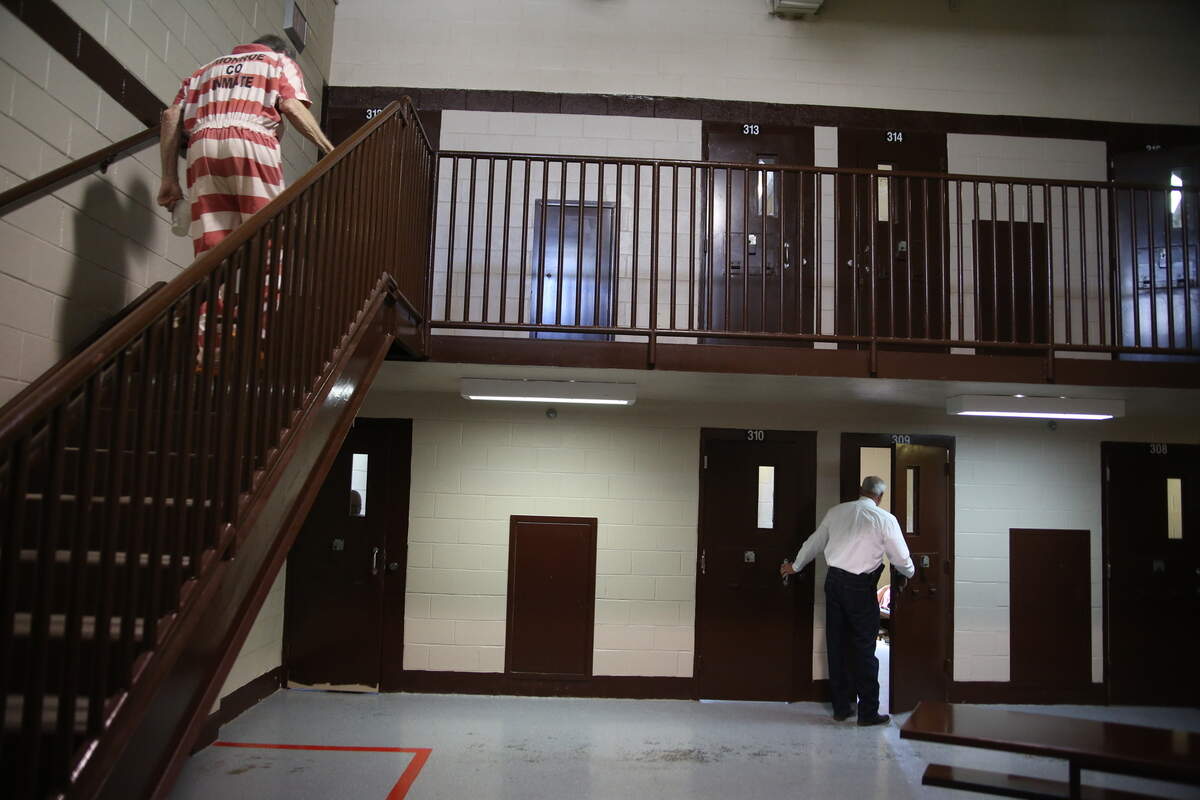
Sheriffs are responsible for everything that happens inside a jail. They decide when inmates receive their medication. They approve who can treat inmates. They can send a patient to the hospital. Talk to different sheriffs, and you’ll hear widely varying expectations about the ultimate goal of jail medicine, from getting patients healthy before their release to not getting sued. The sheriffs who spoke with The Telegraph shared different reasons about why they liked CorrectHealth. Some believe private jail health care can improve the lives of inmates in ways county-run government cannot. Others see it as a cost-saving mechanism or a way to unload legal risk and liability to a third-party vendor.
On a recent Friday morning, Monroe County Sheriff Brad Freeman asked his top jailer, Lt. Ricky Davis, to offer The Telegraph a tour of the “hotel,” an eight-bed dorm for patients under medical observation. After booking and receiving an intake screening, inmates can enter a medical appointment request into a kiosk, which then goes to CorrectHealth’s staff. During a 12-hour shift, one nurse checks the blood pressure of a recently booked inmate as part of a physical assessment. If someone needed emergency care, the nurse would need approval from a doctor before sending the patient to the hospital, CorrectHealth staff told The Telegraph. A sheriff’s deputy can override that company’s recommendation, Davis said.
Faced with inevitable lawsuits, some sheriffs have deflected criticism by saying the choice of a medical provider is a shared responsibility between county staffers and the elected commissioners who approve the funding. “A sheriff can’t enter a contract,” said Stacy Jarrard, president of the Georgia Sheriff’s Association. Unless county commissioners hold up a sheriff’s contract, DeKalb County Commissioner Kathie Gannon says county commissioners “don’t have the power” to provide more oversight. Harry Johnston, chairman of the Cherokee County Board of Commissioners — which ended its relationship with CorrectHealth following the 2014 death of inmate Demetrie Jones, who died alone in his cell — noted that county commissions could potentially use the “power of the purse” to gain more control over jail medical services. But he agreed that commissioners are generally limited in the restrictions they can place on a sheriff’s jail operation.
Sheriffs have the power to shape contracts and, later, enforce them. Consider data tracking. Nearly all of CorrectHealth’s jail medical contracts require the company to maintain “complete and accurate” patient records and to make available records related to the delivery of health care. In interviews with 12 sheriffs and jailers that work with CorrectHealth, most said they were hands-off in analyzing its medical provider’s performance and only intervened when serious complaints came across their desks. Jeff Alvarez, chief medical officer at NaphCare, a private jail medical company, says he relies on monthly reports to determine treatment quality within jails and to fix problems. “If you don’t have reports, you can’t judge the care,” he told The Telegraph. “It’s very hard to have oversight.”
In a 2006 deposition, Musso described the importance of the statistical reports, which he said captured “how many inmates are in the jail, how many patients we see, how many what kinds of medical problems they are having.” But CorrectHealth’s publicly available reports do not always show diligent tracking of the treatment it provides to inmates. Monthly reports spanning two years from 27 of 45 facilities in Georgia and Louisiana, from May 2017 to April 2019, contained blank spreadsheet cells that should have held data on how many patients received treatment for chronic care, mental health, dental work, and other specialty care. Asked why the reports were incomplete, Musso wrote that they were simply outdated and that “there’s no missing data.” The company declined subsequent requests to disclose updated data, saying that the information was privileged. When The Telegraph informed Janis Mangum, the sheriff of Jackson County, Georgia, that the company hadn’t fully collected data on health screenings, hospital visits, or medical grievances, she replied that she was “very busy” but would look at her contract “when I get time.” She did not provide further comment on the contract or missing data.
“I have no issue with the medical care [our inmates] receive,” Mangum said. “I’ve never had a problem.”

Ideas welcomed
Terry Deese, sheriff of Peach County, says he’s willing to listen to any idea that might improve health care in his 116-bed jail. As former president of the Georgia Sheriffs’ Association, he believes other sheriffs are interested as well. “We’re always looking,” said Deese, who currently works with CorrectHealth. “If we can improve [health outcomes], I’d love to see how.”
Sheriffs have no shortage of ideas from which to draw inspiration. Generally speaking, those reforms fall into three buckets: standards, performance, and oversight.
Currently, sheriffs decide whether or not they want their jails to receive accreditation from organizations like the NCCHC, the American Correctional Association, or the Medical Association of Georgia. Instead of a voluntary process, Josiah Rich, cofounder of the Center for Prison Health and Human Rights, believes all jails should be required to conduct site surveys, review records, and adhere to health care standards. How to do that—and whether it’s politically feasible—is the subject of debate in law enforcement circles. Some experts suggest that jails could follow the lead of hospitals, which must be accredited in order to participate in Medicaid and Medicare.
Beyond those standards, multiple jail doctors told The Telegraph that providers should thoroughly track data that captures not only how much care is administered but whether it’s effective in improving outcomes. Some lawmakers agree, too. Presented with CorrectHealth’s missing data, a pair of Georgia state representatives—Scott Holcomb, an Atlanta Democrat, and Terry England, an Auburn Republican — said the state could potentially require oversight of private jail medical providers.
“We need to think creatively about oversight mechanisms and to make sure taxpayers get the best bang for their buck,” Holcomb said. “Certainly, before any contracts are renewed, there should be a rigorous look at what are we getting, and is it working?”
Multiple sheriffs told The Telegraph that future contracts should strengthen compliance measures and said they would consider inserting language into future contracts that outlined better data collection or performance benchmarks. While Pishko believes counties could go further—distributing jail funding only if key health outcomes are met—other criminal justice activists see political hurdles.
“There’s no question that a lack of oversight in jails and prisons is a huge barrier to improving health care,” said David Fathi, director of the American Civil Liberties Union’s National Prison Project. “If you don’t know the problem, it’s impossible to remedy them.”
In 2006, the Dallas County, Texas, sheriff hired Parkland Health, the county’s safety-net hospital, to take over medical care at its 6,000-person jail. One Parkland exec recently noted the partnership has since lowered the mortality rate, overall costs, and lawsuits. (At least three Georgia counties, including Cobb and Dougherty, partner with local hospitals.) After a judge declared California’s prison medical system unconstitutional, a receiver created the health CEO position, allowing practitioners to report to a medical administrator instead of a warden. But correctional experts caution that these solutions—along with others—require substantial resources. Sheriffs will only be as successful as the investment into their facilities, said Dr. Marc Stern, former health services director for the Washington State Department of Corrections.
“The main problems come down to three things,” Stern recently told jail medical providers at the NCCHC’s annual conference. “The first problem is money. The second problem is money. And the third problem is money.”

Reforms needed?
Improved health outcomes for inmates will only happen if sheriffs embrace reforms, said Sara Totonchi, executive director for the Southern Center for Human Rights. Criminal justice advocates say sheriffs can be reluctant — resistant, even — to regulations proposed by outside parties. “They don’t want to be told what to do, how to run their jails, or be accountable to anyone,” Totonchi explained.
For a case study, look no further than the Chatham County Detention Center. In 2016, after seven inmates died under Corizon’s care, the county hired CorrectHealth to improve medical services. The contract, worth $7 million a year, required the company to be watched by Steve Rosenberg, an independent jail monitor. CorrectHealth’s tenure got off to a rocky start that included missed intake screenings and insufficient staffing, which led Rosenberg to recommend a $5.2 million fine against CorrectHealth.
CorrectHealth wanted Rosenberg gone, claiming in a letter to Chatham’s county manager that he was “bullying” one of the CorrectHealth nurses to tell Musso to provide higher-quality care. So, evidently, did newly-elected sheriff John Wilcher. The veteran lawman had cut off Rosenberg’s jail access because the monitor wouldn’t report findings directly to the sheriff. “I can’t fix something if I don’t know it’s broke,” Wilcher complained to the county officials who hired Rosenberg. Wilcher strongly supported Musso, one of the sheriff’s largest donors. In October 2017, when Chatham commissioners unexpectedly ended CorrectHealth’s contract, he was furious. The sheriff accused the county manager of “trying to micromanage” his jail and questioned Rosenberg’s judgment. “I don’t need nobody to oversee me,” Wilcher told officials. “I’m happy with my contract.”
Under pressure to avoid a lapse in medical coverage at the jail, Chatham commissioners reversed course, offering CorrectHealth a temporary extension. Leveraging the county’s predicament — switching companies would create a lapse in provider — CorrectHealth agreed to stay so long as Rosenberg no longer provided oversight. The county never collected the $5.2 million penalty that Rosenberg suggested. CorrectHealth last year won a three-year, $22 million contract, which no longer penalizes the company for missed screenings. Wilcher hired a new monitor who reported directly to the sheriff’s office. Months later, Mosheh Underwood, a 24-year-old Savannah father awaiting trial for aggravated assault charges, committed suicide. Wilcher declined to comment on Underwood’s case.
“You can say you have policies,” said Claiborne, who represents the family of Mosheh Underwood, one of the men who ended his life. “But if you don’t have enough people, the policy is only as good as the paper it’s written on.”
This story is part of a collaboration between The Telegraph and Atlanta magazine. Blau’s series was supported by the Association of Health Care Journalists, the Commonwealth Fund, and the Fund for Investigative Journalism. Margaret Pfohl and Jade Abdul-Malik contributed reporting.
This story was originally published December 13, 2019 at 1:10 PM.