‘We won’t be afraid.’ How a Black man’s death in 1971 led to change in Macon
READ MORE
Macon Telegraph’s Black History Month coverage
Read the Telegraph’s coverage of Black History month, including fresh reporting and gems from our archives.
Expand All
Editor’s note: Warning, this article contains graphic details.
It sounds hauntingly familiar: a white police officer shoots and kills a Black man. In response, the community and local activists protest, calling for systemic changes that should have been made decades before.
It’s a story that could have been written last summer after the killings of George Floyd, Breonna Taylor and Ahmaud Arbery. But this particular one starts in Macon more than half a century ago.
On June 24, 1971, Jimmy Lee White, 38, was fatally shot around 10:20 p.m. by John Beck, a white police officer for the City of Macon.
Civil Rights activists and Black community leaders wanted an investigation. Blocked by a recalcitrant mayor and unconvinced grand jury, activists were still able to improve access to jobs and polls for the city’s Black residents.
The tragedy of White’s death
The story, pieced together from Telegraph archives (it’s worth noting the Telegraph’s coverage at the time was much more sympathetic to the law enforcement than White), begins with White, a former city employee in the traffic engineering division, arriving at the home of his brother, Sanders .
Sanders had reportedly attacked his wife and taken their baby. White’s sister-in-law called him, and while it’s unclear when he arrived at the house, at some point police officers were also called.
Officer John Beck and Officer R. L. Stembridge responded to a call about a disturbance at the Walnut Hills Apartments residence. After they arrived, Sanders returned, gave the baby to his wife and explained what happened to the officers.
Beck told Sanders he was under arrest and attempted to handcuff him. Beck said he hit Sanders with his flashlight a few times in the head to “subdue him,” and White intervened.
“Don’t hit him [any expletive] more,” White reportedly said to Beck before pulling the officer off of his brother.
They tumbled down an embankment, and what happened next is unclear. Beck’s report of events and statements from county officials were the only complete reports that The Telegraph printed in 1971, although it was mentioned that Beck’s report was not fully corroborated by witnesses on the scene. Beck’s report also contradicted some of the evidence, according to reports at the time.
Witnesses at the scene confirmed that there was some type of struggle, but they could not confirm who started the fight. The result was that Beck shot White five to six times in the left shoulder, torso and left hand, according to Dr. Larry Howard, director of the State Crime Laboratory who performed an autopsy on the body.
Dr. Leonard H. Campbell, Bibb County Medical Examiner, said he went to the scene and saw no evidence of a struggle.
Based on the coroner’s inquest’s findings, Beck was charged with “involuntary manslaughter in the commission of a lawful act without due caution and circumspection.”
No indictment for Beck
But that charge didn’t stick: a Bibb County grand jury declined to indict Beck. Black leaders then gathered around 300 people at First Baptist Church on New Street to decide their next steps.
“I know you are mad,” the Rev. Julius Hope, state president of the NAACP, said at the meeting. “I too am mad. We all agree Beck should have been suspended and he should have been given some type of sentence.”
Hope encouraged people to use their anger to create a united front in dismantling the system that failed them.
“When you move blindly, it’s dangerous to all of us. We come to plead, admonish you to follow some leadership… It wasn’t the grand jury that brought this verdict out today, it was the system. This is what the system wanted and this is what the system got,” he said. “We are continuously being misused by the system, it’s not just Beck, or the mayor, or anyone alone - it’s a system, the power structure, that is committed to destroying Black people.”
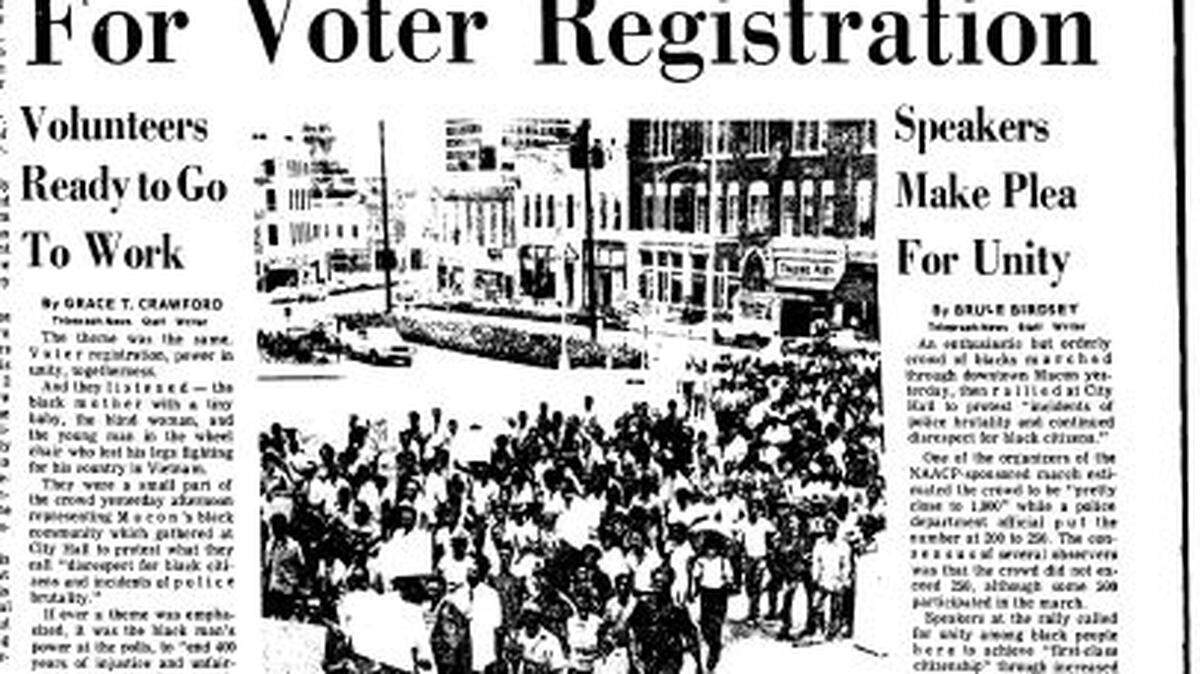
Although Beck was not indicted, the Civil Rights activism that rose from White’s death culminated at a march on City Hall a few weeks after the killing, on July 17, 1971.
Organizers of the event said the crowd was close to 1,000 people while the police estimated around 250. The Telegraph reported the number was closer to 500 people.
“We are dog-tired of being considered second-class citizens,” said the Rev. J. L. Key, president of the local NAACP chapter, at the event. “We have come today to say to the people of Macon that it is high time you screen the candidates that you put in public office.”
Speakers at the event were critical of Mayor Ronnie Thompson for his actions earlier in the month where he implemented curfews and reportedly suggested that an officer should fire a submachine gun in “the neighborhood,” likely referring to a majority Black neighborhood.
Thompson refused to suspend Beck, and he responded to an “officer under fire” situation and returned fire with a submachine gun, earning the nickname “Machine Gun Ronnie.” No shooter was ever found, and reportedly no one was shot during the incident.
“Sometimes we have little men in high places who got there by crying, ‘[racial slur].’ The only way they can exist is in an attitude of racism,” Hope said following Thompson’s actions.
Demonstrators encouraged people to register to vote and demanded an end to job discrimination and segregation, especially when it came to management positions.
“Let the record show that we won’t be afraid if the machine guns start shooting in the neighborhood tonight,” said William P. Randall, a local community leader. His words were followed by a roar of cheers from the audience.
Making a better Macon
Around four days after the march on City Hall, local business leaders sat down with NAACP leaders to create a plan to immediately offer employment opportunities to Black residents and to create an organization to assist with the employment of Black residents.
On July 22, 1971, the Bibb County Board of Elections approved a one-day trial run for a portable neighborhood voter registration booth. The decision was made after the board listened to complaints from the Black community that the current system was inadequate to fill the need for registering Black voters.
The portable registration booth would eventually be run by an all Black staff in order to encourage participation from the Black community.
“People won’t come when they see all white faces. They just say my vote won’t count anyway. We are saying we want the Negro to become involved and he can’t be involved unless we let him,” said Willis Sheftall, the board’s only Black member.
This story was originally published September 5, 2021 at 8:00 AM.
.jpg)