The South may see northern lights. Here’s when, why & if the aurora will be visible in GA
If you want to see the northern lights here in the South, tonight might be the perfect opportunity.
The NOAA Space Weather Prediction Center has issued a severe (G4) geomagnetic storm watch for Oct. 10 and Oct. 11.
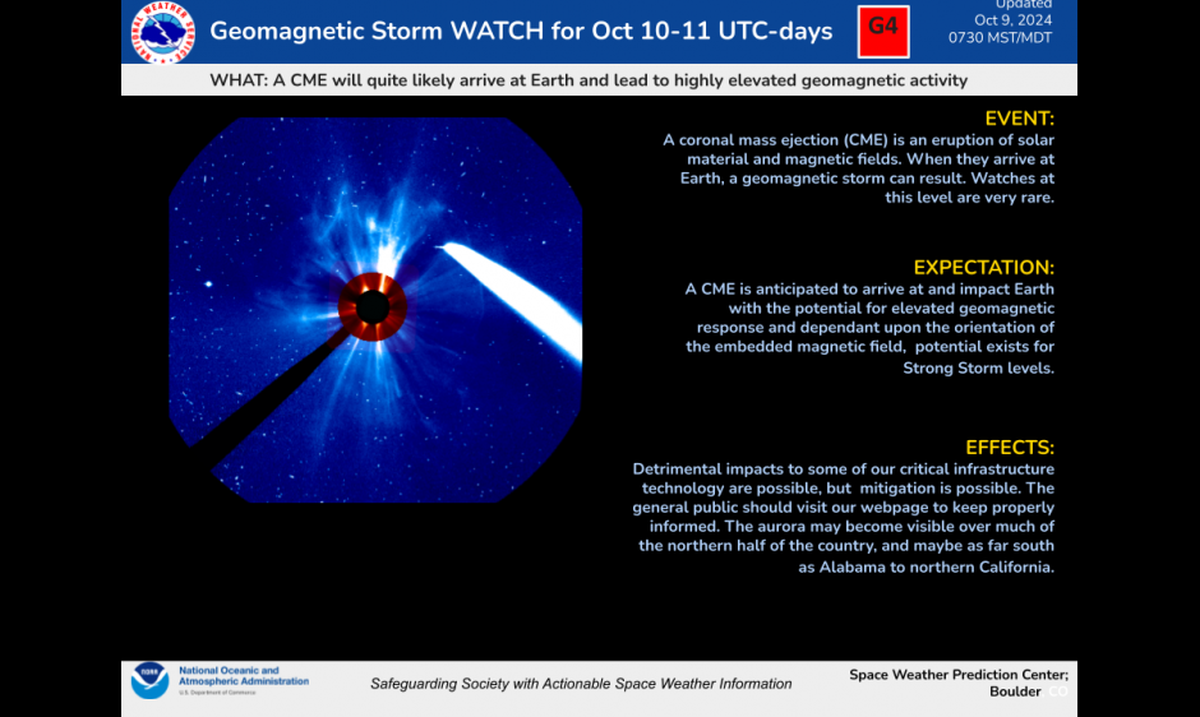
The coronal mass ejections (CMEs) event is “an eruption of solar material and magnetic fields” capable of reaching earth and creating geomagnetic activity.
So, what does the storm actually do to Earth once it reaches the planet? Here’s what else to know.
What will happen when the storm reaches Earth?
The NOAA reported that a storm of this magnitude could create “Detrimental impacts to some of our critical infrastructure technology.” In the past, the extreme (G5) geomagnetic storm of 2003 created a power outage in Sweden and damaged power transformers in South Africa.
However, for several regions of the U.S., there will be an aurora, which resembles the northern lights. Auroras occur when the sun’s particles get into the earth’s magnetic field and begin to mix with oxygen, creating a beautiful, colorful light show in the sky.
Could the northern lights be seen in all southern states?
The aurora is likely to be seen over the northern half of the U.S., but some southern states may even get a glimpse of the storm in the night sky. According to the NOAA, parts of Alabama may get to see the northern lights and this visibility could stretch all the way to California.
When the last severe geomagnetic event arrived in May 2024, the NOAA reported it as unlikely for Georgia to see the aurora.
However, the Telegraph received several comments on Facebook from the public which included photos of the northern lights all across spots like Columbus, Macon and Augusta, Georgia as well as parts of Mississippi.
Watch for updates on the NOAA’s online Aurora Dashboard.
Will you be watching the sky tonight? Let me know in the comments or email me at cmadden@mcclatchy.com.
This story was originally published October 10, 2024 at 11:57 AM.