
An open talk with former UGA athletes on being black in America, George Floyd death
Note: This is the final installment of a two-part conversation around race relations with a selected group of six former black student-athletes at Georgia. The first story was a discussion on police brutality and reform.
On Thursday morning, Yante Maten went for his usual run through the streets of a business district. He didn’t have a second thought about his attire until glancing at drivers as they passed by. Maten’s eyes fixated on cars for a brief glimpse, but he realized each driver was staring back.
He looked down at his attire. Black shirt. Black shorts. A moment turned uncomfortable and anxiety amplified. A black woman then pulled over and said, “Are you OK?” to Maten, and he didn’t quite get it at first. He then realized that the simple task of a leisurely run in black clothing became a warning sign through a period of social unrest.
Maten saw the interaction as gratifying, but the deaths of unarmed black citizens — George Floyd, Breonna Taylor and Ahmaud Arbery (who was shot while jogging in Brunswick) — played on a loop in his head. Maten felt the same unease when driving to a funeral to show support for his friend. No matter the circumstance, an inkling of worry sets in.
“I didn’t want to be on the news or my life to be threatened,” Maten said. “It might not be reasonable to think that, but that fear crept up on me. I gave it to God and realized He would walk before me in the car.”
These are the fears that black people, even as a high-profile athlete, face on a daily basis. These are their perspectives and stories on being black in America with the hope for change. Meet the panelists in our discussion:
Haley Clark: A defined leader for the Lady Bulldogs’ women’s basketball team over a four-year career. Clark earned the 2018 Co-Scholar Athlete of the Year honor while pursuing a career in finance
Aaron Davis: As a former Georgia football walk-on, Davis became a starting defensive back. He recorded 43 tackles, fifth-best on the team as a senior in 2017
Mackenzie Engram: A third-round draftee by the WNBA’s Atlanta Dream and a leading contributor to the Lady Bulldogs over four seasons. Engram has become known for openly sharing her faith and serving others through social media
Yante Maten: A three-time all-SEC honoree, Maten fills the Georgia men’s basketball record books. The Pontiac, Mich. native made his NBA debut with the Miami Heat and currently plays in the Boston Celtics organization
Keturah Orji: As an Olympian for the United States national team, Orji cemented herself as one of the greatest Georgia track and field athletes in program history. She was awarded the Women’s Field Athlete of the Year honor during the 2018 outdoor season
Rashad Roundtree: A former five-star recruit from Evans, Ga. who played three seasons for Georgia football medically retiring
How have you taken in the escalated discussion, anger and unrest after Floyd’s death?
MATEN: It has been eye-opening to see how people have felt about African Americans. There are people who speak up, then others who aren’t seeing the big picture. I don’t know what to take out of it other than things need to change. I don’t know how to feel. A lot of people are taking it as a black vs. white thing when it’s really us vs. racism. It has been a journey.
I told my friends to not let the devil take any of your joy or happiness. Don’t let it cause doubt or fear in your mind. That’s what the devil will do, rob you of those things that God blessed you with.
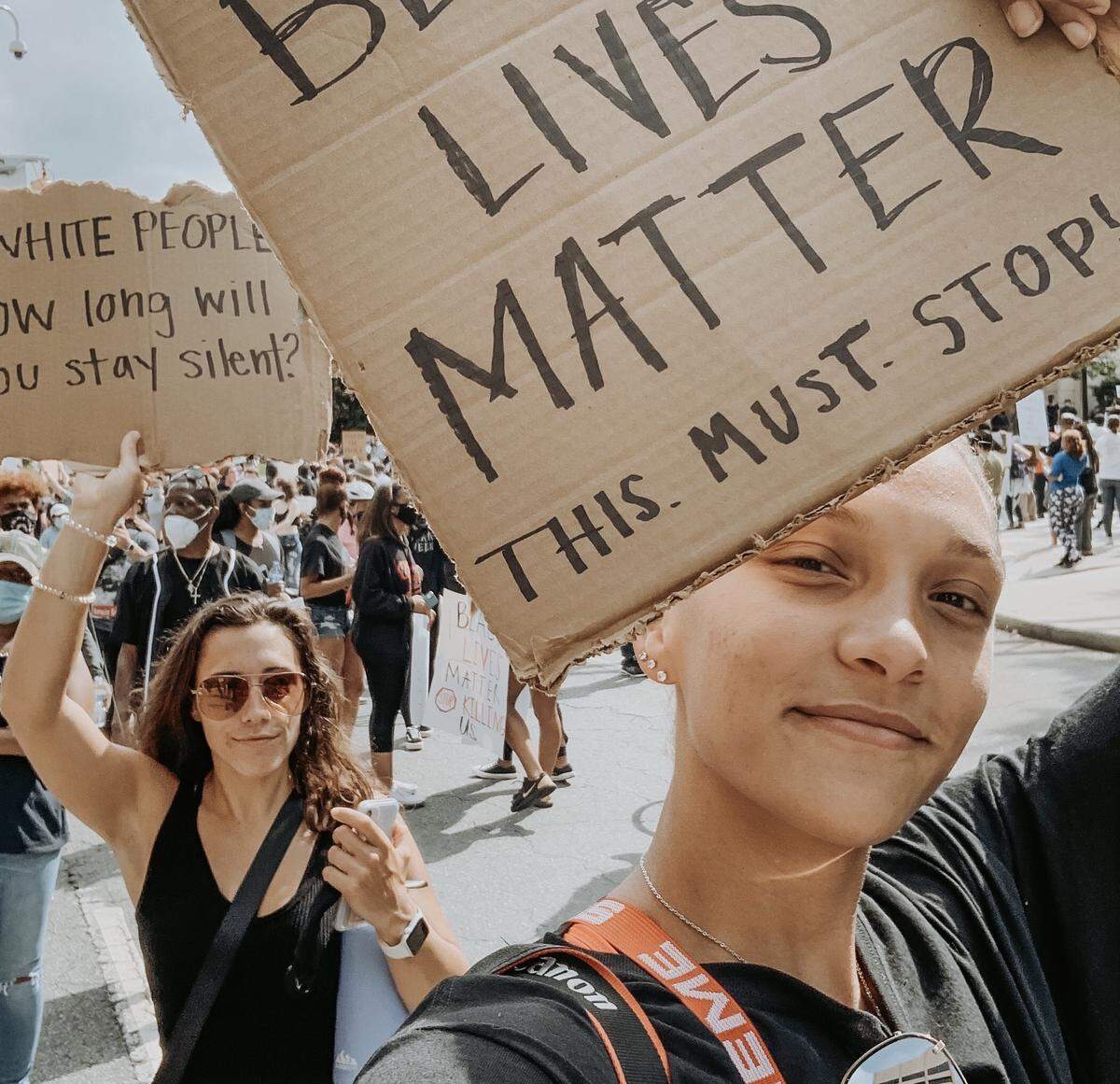
CLARK: At first, I was pissed and angry. That turned into energy to do something, especially after seeing that people who aren’t black actually care. People say “posting on platforms doesn’t do anything,” but no. When we see people who aren’t black post something, it’s one of the first times we’ve seen people outside of our community actually care. I’m now hopeful and excited for what’s to come, because it’s revolutionary.
ENGRAM: I started calling out my white friends who weren’t posting. I got really hurt that they weren’t posting. I got into this mode of thinking, “What would Jesus do?” I really tried to handle it in a Christ-like way, and a lot of that is forgiving and having conversations about, “Why are you silent?” I do think there are some who post to avoid conflict and look like they’re with the crowd, then you have some who are delayed but take steps to educate themselves. It has been a scary place for me, too, because I’m half-white and half-black. I have the white privilege and also the privilege of the struggle of being black. I’ve never, to this extent, feared the life of my dad or black friends. There have been a lot of emotions to handle.
ROUNDTREE: The fact that we’re standing up now is great, but it should’ve happened 20 or 30 years ago. That has been the whole disheartening thing about all of this. We learned to live with this. I will never teach my kids that this is the way it is. It’s not.
In everyday life, what was your first experience with systemic racism?
CLARK: I was born in Dothan, Alabama and went to a private Christian school. My kindergarten best friend came up to me one day and said, “Hey, Haley, we can’t play anymore.” I said “Why, Abby?” She said “My mom said it’s because you’re brown.” My mom said I came home crying because I lost my best friend. She gave me the speech that this is America and what we live in. We couldn’t go to the school and tell anyone, but had to accept it for what it is. You teach your kids how to live with that.
Another memory I have is everybody watching “Walker, Texas Ranger” as a kid. I played with a lot of boys at recess as a tomboy. There’s a black guy in the show, Trivette. Everyday at recess, they’d alternate who played Walker, because he was the superhero. It was always my turn, and I’d ask. I was always confined to Trivette, because he was the only black one.
Those experiences gave me and my sister this thought of, “You are less than.” So we wouldn’t play with black Barbies or black baby dolls. My mom would try to buy us the black ones, and we wouldn’t get them. It shows how early that is instilled in us — being black is not equal. Thankfully, we moved to Florida and I started playing basketball with black girls and realized that being black is cool and OK.
DAVIS: Growing up, I was smart early so most of the people in the honors classes were not my skin complexion. There were people who were surprised that I’m smart. I noticed that from teachers, and people didn’t know that it’s not OK to call me “boy.” We know what that is, so I had to navigate through those situations and understand where that person stands. I would have to distance myself, then ask what I could do to be comfortable in the space that I had to be in. You had to walk with caution while still being able to function.
ORJI: I grew up in a mostly-white neighborhood in New Jersey. I always experienced these microaggressions like, “Can I touch your hair?” or having to represent the entire race in class. If I’m loud or angry one day, they’re going to assume I’m the loud black woman. If it’s a white person, you don’t say, “White people are angry.”
I didn’t experience systemic racism until my senior year of high school. I had an issue with a teacher because she tried to kick me out of an office. I was in my coach’s office and said I was allowed, but she didn’t want it. She said I was intimidating and bullying her. I asked, “I’m 5-foot-5 and intimidated you without touching you?”
She reported me and I got suspended for two days. I had never been disciplined, had any issues and was well-behaved in class. I remember being so mad and worried it would affect college and stick with me forever. I knew the suspension was intentional because they didn’t let me have any access to the track or letting me train. They could’ve just given a detention, but that’s when you realize that black kids get punished harsher. There’s a fear of black people in the system.
How does change occur from within and the people surrounding you — regardless of race?
CLARK: It’s a wiring of the brain. For so long, non-black people have been trained by their parents to view black people a certain way. The change starts at the home and it has to be acknowledged, talked about and intentional not to change your view. Even in the subtle things. They’ll say, “I’m not racist,” but they don’t know the subtle things that have been traditions.
We weren’t brought here to be slaves, but to be commodity and property. It’s a transition of a mental thing that people have to undo. The legislators are raised in homes, so it has to start there.
ROUNDTREE: We’ve learned to conform to things as black people. How could I let this go on for so long, especially with our platform? I really go back to 2016 and Colin Kaepernick kneeling. If I were a teammate of his, how could I let that slide? How can I let that man stand alone?
CLARK: I never thought about it, but we have been trained by our parents to conform. We’ve been taught, “This is how the world is,” and “I’m going to teach you the best way to live in it.” That’s why people are so passionate now about getting people to speak up. I’d been taught to sit back, but nothing changed to live in this world as a black woman and do the best you can.
This is nothing new to us. When things happen like this, we scream out then are suppressed. The fact that we’re screaming out and people who aren’t black scream with us, it makes for an “Oh crap, it doesn’t have to be like this” moment. That’s why it’s so blown up now.
MATEN: As long as we aren’t slacking as African Americans, too, that can push other people to help us fight for that equality and respect.
DAVIS: We’ve already waited this long, so make now the perfect time. This is the first time I’ve seen people outside of our community get so invested. When the Kaepernick stuff happened, I remember Richard Sherman and Malcolm Jenkins calling for white quarterbacks — the golden boys of the NFL — to step up and say something. There was nothing said, but now people are stepping up. We can’t judge what’s intentional or actually in their heart, because they’re putting money, family and relationships on the line to make a statement. We can use that to build on what we’ve done so far.
MATEN: The heart was mentioned and that’s the biggest thing it’s going to come down to. You can go back to the legislature, and that matters, but essentially it comes down to the heart. It says in the Bible (Matthew 12:34) “From the abundance of the heart, the mouth speaks.” A lot of what we say is how we actually feel. Slavery taught us to conform and to hate our own self, so it takes a mindset that we’re just as good as anybody else. If you don’t change a person’s heart, they’re going to feel the same way. They might not say it out loud right then and there, but they’ll say it eventually.
ORJI: Exposure is important, too. If you’ve never been around black people, you have this view of what you see on TV or in the movies. You see them on the football field, so OK, they’re an athlete. You see a mugshot, so you think they’re criminals. You’ve seen TV shows where they’re a loud character. These people who have never interacted with people of color only have one view. That’s why, when they see these incidents with police, you hear, “Oh, I want to see what happened before.” It doesn’t matter, because they were shot while unarmed. They need exposure to see that we are smart, capable people.
The other thing is policies. There’s so much of a gap that policies need to make up for. It’s not just going to be “one day we’ll catch up.” We need policies that will advocate for people of color to be in places. Affirmative action is a great one, and people say it’s not fair that someone less qualified than me can get a job. It’s not fair that we were brought over here, torn down and used for money. We’re behind because of that. There have to be things to catch up in order to make this a level playing field.
ROUNDTREE: If you want black policies, you need black people in political power to make them. You’re currently trying to convince people that we have a voice. The fact that we have to convince people about a problem is the problem. You have to get people that will fight for you in your corner. If not, you’ll face the worst thing in the world — convincing people you need more and we’re lacking.
DAVIS: Don’t whitewash it or try to focus on what benefits you. Educate yourself on everything and all of the people who contributed to this country. We shouldn’t only have Black History Month, but it should be year-round. The next step is for white people to hold other white people accountable. If you have a friend who is using language they shouldn’t, don’t let it slide and confront them. Being silent is not OK.
As a black person, do you feel a sign of hope after more discussion?
ORJI: This is a good start, but I’m no hopeful person. I’m realistic. I’ve seen a lot more people speaking out than usual, but it’s just speaking out. Actual actions have to happen. There has to be more than posting on social media. It’s a lot of talk and fluff, then it might die down without much change.
Has anything changed yet? Do you see how long it took for the police officers to get charged? Some are still releasing statements (as of Thursday evening). I want to see more happen and use this as a good opportunity to educate. Hire some black people instead of all white people.
CLARK: If nothing else comes out of this, the major change we’ll see is how non-white people view black people on a day-to-day basis. I feel like there have been chains broken off of how I have to be in public. For example, the CEO of my company held a virtual portal where he came in to listen to the black community. He cried. I feel like it’s now OK to come to work as a black woman. We don’t have to suppress our blackness. They’re starting to understand that we aren’t the same.
Everybody who says, “I don’t see color.” No. You need to see it in order for me to be who I am. That can be the smallest thing we get.
ROUNDTREE: We’re fighting an uphill battle for things that have been in place over hundreds of years. It’s going to take a movement, and we have to do our research as to why people think this way. There were policies and reasons to keep minorities down. We got this far and there’s no going back now. I can’t be quiet this time. I remember marching for Trayvon Martin and it was all over in three months. I can’t have that feeling again. We might as well go to the top of the mountain.
How do you feel about the mass protesting across the country? When corporations make statements about the entire situation, how do those make you feel?
ROUNDTREE: It’s not just black people protesting, but it’s everyone. We’re all feeling that oppression with force used. Everybody is saying: “Hold on. You’re saying I had this freedom of speech and all of this, but now I don’t.” I say: “Yeah. This is what black people have fought for the entire time. This is a little taste of wanting to be heard, but you still aren’t heard.
My company came out with a statement (Friday). He called me to ask and review it, and I’m trying to look at it through a positive lens. In my mind, it’s a little too late for me. The delay told me everything I need to know. You haven’t been listening or been paying attention to what’s going on, so now I feel like you’re trying to save face. That’s the message you’re sending to people, and companies don’t understand it. I can’t hear it with a response time like this, because it’s not genuine.
ORJI: It was a follow-the-leader thing, too, with the statements. They think, “They’re making a statement, so we need to as well.” It makes you think if they truly care about a statement.
Where does the pride lay in being black in America?
ENGRAM: It’s different, but it’s not — just because I am mixed. I don’t want to say this like I’m degrading white women, but there’s something about an African-American woman that is so powerful. I look at people like Joni Taylor and Michelle Obama, and those women are seen as so powerful because we don’t see enough of them at that higher role in whatever they’re doing. They stand out and it’s beautiful. I love being mixed, but I’ve always said that if I wanted to be one or the other, I would want to be black. There’s so much power and beauty to it, not to say that whites, Hispanics and Asians aren’t. There’s just a different weight to it, and that’s a beautiful thing.
CLARK: We overcome so much more that Caucasian women don’t have to. We’re cut from a different cloth because we have to be. Not even because we want to be, but we have to be in order to be in the same rooms and on the same platforms. There’s bias and views that we have to overcome.
We came from slavery. Not only did we come from it, but we survived it. If you have watched any slave movie, you know that it is the most inhumane and terrifying thing. We survived it. We’ve survived segregation and still today in oppression. That’s what we do. It makes me so proud to be black because we endure. Not only do we survive, but we still love.
ORJI: I have a bit of a different view because my dad is Nigerian. Fifty percent of me was not a descendant of slaves, but my mom was. I have struggled with finding pride in being a black American because of everything that has happened to us. I’m proud to be a black person — I love that — and very proud to be Nigerian. I can say, “I have this background and culture rooted here.” A lot of black Americans are missing that. They don’t know what country they came from, what language they used to speak or what the culture originally was. They just know America, which isn’t actually their culture or history.
I’ve had trouble finding pride in being an American person because I guess I feel like I don’t belong here or nobody wants me here. It gets hard with track and representing Team USA (in the Olympics). You go on the big stage, say “Go USA” and hold the flag. You’re battling that you’ve fought really hard to get to the top and represent this country, but at the same time the country doesn’t really value me as a person. It’s definitely difficult being proud as a black American. It’s hard to say.
DAVIS: I’m going to call it what it is. If you look around the culture in America right now, there are so many different fields that black people lead — hip-hop as the No. 1 genre, black women with higher education, our most-famous athletes like LeBron James and Kobe Bryant. All of the desirable traits of how people envision themselves stem from black people. We’re leading the charge and it’s lovely to see.
It’s double-edged because it’s a great time to be black, but you’ve still got a target on your back.
ROUNDTREE: Not only am I reshaping the future, but trying to create a better future for my kids. I want them to have all of the things I didn’t have. I want them to have choices, freedom and not be knocked off because of their skin color — whether that’s who they date or career choice. We come from so far, but we’ve got so much farther to go. Imagine things in 30 years if we keep this up. I’d love to be on that side of history.
I’m most proud because this world wasn’t given to us. We had to come in, take it and we’re still going to love people. We could always be mad and angry, but we’re not. It’s about talking and educating people.
I wouldn’t want it any other way. I say bring on the racism at this point. I want all of the smoke. I really do. I want to make a change. I’m mad that I’ve been quiet for so long about this. I’m mad about conforming for so long, and I’m ready to go. I’m right there with Kaepernick. If I could’ve kneeled in our games, I would have.