
Okefenokee protection bill won’t pass this year, despite majority support in the House
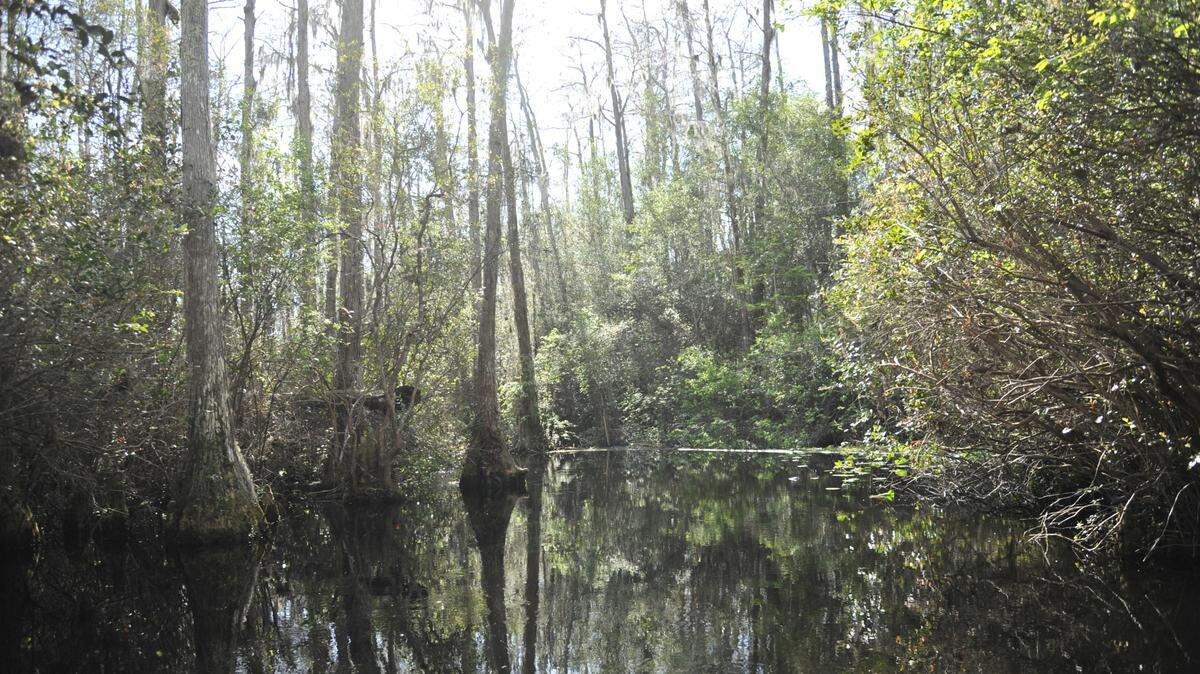
A bill to protect the Okefenokee Swamp from future mining has 91 sponsors in Georgia’s House of Representatives, a body with just 180 members. The bill would almost certainly pass the House if given a floor vote, having been introduced with majority support at the outset of its legislative journey.
Since HB 71, or the Okefenokee Protection Act, was introduced in January, supporters have focused their efforts on the primary hurdle of getting it out of the Natural Resources Committee, whose chair, Rep. Lynn Smith (R-Newnan), stymied a similar effort last year to stop mining near the swamp.
This year’s bill would block the Environmental Protection Division from granting mining permits along Trail Ridge — a geologic feature forming the Okefenokee’s eastern boundary — near the swamp after July. It would not impact the ongoing permitting process for the controversial Twin Pines titanium mine in Charlton County.
Despite getting a long-awaited hearing in the Natural Resources Committee last week, HB 71 cannot pass this year, due to Smith’s decision not to hold a vote this year.
“It’s not gonna move this session” due to limited time left, Smith told reporters after last week’s hearing. She would not say whether she plans to schedule a vote on the bill next year, the second in the two-year cycle that makes up Georgia’s legislative session.
“Is the bill dead? No, it’s a two-year term,” Smith said. “But I will never commit to what happens to a bill. I chair the committee but the committee members make the decision.”
Pressed on the point, Smith conceded that she, not the committee members, decides whether the bill gets a vote: “I chair the committee. It is my call when a vote is made, if a vote is made.”
“My job is to make sure my committee members have the information they need. And I have never been rushed on an issue,” Smith said. “If somebody pushes me, I slow down. You know, that tells me something else is going on. And I want the committee to be informed, that’s my job. They will vote if and when this bill comes back or another bill is introduced or no bill is introduced.”
Rep. Darlene Taylor (R-Thomasville), the bill’s lead sponsor, told the Telegraph the bill’s unusually high number of co-sponsors meant it would pass if it could advance to a floor vote in the House.
“There were more than 91 people that supported that bill; that’s just who signed the bill. The bill would pass, there is no doubt in my mind,” Taylor said.
Smith said the bill’s number of cosponsors was just “one of 1,000 things you look at.”
“Remember, we’re citizen legislators,” Smith added. “I mean, y’all could run for office and have your opinion.”
Last week, Taylor also introduced a resolution proposing a House study committee in which representatives would hear from experts about the issue between this year’s session and next.
At the March 14 committee hearing, advocates and opponents of the bill were each given 52 minutes to make their case to the committee.
In her remarks to the committee, Taylor, who chairs the House appropriations committee, described her sponsorship of this bill as a departure from her usual concerns.
“I’m not usually active in the environmental arena. That’s not my sphere,” she said.
But she described personal attachments to the Okefenokee Swamp that date back to her childhood in Florida as motivating her opposition to mining on Trail Ridge: “As a child, my family would come up during the summers and vacation there. The highlight was going to the Okefenokee.”
“There’s probably some sentimental value involved with my caring for the Okefenokee, but it’s bigger than one person, one legislator and one place,” Taylor said in the committee hearing. “On another note, because I did grow up in South Florida, I witnessed what happened to the Everglades. I lived it” — referring to decades of development and drainage during the 20th century that Florida has long attempted to reverse through an expensive restoration project.
“You don’t want that to happen to the Okefenokee. They are now spending billions of dollars to try to fix and repair what’s been done there. It will never, ever be the same again,” Taylor said of the Everglades.
A number of environmental advocates, scientists, southeast Georgia residents, and legislators spoke in favor of the bill, focusing their arguments on the potential ecological damage that mining on Trail Ridge could inflict upon the swamp and the nearby St. Marys river.
A smaller group spoke against it. These included Charlton County political figures, local landowners who stand to benefit from the use of their property for mining, representatives from Twin Pines, and Rep. John Corbett (R-Lake Park).
Some of the bill’s opponents said it violated landowners’ rights.
“It walks all over private property rights,” Corbett said.
Corbett also argued that the bill preempted a decision that should be left to the EPD.
“We’re basically telling the EPD back here, look here, you’re either incapable, incompetent of making a decision,” Corbett said.
EPD director Rick Dunn spoke at the hearing but did not weigh in on the bill, describing future mining permits as a subject for the legislature to decide on.
“Any blanket prohibition of mining on Trail Ridge like those contained in HB 71 is a policy question left to the General Assembly,” Dunn said.