
Republican, Democratic lawmakers in GA are trying to protect Okefenokee Swamp. Here’s how
An unusually strong bipartisan show of support in Georgia’s House of Representatives has given environmental advocates hope that a bill to block future mining near the Okefenokee Swamp could pass, if given a floor vote.
The bill does not affect permits for a controversial proposed titanium mine currently under consideration by the Environmental Protection Division. Instead, it bars the EPD from approving any future applications for surface mining along the ‘Trail Ridge’ adjoining the swamp submitted after July 1.
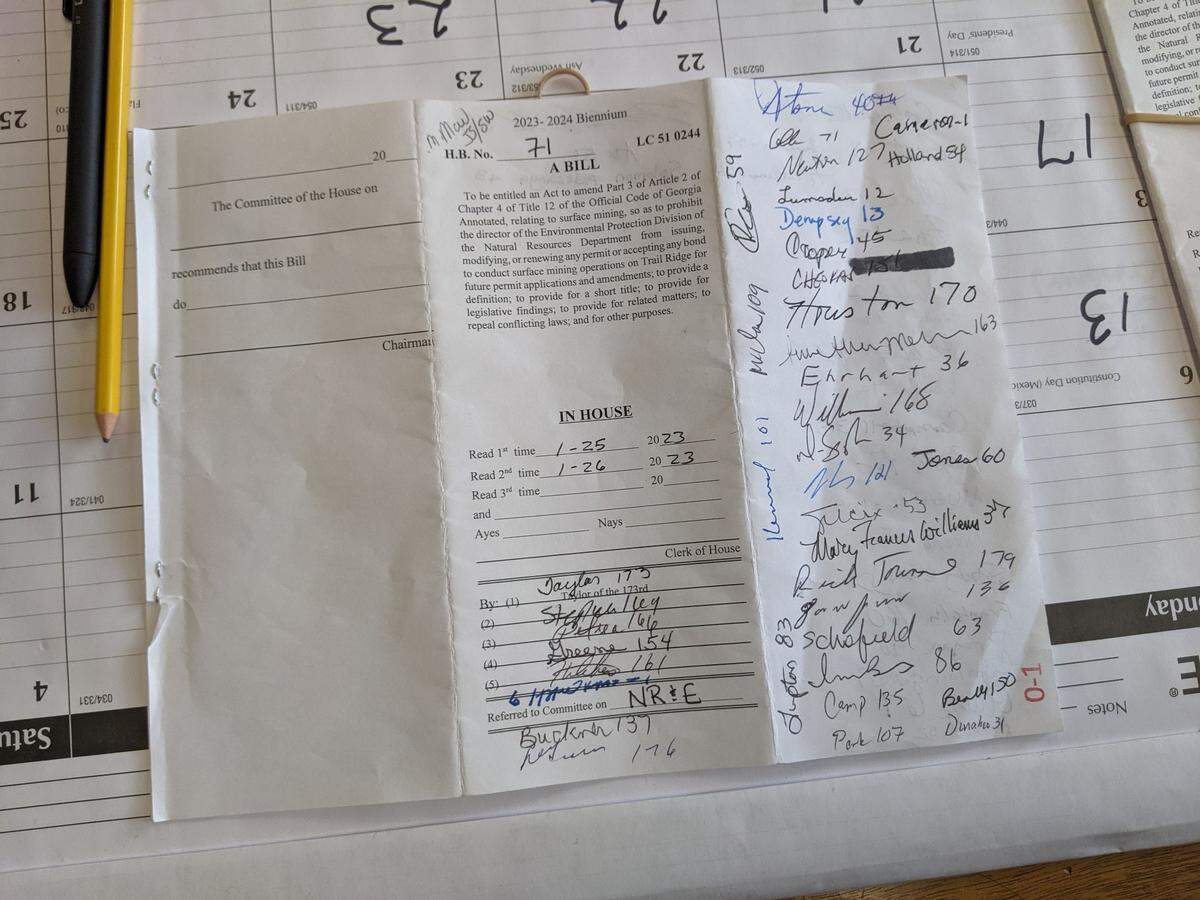
While environmental legislation is usually a low priority in the state’s Republican-dominated legislature, supporters of the Okefenokee Protection Act (HB 71) are buoyed by the fact that the bill has 70 co-sponsors and counting — 25 of whom are Republicans — in the House.
“I don’t know that I’ve ever worked with a piece of legislation that had 50 sponsors. Roughly a third of the Georgia House have signed on to be sponsors of this bill,” Georgia Wildlife Federation president Mike Worley told a group of volunteers who convened last week in Atlanta to lobby legislators to pass climate legislation for “Capitol Conservation Day,” an annual event organized by the Georgia Water Coalition.
But the bill’s popularity among legislators is no guarantee of its success if it doesn’t first get a hearing and a vote in the House committee to which it is assigned.
“There’s one person that makes that decision and that is Chairman Smith,” said Worley, referring to Rep. Lynn Smith (R-Newnan), who has chaired the House Natural Resources & Environment Committee since 2005.
In that role, Smith has previously been criticized for declining to grant a hearing or a vote to environmental bills with bipartisan support, including a prior bill protecting the Okefenokee against mining.
Smith told the Telegraph last week HB 71 “will get a hearing,” but declined to say whether she plans to permit the committee to vote on it. This would be a necessary step before the bill could be considered by the wider House (barring the use of a rare procedural mechanism by which bills can be forced out of a committee with the support of two-thirds of the House).
“Without a committee vote, the Okefenokee remains vulnerable to future mining proposals,” Georgia Conservation Voters political director Allie Brown told the Telegraph in a text message. “With over 70 bipartisan cosponsors and broad public support, it’s up to Rep. Smith to use her leadership to call for a vote for HB 71. We urge her to do this swiftly in order to protect the wild heart of Georgia.”
Eight of the Natural Resources & Environment Committee’s 24 members are among the Okefenokee Protection Act’s sponsors.
Protecting the swamp
The Okefenokee is a highly biodiverse federally protected wetland and the largest blackwater swamp in the U.S. Along its eastern border sits a mineral-rich formation known as Trail Ridge.
When Alice Keyes, vice president of coastal conservation at the advocacy group 100 Miles, first visited the swamp and saw Trail Ridge, “I thought it was a railroad, honestly,” she told the Telegraph. “There’s this hard north-south boundary and I thought maybe that’s a rail line or something, but it’s not — it’s the old coastline of the Georgia coast. It’s old barrier islands, old ridges that formed millions of years ago.”
Since 2018, Twin Pines Minerals, an Alabama mining company, has sought permission to develop a mining operation along Trail Ridge.
The ridge’s sandy soil contains titanium ore, which can be treated to produce titanium dioxide, a chemical widely used to make white pigments. Advocates say titanium ore is a widely abundant mineral, and that Trail Ridge plays a crucial and delicate geologic role in protecting the swamp which would be threatened by mining activity.
“Once you start digging a 50-foot hole in a geologic dam, there’s no telling what will happen to water levels in the swamp,” Keyes said.
Advocates have also raised concerns about the mine’s potential impact on the St. Marys River, which flows downstream of the swamp.
Impact on demonstration mine
Georgia regulators are currently receiving public comment on Twin Pines’ application to develop a 773-acre “demonstration mining area” on Trail Ridge.
The demonstration mine is merely the first phase of Twin Pines’ planned operation, which would eventually involve the strip-mining of some 8,000 acres the company has bought along the ridge.
HB 71’s passage would not interfere with the ongoing process of evaluating the application for a demonstration mine; it would only block permits for the later phases Twin Pines has planned, as well as any other future efforts to mine the ridge. But Worley said he hoped that, should the bill pass, Twin Pines would abandon its effort to build the demonstration mine in light of the larger project’s infeasibility.
The planned mining operation has sparked a strong backlash from both Southeast Georgia residents and national political figures who say it would endanger the swamp’s hydrology.
Sen. Jon Ossoff and Interior Secretary Deb Haaland have condemned the proposed mine, while the nearby municipal governments of Valdosta, St. Marys, Kingsland, Homeland, and Waycross/Ware County have passed resolutions calling for greater protection of the swamp.
In last year’s legislative session, a bill similar to HB 71 was introduced into the Natural Resources Committee. Unlike this year’s bill, it would have blocked any mine, including the demonstration project, from being greenlit.
Despite the bill’s sponsorship by several Republican committee chairs, it did not receive a vote or a hearing, due to Rep. Smith’s argument that the legislation was premature while the EPD was conducting its review of the permit.