
Clearance rates alone no cure-all for homicide deterrence
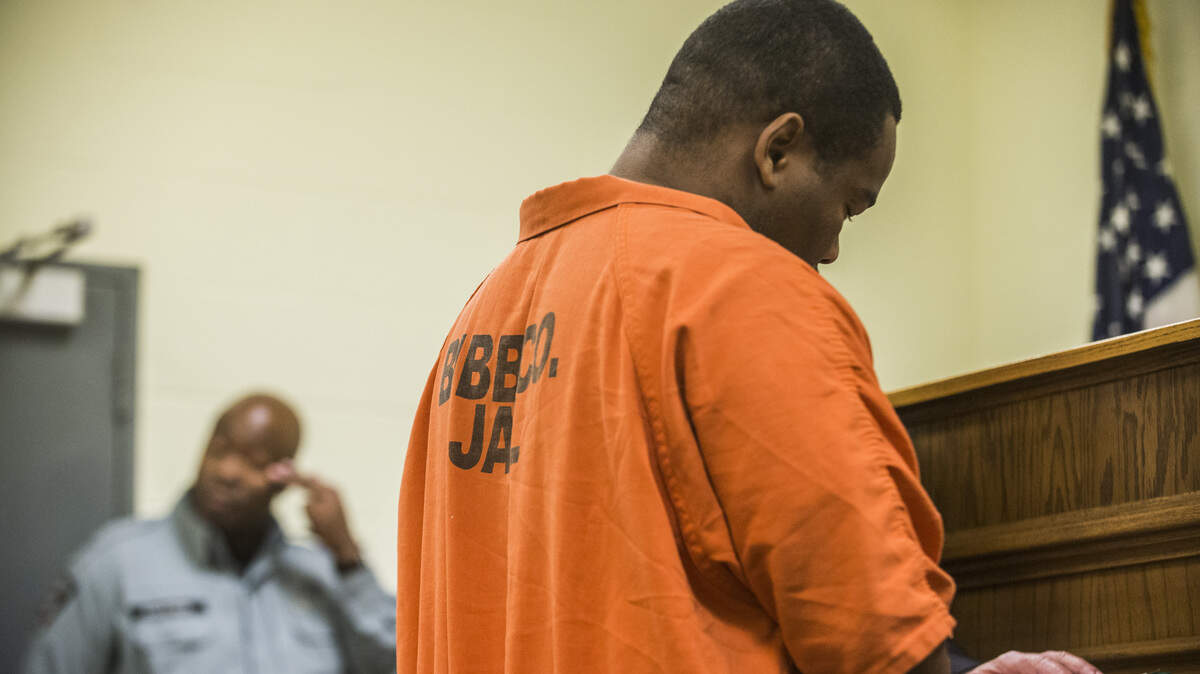
The scene in the small courtroom inside the Bibb County Law Enforcement center was a familiar one.
On a day scheduled for first court appearances, there was one charge on the docket. A murder case.
In his orange jumpsuit with matching shower sandals, attorney at his side, Damion Henderson stood for what was actually his second appearance in court on charges stemming from the slaying of Jibri Bryan, a Mercer University basketball player. By the time of this hearing, it was about a month since Bryan's death.
Accused killers appear regularly in Bibb County courts after they're charged. When they do, those homicide cases are said to be cleared. The pace at which law enforcement hands over suspected killers to prosecutors is called the clearance rate.
According to the FBI, Bibb County had a homicide clearance rate of 81 percent in 2014 and 86 percent in 2015. The sheriff's office had a string of years with clearance rates of more than 90 percent. The national average is 64 percent.
As cities across the country wrestle with how to stop the pace of homicides, it is tempting to lock onto the clearance rate as a source of deterrence, but whether killings go down as the clearance rate goes up is unclear.
Bibb County District Attorney David Cooke is quick to tell you there is no perfect measure of deterrence, but a high clearance rate is better than a low one.
"You want to solve murders. You want to have an idea of who did it. You want to know who did it," he said. "But there's a difference between what we know and what we can prove."
Not every cleared case equals a conviction. Still, Cooke's office has a record of convictions that closely tracks the clearance rate. What the numbers don't make clear is how these local trends affect the number of homicides.
For that, Cooke has a story.
"We had a drive-by baseball bat beating," he said. "That is, one gang drove up to another gang's hangout, and they jumped out of a van and beat the guys up with baseball bats and jumped back in the van and drove off."
There were injuries but no deaths. One of the bat-wielding gang members, he said, told an investigator they laid down their guns because they had run the numbers.
"They said, 'Well, you and the DA have been real serious on this gang stuff lately, and we knew if we shot somebody and killed them we would never get out,'" Cooke remembered.
Stories like that make people feel better. Cooke says people tell him as much when they stop him in the grocery store.
OTHER VARIABLES
Al Blumstein, a longtime criminologist at Carnegie Mellon University, agrees that stories and the feelings they create are good for our communal mental health.
"The feel is much more important to the community. It is much more important to the people managing the process," he said.
Blumstein was an engineering physicist before President Lyndon Johnson tapped him to head a data-driven crime task force in the 1960s. Despite what you can say about the emotional good that flows from a high clearance rate, he says there are too many other variables in the way of a concrete look at how clearance alone affects deterrence.
"Like the number of people recruited into the gangs," Blumstein said. "Like the economic opportunities available that would encourage people to leave the gang."
There is one thing Blumstein says you can learn from a jurisdiction's clearance rate. That's how well a police force does its job.
"And particularly in the communities where there is a strong rapport between the police and the community, you're going to get information about who might have committed something," he said.
That is the information that clears cases.
Blumstein says a strong rapport between police and community comes easier outside of big cities, where the connections between victim and killer are less layered.
That last point hits home with Bibb County Sheriff David Davis.
"A lot of our investigators grew up in some of these neighborhoods," he said. "So they know these individuals. Some of them may even be related to them in some way or another."
Ironically, Davis says it's the moments when that tight weave of relationships ruptures that leads to most of the killing in Macon-Bibb County. Still, he says investigators' phones start ringing with calls from community contacts not long after a violent death.
Despite the investigative successes and the high clearance rate, Macon-Bibb County saw 12 more homicides in 2015 than in 2014. That may or may not continue. Still, Davis is looking at other paths to deterrence. A lot of it looks like Al Blumstein's pile of messy variables.
"Especially engaging these young people early on," Davis said. ... You know the parents really don't keep up with the kids. They're really just kids themselves." Davis says he sees educational intervention and social services as the fertile ground for homicide deterrence. Right now, the landscape of just who is providing those services locally is not always so clear.
"So that's where we are now, identifying those types of agencies that can help with that," Davis said.
So for now, at least in Macon-Bibb County, the effort to look past arrests as a tool to slow killing is on the ground floor.
This story was originally published March 23, 2016 at 6:33 PM.