
These are the 3 oldest unsolved homicides in Warner Robins near Air Force base
The deaths of two Robins Air Force Base employees and a World War II veteran are among the oldest unsolved homicides in Warner Robins, according to records from the Warner Robins Police Department.
The incidents happened in the 1970s and 1980s, each in neighborhoods near the base, which made up the foundation of Warner Robins.
The three victims were killed in the overnight hours at or blocks away from their homes, investigative and death records showed.
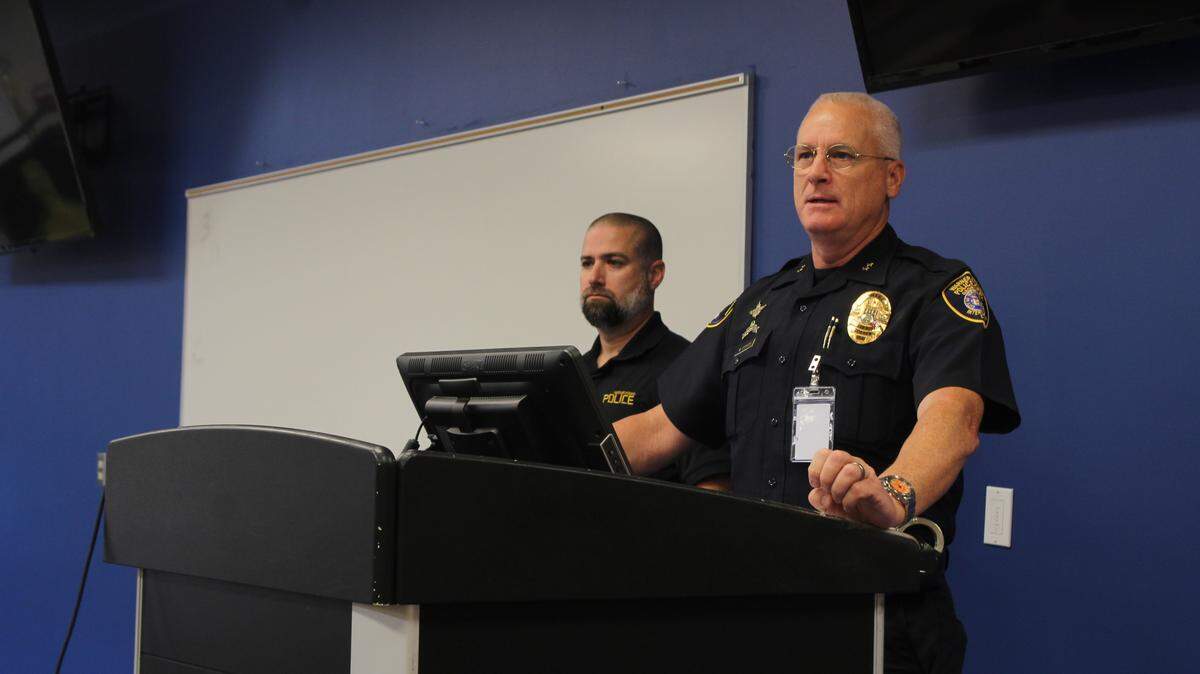
Limited technology and staffing issues at WRPD at the time challenged investigators’ ability to solve the cases, according to previous news reports and Lt. Justin Clark, the agency’s head of cold cases.
“You take a little bit more time with (older cases) because it’s harder to track people down, find if people are still living or not, moved over states,” Clark told The Telegraph on Nov. 18. “The older a case gets, the harder it can be to work.”
When the city’s oldest still-unsolved death happened in 1977, investigations into murders were delayed due to a shortage of detectives at WRPD, according to Tommy Wright, who was the chief of detectives. His team of four detectives usually handled around 260 cases per month, Wright told The Telegraph that year.
Now, each investigator handles around 50 to 75 cases “at any given time,” in addition to a cold case, Clark said.
He said he focuses more on newer cases because evidence and witnesses’ statements are fresher, such as in the unsolved deaths of Parker Killian Moore and Janak “Jack” Patel in 2018.
He, two sergeants and nine detectives have each been assigned different cold cases. There are over a dozen violent death and missing person cases in Warner Robins, according to investigative records and Clark.
A case becomes cold when “you completely run out of leads” after about a year, Clark told The Telegraph.
“You’ve investigated everything you can think of at that point in time, talk to everybody you can talk to and then the case literally just kind of goes cold,” Clark said.
Cold cases at the WRPD are reviewed four times per year, in which investigators review evidence, try to find new leads and seek testimonies from witnesses and others potentially connected to the incidents.
The Telegraph analyzed newspaper archives and early investigative records that reveal the police department’s initial accounts of what happened in the city’s three oldest unsolved homicides.
Clark urged anyone with details related to local unsolved cases to contact him at jclark@wrga.gov or 478-302-5384.
“We want to always make sure that we never give up on trying to get those families closure,” he said.
What we know about Warner Robins’ oldest cold case
Felix M. Vaughn was found dead on June 4, 1977 with a revolver at his feet, according to investigative records from WRPD’s oldest cold case.
Two people told officers they drove to get something to eat and saw a man, later identified as Vaughn, “trying to hitch a ride … staggering out into the street” with clothes hanging over his shoulder, officers said in an incident report. The two people, described as witnesses, saw him staggering after 12:30 a.m. while driving north at South Second and Doyle Streets in a neighborhood off Armed Forces Boulevard near Robins AFB, investigative records and previous Telegraph reporting show.
They drove the same way back from grabbing food, but this time they saw the 52-year-old man “laying on the sidewalk … bleeding,” the incident report said. He was found at 101 South Second St. off Watson Boulevard, which is over 1,000 feet from where he was staggering earlier.
Vaughn lived on that block, near South Second and Naomi streets, according to police.
The first two witnesses told officers they stopped their vehicle to check on him and called 911, the incident report said.
Another witness “went straight to the Police Department for help” when he saw those other two witnesses standing around Vaughn who appeared hurt, officers said.
Then another person told police, “the dead man over (there), what happen was he was shot in the head,” the incident report said.
He was dead when officers found him, and Joel Sullivan, a detective who initially investigated the case, said the Smith & Wesson .32-caliber revolver at his feet was the homicide weapon, the incident report said.
Police found “fresh cleaned clothes” about 30 feet away from his body, investigative records said.
Vaughn was shot around 2 a.m., the incident report said. A coroner’s jury ruled the gunshot was not self-inflicted, and detectives said it was not a robbery, The Telegraph previously reported.
Multiple witnesses were named in investigative records.
The 52-year-old was a civil service employee at Robins Air Force Base, lived in Warner Robins for 18 years and was born in Mobile, Alabama, according to his obituary. He was president of the Usher Board at Warner Robins CME Church, where his memorial services were held.
Detectives lost what “would have been an investigative aid” when some evidence samples were contaminated because the WRPD lacked proper forensic testing equipment, Wright told The Telegraph that year.
By August 1977, detectives bought testing kits using their personal money, Wright said. The city of Warner Robins did not fund the purchases, but Wright didn’t blame city officials for that.
“It takes a number of dollars to run the city, and some areas have to take priority over the police department,” he said at the time.
Veteran dead at train stop
A World War II veteran was found dead outside what is now a WWII museum — it’s the second-oldest cold case in Warner Robins, according to investigative and death records.
Railroad workers first noticed the victim through a train window on May 28, 1984, police said in an incident report.
Two engineers of Norfolk-Southern railway reportedly rode a train that stopped at Watson Boulevard and North Armed Forces Boulevard.
They reportedly saw a body laying in the grass under the roof of an old train depot — now the Elberta Depot and World War II Museum, 99 Armed Forces Boulevard, which is across from Robins AFB, The Telegraph previously reported.
One of the men told officers he approached a man, later identified as Edward Francis Hanley, who had “a large amount of blood underneath (his) head” and he wasn’t breathing, the incident report said.
That’s when the witness called 911 around 6:30 a.m., and officers were dispatched to the scene, police said.
Hanley lived in housing behind Owen’s Boarding House restaurant, about two blocks away from where he was killed, investigative records and his obituary said.
The 66-year-old died sometime between 9 p.m. May 27, and 6:30 a.m. the next day, according to Maj. Dan Hart, commander of the WRPD’s Criminal Investigation Division. Hanley was likely killed where they found him, and the homicide might’ve been connected to a robbery, Hart said days after the incident.
The Worcester, Massachusetts, native lived in Warner Robins for nine years, and was a retired machinist, his obituary said.
Assault at a grandma’s home
The front door of Evelyn Springer’s house was unlocked when her granddaughter came to visit on March 7, 1987, according to an incident report.
Her granddaughter reportedly found Springer on the floor near a living room sofa around 7 p.m., the report said. The house was in the 100 block of Crawford Street, in a neighborhood off Hawkinsville Road across from Robins AFB.
The granddaughter called 911 and told her neighbors.
Police arrived and noticed the house’s front and back doors were unlocked, and there was “a small cut in the rear door screen,” the incident report said.
Springer “had a bruise near her right eye and also a ½-1 inch cut on her forehead,” Officer Charles P. Allen said in the report. “A small amount of saliva was found near the location of the head with fragments of the victims’ dentures.”
The 60-year-old died from the “assault” on Sept. 30, 1987, in a Bradenton, Florida, hospital, according to her obituary.
Springer was a Washington, D.C., native and lived in Warner Robins for 40 years. She was an avid athlete in the Warner Robins Bowling Association, retired secretary, retired civil service employee at Robins AFB and founding member of Parents and Friends of Lesbians and Gays in Warner Robins, the obituary said.