
Ex-superintendent Dallemand takes stand in fraud case. Here’s his testimony
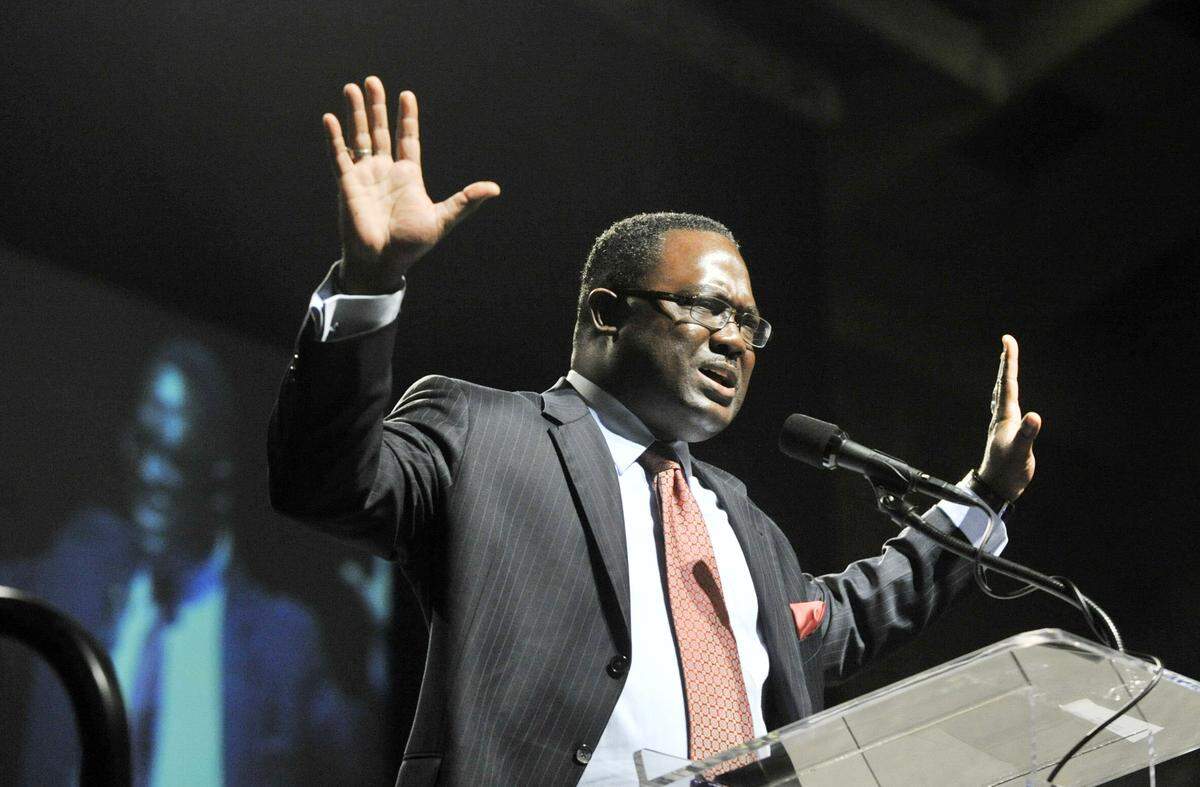
Romain Dallemand, the controversial and embattled ex-superintendent of Bibb County schools, took the stand Thursday as a government witness in the federal trial of a Macon tech firm’s CEO who is accused of defrauding the school district in a multimillion-dollar computing deal.
Live: Trial in alleged scheme to defraud Bibb County schools
Dallemand’s 50-minute appearance in U.S. District Court here was — at least for those who have followed the tumult during and in the wake of his 28-month tenure as the county’s education boss — the main attraction of this week’s proceedings.
Testimony in the case against Isaac J. Culver III, CEO of Progressive Consulting Technologies Inc., began Tuesday.
Culver, 48, is accused of conspiracy to commit wire and mail fraud and conspiracy to launder the proceeds of unlawful activity. The allegations stem from a 2012 deal in which Bibb schools paid $3.76 million for computers and services to an Ohio firm.
Prosecutors contend Culver and his company along with his business partner privately bought the computing devices themselves for $2 million or so less than that and then enlisted the Ohio company as a go-between to later make it look like the Ohio company was the seller.
Dallemand verified during testimony that he believed the Ohio company had sold the devices to Bibb schools. He noted, too, a service agreement that required such devices be provided or bought by the schools and not by Culver’s firm. The firm had been hired as a project manager to oversee technology upgrades, not to serve as a vendor.
Dallemand also spoke of being shown an invoice for $3,768,000 in December 2012 for the purchase of 15,000 Ncomputing devices from the Ohio firm.
He said he was in his office with the school system’s chief lawyer and the system’s technology director.
Dallemand said Culver was also present when he was shown the invoice but admitted that his memory has at times “vacillated” as to who was there.
Dallemand, who is not accused of wrongdoing in the case, said he believed Bibb schools were following proper procedures to buy the computing devices, and he asked those at the meeting “if it was in accordance with the way we’re supposed to do things, if we were following the right procedures.”
He added, “I was told it was industry standard.”
When he asked what that meant, Dallemand said Culver told him, “That’s how things are done in the technology sector,” and that the county’s technology director concurred.
“I said, ‘OK, move forward ... on payment,’ ” Dallemand testified.
While his testimony on Thursday did not necessarily add anything eye-popping to the prosecution’s case, Dallemand’s mere presence in the courtroom was nothing short of a Macon moment.
For here sat the man viewed by some as an instigator of institutional tumult. He was back in town from his now-home in south Florida — testifying, no less, as part of a plea agreement in a separate public-corruption case. And he was on the stand less than 100 yards across Mulberry Street from the front door of his former office at the board of education.
Dressed in a deep blue suit, a white shirt and a soft blue print tie, the bespectacled former educator agreed while under cross examination by Culver’s attorney, John Garland, that Bibb schools were in disarray, and their computers were antiquated when he arrived in early 2011.
“A mess?” Garland said of the schools at the time.
“Well,” Dallemand replied, “that’s an understatement.”
Garland aimed to show that Culver and his company had done business with a organization in turmoil, one with Dallemand — who Garland described to jurors as a “bold, strong,” feather-ruffling leader who “wasn’t afraid to shake things up” — at the helm.
Dallemand said he told Culver he wanted computers available to every child in public schools here — and quickly. Dallemand also acknowledged he could have halted the deal with the Ohio firm to buy the $3.7 million in devices and services, but he wanted the devices here.
Where they actually came from had remained a mystery, at least to much of the public, until the tail end of Thursday’s testimony.
The former vice president of Ncomputing took the stand and explained an invoice that showed Culver’s company, in late December 2012, as the purchaser of 15,000 model L300 devices at a cost of $1,749,000.
The devices can serve multiple students on different computers, typically in a lab setting.
Prosecutors rested their case about 1:30 p.m.
After jurors were sent home for the day, defense attorney Garland requested a directed verdict on grounds that there was “insufficient evidence to support elements of the crimes” Culver is accused of, that there was no fraud.
“There is some evidence here of some type of intent to deceive,” Garland argued. But it doesn’t rise to the level of criminal action, he said.
“What’s the intent to deceive about?” Garland asked. “Is it an intent to deceive who sold the device? ... Is there an intent to deceive that it was a good deal? ... The evidence is overwhelming that the (schools) ... got the devices they paid for.”
Judge Marc T. Treadwell denied the motion.
Treadwell told Garland there was evidence presented of deception and misdirection, but he would leave it to the jury to decide.
“There’s a lot of room for interpretation here,” the judge said. “No doubt about that.”
Testimony resumes Friday morning at 8 when Culver’s attorneys may present his side of the story. Jury deliberation is expected to begin Monday.
This story was originally published July 19, 2018 at 5:44 PM.