
This new transgender support organization open in Macon. Free resources available
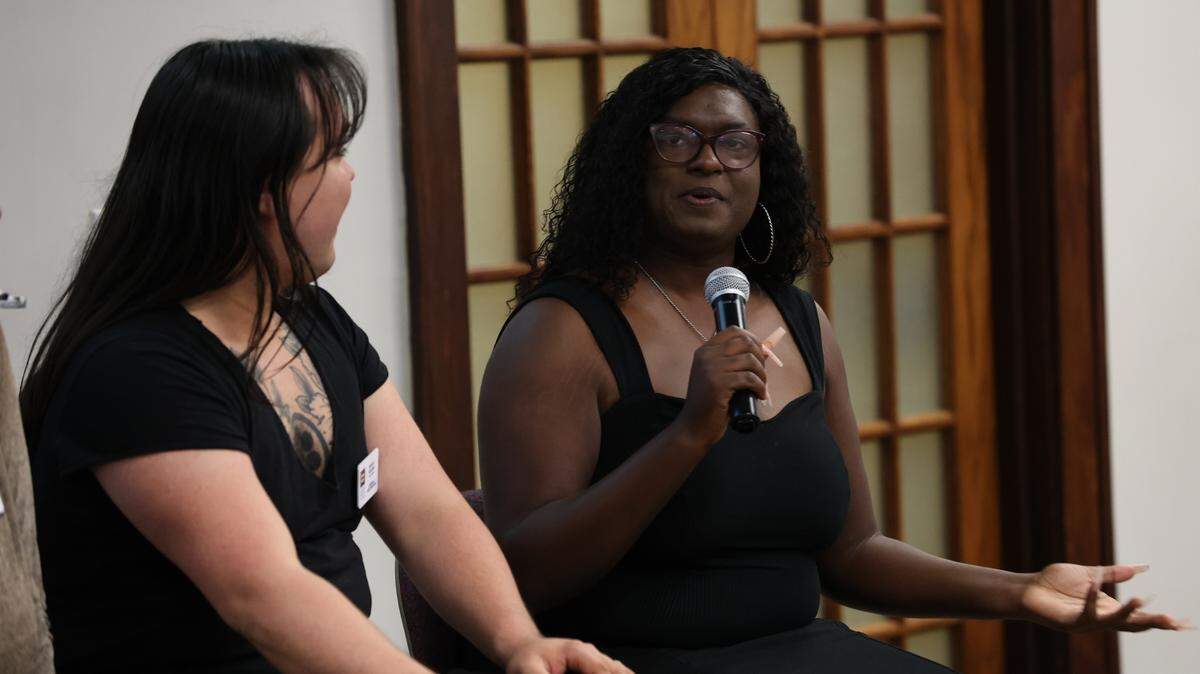
The daughter of two deacons recently opened Middle Georgia’s first and only nonprofit focused on transgender resources in Macon.
Navigating Omitted Minds Overtime Organization is a Black trans-led nonprofit that offers free support and therapy groups, scholarships, connections to trans-inclusive legal and medical providers, a food pantry, clothing closet and computer lab for LGBTQ+ people of all ages, according to Zaria Newbill, its founder and executive director.
The organization has been vital in Middle Georgia, where gender-affirming care is scarce, The Telegraph has previously reported.
“I have been trying to navigate mentally how to work and move through life, while working out my gender identity,” the 35-year-old said. “For people that don’t understand us or have any idea about who trans folks are, we’re omitted from a lot of spaces.”
NOMO became a trans-focused 501(c)(3) nonprofit in 2017, but it never had a place of its own until now.
It opened on March 31 — Transgender Day of Visibility — and is open by appointment and during support group meetings. Those looking to find out more about the organization’s services can visit nomoorganization.org or email info@nomononprofit.org.
The organization’s name originally came from a nondenominational church ministry which Zaria Newbill led in Lithonia, in east Metro Atlanta. The ministry was not LGBTQ-centered. It was focused on raising money for underprivileged youth.
While NOMO is not a religious organization, Zaria Newbill thought it would be fitting to keep the name to support people who feel oppressed, or whose ideas have been shut out.
“There’s not necessarily any religious ties, but the purpose behind NOMO was always a sense of service and giving back to the community,” Zaria Newbill said.
The Hawkinsville native, who now lives in Haysville, said trans representation was rare as a child in a town with just a few thousand people.
“In a small country town, no one really knows what trans is,” she said. “It was just pretty much you’re a lesbian or you’re gay. I knew at 4 years old that I was just different.”
Zaria Newbill recalled an affirming moment when she went to a nightclub at 17 years old in a black dress.
“I was like, ‘This is how I’ve always seen myself,’ then having to take everything off, be home by curfew, was definitely difficult,” she told The Telegraph.
She created a free clothing closet at NOMO to give trans people access to attire that matches their gender expression.
Zaria Newbill attended a private Christian school as she navigated her relationship with God, herself and her parents, who are deacons at Universal Light Christian Center in Macon.
When Zaria Newbill came out as a gay man, then later as a trans woman, her mother, Sandra Newbill, received counseling from her pastor to talk about what this meant under God.
“We did accept it, but it was a conflict within our beliefs…,” Sandra Newbill said. “My husband came to me one day and said, ‘God said that no matter who she is, we are to love our child because that’s the seed that she gave us to birth on this earth, and to bring forth on the earth.’”
The 54-year-old said NOMO is not only for trans people, but their parents too. NOMO hosts support groups for parents of LGBTQ+ kids, women of color living with HIV/AIDS, trans men and LGBTQ+ couples.
“I’ve seen parents of gay children put them out on the streets because they didn’t want them in the home,” Sandra Newbill said. “I never wanted my child to feel that way … I truly believe that because of the love we have in our heart for God and others, it was very easy for us to just love our child and accept who she is.”
Sandra and Zaria Newbill feared the Religious Freedom Restoration Act, which recently passed in Georgia, would allow for discrimination of marginalized communities, The Telegraph previously reported.
Zaria Newbill, and many other Black trans women, often feel unsafe visiting public spaces such as doctor’s offices due to a lack of trust and possibility of getting turned away.
“That puts Black trans women in the space of having to go and get medications off the black market, which is not healthy at all,” Zaria Newbill said. “And a lot of people don’t have the capacity or the financial means to drive up to Atlanta to see a doctor.”
Most medical providers that offer gender-affirming care are in Atlanta, such as Emory Healthcare’s Transgender Clinic and AvitaCare Atlanta.
Zaria Newbill hopes to partner with local schools, doctor’s offices and businesses to increase trans health care access and HIV/AIDS awareness, which are often stigmatized in low-income, Black communities.
Georgia had the second highest rate of HIV diagnoses among adults and adolescents in 2021, and the Black community was disproportionately impacted, reflecting a national trend, according to the Georgia Department of Health HIV Surveillance Summary.
“They don’t have to continue to be siloed in their own spaces,” Zaria Newbill said. “You can come and build community with us.”
Editor’s note: This story has been updated to properly clarify the organization’s independence from other organizations.
This story was originally published April 16, 2025 at 1:24 PM.