GA saw a warm December and freezing January. Why the big shift?
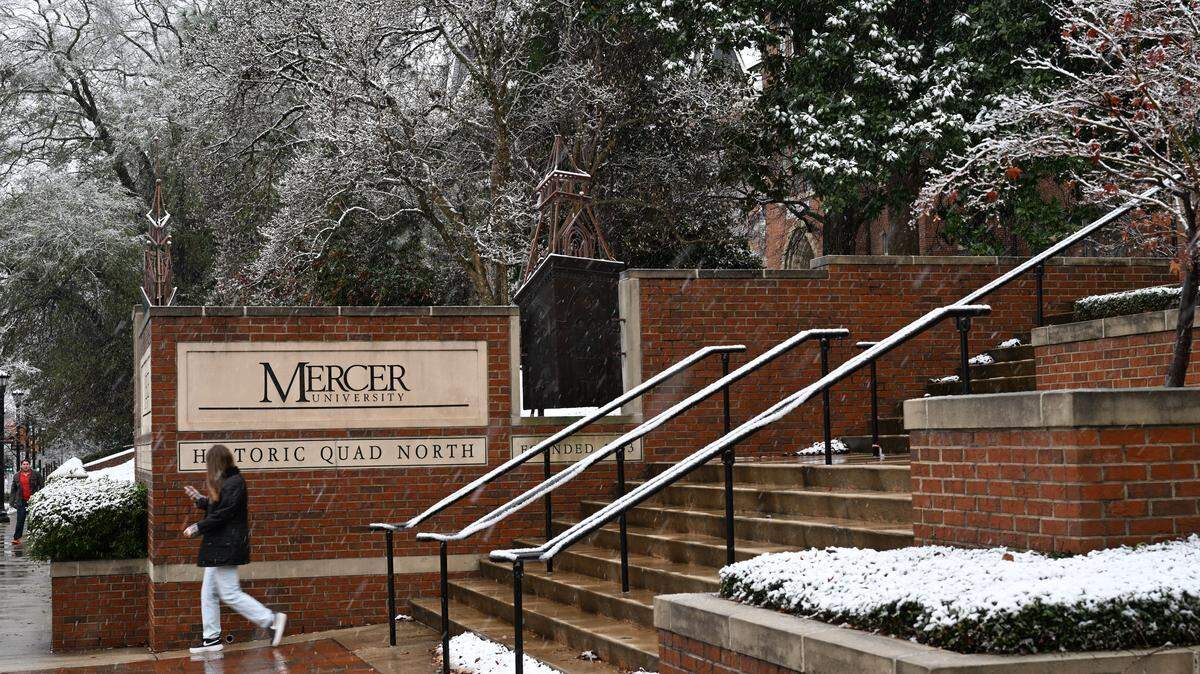
Georgia is experiencing a winter marked by extremes: near-80-degree highs in December followed by freezing temperatures and winter storms in January.
Despite the National Weather Service’s seasonal outlook that the Southeast would have a warm and dry winter, the region, including Georgia, instead has seen multiple instances of ice and snow in recent weeks.
The two biggest drivers of the “warm and dry” prediction this year were the rising temperature trend due to climate change and the weak presence of La Niña in the Eastern Pacific Ocean, according to Pam Knox, director of the University of Georgia Weather Network.
“Seasonal predictions are made based on probabilities from past events,” Knox said. “Both of these (factors) tend to predict that a warmer than normal winter is more likely to occur than a colder than warmer winter, so (the NWS) went with the highest likelihood.”
And the prediction wasn’t totally off, as the Peach State saw temperatures reaching almost 80 in December.
Those same background conditions — a weak La Niña combined with a warming climate — that allowed for such a warm December also help explain the abrupt shift to freezing temperatures in January.
“It is not that unusual to have large swings in temperature patterns from one month to the next, although this seems like a bigger swing to me than most, just because we don’t get two winter storms so close together very often,” Knox said.
Warmer winters can pose challenges for Middle Georgia farmers, as warmer winters cause fruit crops to bud early and then have the potential to get hit by frost.
“Warmer winters has a big impact on fruit crops,” Knox said.
Freeze damage from January’s cold snaps may not be immediately apparent, because injury to crops often takes weeks or even months to show up, according to Kathy Hensley, an Agriculture and Natural Resources program assistant with UGA Extension in Macon.
Damage is most likely when a long stretch of warm weather is followed by a sudden, prolonged hard freeze, especially without a gradual transition. Brief cold spells are generally less problematic, while late freezes in March after fruit trees have bloomed pose the greatest risk to Georgia growers. That scenario, rather than mid-winter cold, is typically when the most severe crop losses occur, Hensley said.
What drove Georgia’s abrupt shift from warm to freezing temperatures
When the La Niña is weak, other factors in the atmospheric circulation have a larger influence.
The most influential atmospheric factors this winter were a highly wavy jet stream, which many scientists link to rapid warming in the polar regions driven by climate change, and a sudden stratospheric warming, or SSW, that disrupted the normal circulation of air around the North Pole, according to Knox.
Together, these conditions made it easier for Arctic air to spill farther south than usual.
The Arctic is getting warmer much faster than other parts of the world due to the loss of snow cover and sea ice, both of which affect surface temperatures in the region. As the temperature difference between the pole and the tropics shrinks, scientists expect a wavier atmosphere in the future, Knox said.
The area of coldest air, which is normally confined near the North Pole, shifted and split due to a number of factors, including a SSW, which is an unusual warming in the stratosphere high up in the atmosphere.
SSWs are not predictable far in advance so do not factor into seasonal forecasts, Knox said.
That disruption helped produce a highly variable atmospheric pattern across the Northern Hemisphere, increasing the likelihood of sharp swings between warm and cold weather and setting the stage for repeated intrusions of Arctic air into the Southeast.
Even so, long-term data show winters are becoming milder overall. Across the contiguous United States, there are now about 13 fewer days below freezing each year than there were in the 1970s — roughly half a month less of freezing conditions on average, according to temperature records compiled by Berkeley Earth.
This story was originally published February 4, 2026 at 2:19 PM.