Georgia is going to stay warmer, drier this winter. Is a warming planet part of it?
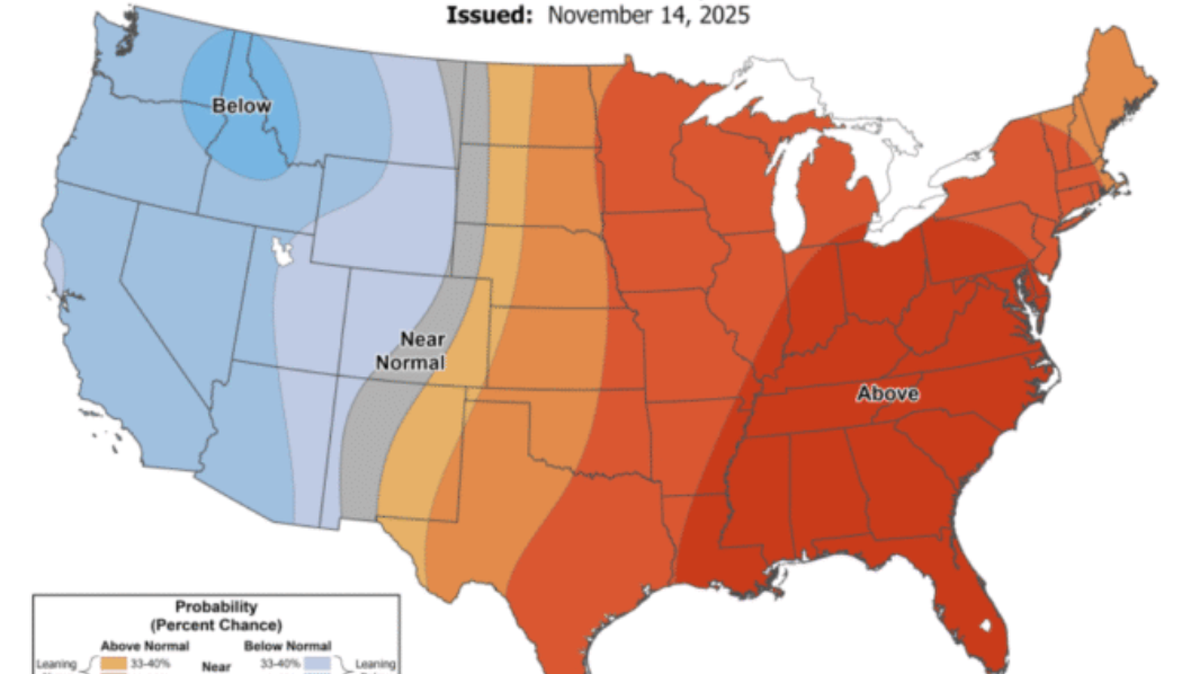
New predictions from the National Oceanic and Atmospheric Association released this week show that the Southeast, including Georgia, is likely to remain warmer than average after Thanksgiving through December.
November started warm in the western U.S. and cold in the east, but a combination of big atmospheric drivers is about to flip that pattern.
“After the shift occurs the coldest air will shift to the northern states with the warmest conditions likely in the Southeast,” Pam Knox, director of the University of Georgia weather network and agricultural climatologist, said in a newsletter.
NOAA’s outlook shows that during late November into December, much of the Southeast is more likely to see above-normal temperatures, while parts of the northern United States and the west lean colder. Over the full winter from December through February, NOAA projects above-average temperatures for much of the South, along with below-average precipitation, raising drought concern.
Several large-scale climate forces are lining up at the same time that can dramatically change weather over the U.S.
The forces at play are: La Niña, a cooling event in the Pacific that reshapes jet streams and typically brings dryer and warmer weather to the South; Madden–Julian Oscillation, a tropical storminess cycle that moves eastward around the globe; and a possible Sudden Stratospheric Warming event — rare for November — which can disrupt the polar vortex and sometimes bring cold outbreaks.
Warming global temperatures is shifting the background conditions that patterns like La Niña, the Madden–Julian Oscillation and the Sudden Stratospheric Warming events operate within, according to Knox. These patterns still happen, but they now play out in a warmer atmosphere that raises the floor on temperatures almost everywhere.
Because the planet is warming, the contrasts these patterns usually create are muted: La Niña’s warm zones tend to get even warmer, while its cooler zones don’t cool as much, Knox explained. That upward trend also makes extreme heat easier to reach than extreme cold, even though sharp cold spells are still possible.
“Areas that were warmer than normal due to La Niña get a little bit warmer and areas that would be cooler than normal are a little less cool,” Pam Knox explained. “So in the seasonal forecasts, areas that would have been colder than average might now look more like equal chances of above, below, or near normal, and areas that had some chance of warmer than normal temperatures now have a better chance than years ago.”
“It is easier to get extreme high temperatures than extreme low temperatures because the trend in temperatures is upward, although record cold days can still occur,” Knox said.
Scientists are still debating whether climate change is altering the frequency or strength of La Niña and El Niño, Knox said, though La Niñas have been more common over the past few decades. It’s unclear whether that increase is part of a long-term climate change signal or just a natural swing in the atmosphere-ocean system.
Knox also noted that the timing of this La Niña is especially concerning for southwest Georgia, where the newest U.S. Drought Monitor shows extreme drought. Since La Niña usually keeps the Southeast drier through winter, she said the region could see worsening conditions and a greater chance of the drought stretching into spring.
This story was originally published November 21, 2025 at 6:00 AM.