Music hall doomed almost from start
It’s a familiar song to Middle Georgians by now.
The state cutting funding to the Georgia Music Hall of Fame because of a budget crisis. Atlanta officials saying the museum can’t survive in Macon. Local and state officials failing to come together on a clear vision for the music hall.
These weren’t just notes played in 2011. It was the same tune when the physical museum was first awarded to Macon in 1989 and eventually built in 1996.
To look back at the history of the Georgia Music Hall of Fame is to see a noble idea that was doomed almost from the get-go. Controversial plans beginning with the museum’s location and continuing with what has proven to be an unrealistic economic model ultimately led to the music hall welcoming visitors Sunday for the final time before its collection of artifacts and documents is shipped off to special collection libraries at state universities.
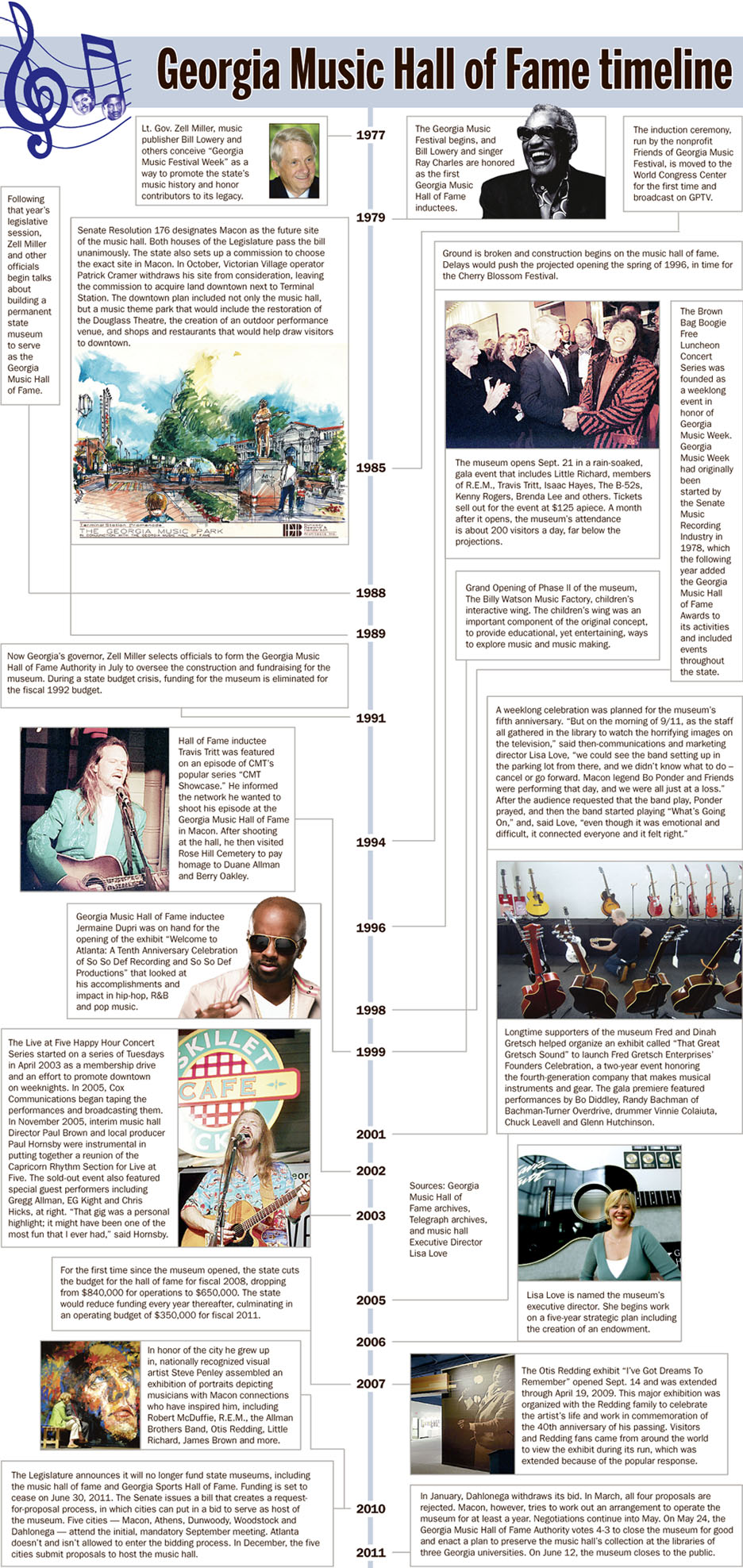
Looking back, perhaps there were portents that would foreshadow the music hall’s demise. On the night officials cut the ribbon to open the facility, it stormed. And during the week the museum was set to celebrate its fifth anniversary, the world changed forever. The date: Sept. 11, 2001.
Throughout the recent process of Macon fighting to keep the music hall open, there’s been finger-pointing and blame spread all over the state about why it failed. But in the end, a look back at the process to win and build the music hall in Macon had inherent flaws from the start, according to those who were involved in the process during those early days.
The beginning
An idea to celebrate and promote Georgia’s rich musical heritage goes back to 1977, when then-Lt. Gov. Zell Miller and music publisher Bill Lowery conceived of a week of music across the state as a way to attract tourists, while at the same time honoring those who had contributed to making the state internationally famous.
In 1979, Lowery and soul legend Ray Charles were honored as the state’s first two inductees into a hall of fame that didn’t yet exist on a physical level, only a conceptual one.
Miller set out to change that. The future governor wanted a structure that would not only serve as a home to the achievements of those whom the state chose to honor, but also would educate Georgians and the rest of the world about that musical tradition, as well as serve as a repository for archives related to all things music.
Such a venue seemed destined for Atlanta, the state’s population center. Emory University, Georgia State University, the World Congress Center and Underground Atlanta all were discussed as potential venues for the music hall.
Macon as a host, on the other hand, seemed like something of a pipe dream. Local businessman Stan Rosen, a key figure at the time in the Macon arts scene, had the idea that such a museum could work in Macon, given its extensive music tradition and central location.
Better still, Rosen said he had a perfect spot for it. Local CPA and businessman Patrick Cramer had just begun Victorian Village, a development off the Hardeman Avenue exit of Interstate 75. Victorian Village had restaurants, boutiques and a 5,000-seat amphitheater, all within a stone’s throw of several historic Macon neighborhoods. Cramer reasoned the music hall would be a perfect fit in the location’s vacant building that used to be the Wesleyan College Conservatory. With roughly 130,000 cars passing that exit daily going to and from Florida, he figured Victorian Village, which went out of business a few years later, was in an ideal place geographically to siphon off a sizeable portion of that traffic.
“It was the perfect spot to advertise the historic heartland of Georgia, which is what Macon is supposed to be,” Cramer said. “Nothing embodies that like music.”
Rosen and Cramer put together a presentation using the Country Music Hall of Fame in Nashville, Tenn., as a blueprint for what the Georgia Music Hall of Fame might look like in Macon.
“It made sense to be in Middle Georgia,” Cramer said. “We did our homework. ... Stan did the work and presented the idea. ... We blew the presentation out of the water. Zell Miller walked up to us after the meeting and said, ‘You got it.’ It was his baby.”
In the spring and summer of that year, both the state House and Senate unanimously passed a bill to award the museum to Macon. The Macon legislative delegation at the time, including state Sens. Tommy Olmstead and Billy Harris and Reps. Denmark Groover and Frank Pinkston, were among the key figures lobbying for Macon at the state level.
“No other site in Georgia ever seriously crossed my mind as the location for this facility to enshrine and perpetuate our state’s rich, diverse and evolving musical heritage,” Miller said in a July 1989 speech to the selection committee.
“Atlanta didn’t need the project,” Rosen said. “They had the ’96 Olympics coming. This was going to have a much higher impact on Macon. Second, Macon had the musical heritage. It was a very logical thing to be located in Macon.”
Conflicts creep in
On Macon’s end, however, the process began unraveling almost from the start.
Later in 1989, city officials and downtown merchants saw the hall of fame as a chance to revitalize downtown. Those officials wanted the museum placed either on a vacant lot adjacent to the now-defunct Green Jacket restaurant -- ultimately the site of the Georgia Sports Hall of Fame -- or adjacent to Terminal Station, where the museum eventually was built.
That put the city at odds with itself, since a downtown museum would kill the Victorian Village plan for the music hall, which had helped sell the concept of Macon as its home in the first place.
Olmstead, chairman of the site committee, ended up submitting all three sites to the state rather than recommend one.
“There were several reasons,” recalled Olmstead, who later became Macon’s mayor and chairman of the Bibb County Commission. “Moving it downtown would help restore the Douglass (Theatre). The (Department of Transportation) would be able to redo MLK Boulevard. We felt that I-16 would be the place to put it. There were more positives than negatives to putting it in the downtown area.”
Cramer still disagrees to this day.
“Unfortunately, politics got involved,” he said. “We would have been there for the general public. We would get the traffic -- get off the exit, get gas, get food, see the Georgia Music Hall of Fame -- that’s what made sense. ... They wanted to solidify downtown. I’m all for renewing downtown, but it made sense (at Victorian Village). It didn’t make sense (where it is). They didn’t think it through. And the (state’s) music hall of fame people didn’t follow up.”
With the vote split between a downtown site and Victorian Village, Cramer pulled out at the 11th hour to settle the issue rather than risk Macon losing the museum to Atlanta.
Unfeasible plan
With the music hall of fame, nothing ever seemed to get done in the correct order. After the downtown site was chosen, the city spent about $150,000 to acquire 2.8 acres from Georgia Power that adjoined the 1.2 acres the city already owned at the site.
This land was then donated to the state with the idea that it would be used not only for the hall of fame, but a music theme park that would include the restoration of the Douglass Theatre, the creation of an outdoor performance venue, and shops and restaurants that would help draw visitors to downtown.
That was the plan already established when Davidson-Peterson Associates of Maine was hired late in 1991 to do a feasibility study to see if a music hall of fame could even survive downtown -- after the spot had already been selected and with the state lining up funds to build it.
The study concluded that the answer “was a clear ‘yes.’ ” Even just a museum by itself -- not including the theme park -- would attract between 130,000 and 150,000 paid visitors per year, the study concluded. That would be the low-range of projected attendance, enough for the museum to break even financially. Throw in the music theme park and other downtown attractions, the study said, and that would increase the number of visitors to more than 200,000.
The study identified three goals set forth by the state for the museum -- to build a quality music facility that would honor Georgia music; to create a major tourist attraction; and to be self-sustaining over time. The study predicted that even just the hall of fame would be self-sustaining in its second or third year without the accompanying theme park.
“Clearly, this is an ambitious program -- one that will require close cooperation among many parties,” it was stated in the study. “It has clear potential for success and growth.”
With such a positive outlook, the state decided to put the proposed Georgia Sports Hall of Fame in Macon as well, with the idea that each museum would complement the other and give visitors even more options downtown.
The music hall has never drawn more than 33,000 paid visitors per year, and has averaged roughly 27,000 paid visitors annually, said Executive Director Lisa Love. Those figures don’t include unpaid visitors or facility rentals.
It didn’t help that when the museum was being constructed, no endowment was set up for its future expenses.
Rosen, who had been the driving force in getting the museum to Macon, had been hired by the state to be in charge of fundraising. But he had gotten another job within the music industry and left the day after the hall of fame opened in 1996.
“My job was to raise private funds (at the hall of fame),” Rosen said last week. “But it was set up as a state agency at a time when they (the state) were not too worried about where the next dollar was coming from. From Day 1, the premise was flawed. I don’t blame anyone who has worked at the museum the last 15 years. (Original executive director) Rob Blount never replaced me. ... The vision 15 years ago was to succeed, but the concept was set up to fail.”
For whatever reason, the endowment was never set up, handicapping the music hall.
“Hindsight is 20-20, but looking back, if there had been a performance venue at the hall, the music theme park had become a reality and our marketing had been stronger and able to reflect more music-themed amenities, maybe our visitation would have been greater,” Love said. “Likewise, if the organizational structure had relied less on the state for finances and management and more on evolving private participation, maybe the museum wouldn’t have been so vulnerable when the economy collapsed in 2008.”
When Love became executive director in 2006, she put together a five-year plan that included the creation of an endowment. But once the state started to make cuts for fiscal 2008, Love said her focus switched from fundraising mode to survival mode.
“Working toward an endowment was a primary goal,” she said. “But once the state funding got cut, the priority became having money for operations rather than toward an endowment.”
The state cut funding that year for operations from about $840,000 to $650,000, and they stayed Draconian ever since, thanks to the flagging national economy. The state’s final earmark to the museum was $350,000 for fiscal 2011. Love had a staff of nine full-time workers and eight part-timers when she became director. Now, the staff is down to two full-timers (including Love) and seven part-timers.
Always struggling
The music hall of fame’s struggles since it opened have been well-documented.
A split with Friends of Georgia Music, which operates the induction process and banquet, left the museum without a potential source of fundraising. Under the way the state set up the process, the Georgia Music Hall of Fame Authority has no say in who gets inducted into the hall, nor receives any revenue from the banquet. Friends of Georgia Music officials have said in the past the banquet loses money each year.
Rosen pointed out that the Georgia Sports Hall of Fame makes money with its induction ceremony, and that its authority has a say in which sports figures are honored with enshrinement.
“The biggest disconnect is that the Friends of Georgia Music have never talked nice about the Georgia Music Hall of Fame being in Macon,” he said. “The two should be coordinating (their efforts) if not being one and the same. ... It really does show that people weren’t working to a common end.”
That problem continued in Macon, when the state first started cutting funds to the museum. Local officials and members of the state delegation wanted to use money from the hotel-motel tax in Bibb County to provide the music and sports halls with extra revenue, but that effort was killed in the state Legislature in 2009 when state Rep. David Lucas, D-Macon, wanted the Douglass Theatre to share in the money. He also wanted some of the funding to finally create an accompanying music theme park.
Ultimately, a compromise was reached in the following year’s legislative session to split the extra penny among the music hall, the sports hall and the Douglass Theatre, but by then some officials said the hotel-motel tax fight had already sent the message that Macon wasn’t united in its effort to keep the museum.
With huge operating costs at the 42,000-square-foot building, the state decided it could no longer operate the music hall.
The authority rejected bids from Macon and three other Georgia cities to take over the music hall’s operation, leaving the collection to be divided among the three state universities.
Officials in Macon have now set their sights on a Macon Music Hall of Fame. Love, meanwhile, is working with other local museums to see at least some of the Georgia Music Hall of Fame’s collection stays in Macon.
“We’re working hard to make sure that music’s story stays in Macon,” she said. “It can enhance and bring value to other local institutions.”
Information from Telegraph archives was used in this report.
This story was originally published June 12, 2011 at 12:00 AM with the headline "Music hall doomed almost from start."