
African-American fathers, sons to strengthen bonds in Chicago project
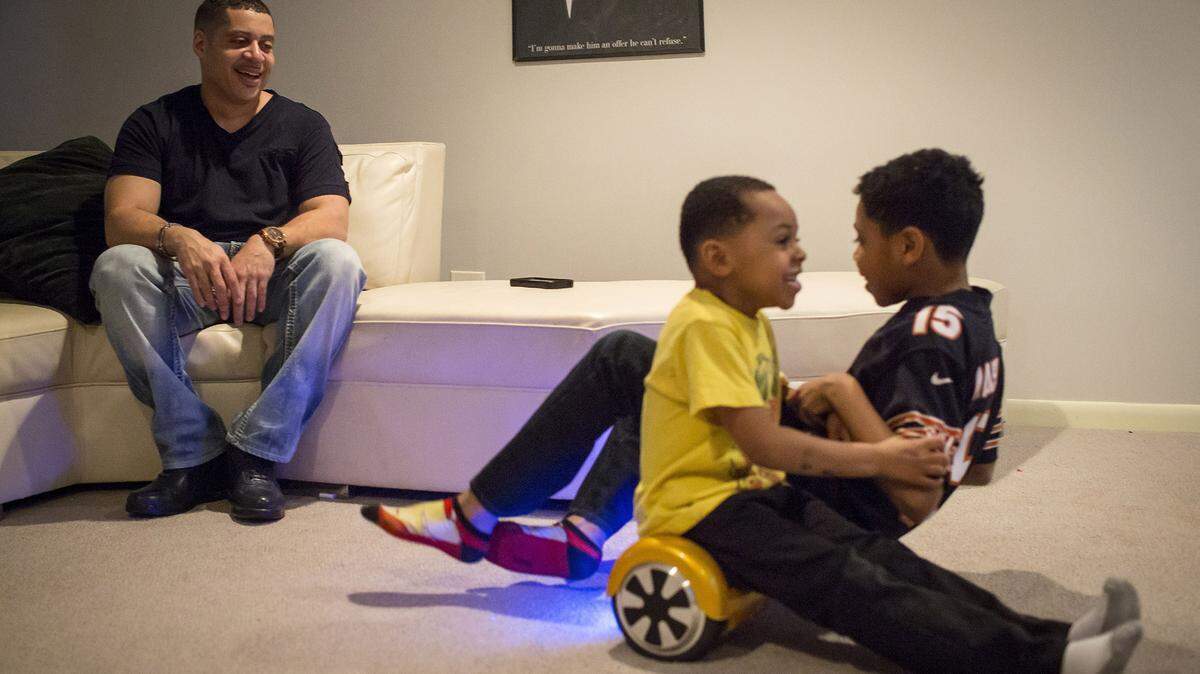
Robert Owens sat in a diner near 88th Street and Stony Island Avenue in Chicago, lamenting the gray stubble on his chin -- a consequence, he joked, of the stress he endures as a black father living apart from his children.
Owens, 41, of Chicago, has two sons, ages 6 and 11, from two women. He also is a Chicago firefighter with a master's degree in health-care administration who plays classical piano and creates oil paint portraits. And he's part of a population in crisis: black fathers and their sons.
Chicago, where black men represent the greatest number of homicide victims and nearly half of young black men are out of work and out of school, soon will become a laboratory for a particularly complicated brand of fatherhood -- black dads who don't live with their young sons.
Recruitment began last month for a five-year, one-of-a-kind, federally funded effort to strengthen the bond between nonresidential black fathers and their sons ages 8 to 12, with the aim of decreasing the sons' risky behavior and enhancing the men's parenting.
Called the Fathers and Sons Program, it has shown promise in a small trial in Michigan. The $3 million Chicago project will expand the program to 400 families with the hope of developing a national model.
"We believe one of our greatest advantages is that we bring both the fathers and sons into the program together," said Cleopatra Caldwell, a professor at University of Michigan's School of Public Health and the coordinator of the project, funded by the National Institutes of Health. "We developed this program with the goal of determining the potential role of parenting for improving African-American boys' and men's health," Caldwell said.
The need is clear. The U.S. Census Bureau last year reported that 57 percent of black children lived without a biological father in their home. The figure for white children is 18 percent, 32 percent for Hispanic children and 11 percent for Asian kids.
And in Chicago, black men face a grim landscape. A Tribune analysis of 2015 homicides shows that black men accounted for 291 of the 354 homicides where race was recorded, or 82 percent.
A report from University of Illinois at Chicago showed that 47 percent of 20- to 24-year-old black men in the city were unemployed and out of school, a trend that is part of a decline in youth employment across all races and ethnicities.
And the Cook County sheriff's office reported that nearly 6,000 of the estimated 8,200 detainees in the county jail -- 73 percent -- are black. Hispanic detainees make up about 16 percent and whites 10 percent. Those numbers underscore a national trend: the probability of incarceration among black men ages 18 to 34 is three times greater than the probability for white men, experts say.
Against that backdrop, black fathers often suffer from the misconception that they don't care about their children, researchers say. But the truth is that many of them want to be involved in their kids' lives.
"They really do love their children," said Wrenetha Julion, a professor in Rush University's College of Nursing who has been researching black nonresident fathers since 2002. "What gets really complex is the host of factors that can get in the way."
The most significant of those is the volatile relationships the men may have with their children's mothers, Julion said. Black fathers also tend to be hampered by economic struggles and lower levels of formal education, experts say.
"I think the value of these men and their importance to their children's lives goes against what's in the popular press," Julion added. "It's easier to say, 'Oh, they're just deadbeat dads.' "
Caldwell and other coordinators of the project say they are optimistic the Fathers and Sons Program will start to change that narrative.
Their analysis of the earlier version conducted in Flint, Michigan, in which 158 families with sons ages 8 to 12 participated, indicated that it reduced sons' aggressive behaviors, helped fathers spend more time monitoring their sons and improved communication about sex, violence and racial issues.
Like the Flint project, the Chicago version will require the men and boys to attend 15 sessions -- twice a week for two months. The sessions will provide information, discussion and role-reversal exercises. Fathers will practice effective parenting skills and sons will practice skills such as refusing drugs from peers. Dads and sons will collaborate on school homework and attend community events.
Once the sessions conclude, researchers will track the fathers and sons for five years.
What makes the Fathers and Sons Program unique, Caldwell said, is that "it is actually a research study designed to test the effectiveness of the fatherhood program we will introduce."
To help coordinate the project, she has lined up heavyweights in the study of low-income, urban minority families. They include Ronald B. Mincy, professor of social work at Columbia University and author the 2015 book, "Failing Our Fathers," a study of nonresident fathers.
Family instability among blacks has been a historical problem that began centuries ago with slavery, Mincy said. Since then, nonresidential fathers have been far more prevalent and accepted among blacks than among whites. Unsteady and poor job prospects, disproportionate rates of incarceration for black men and the expansion of welfare rights into the black community in the 1960s exacerbated the problem, he added.
"If you're going to get to changing this norm, we need to start really, really early" in black men's lives, Mincy said.
Owens, the single father of two boys, said he has made his complicated arrangement work in part through functional parenting relationships with the women who bore his sons and have primary custody.
He said he typically accommodates the mothers' schedules and spends hours driving to pick up and drop off his sons. Owens gets the boys every other weekend and said he'd consider participating in the Fathers and Sons Program, if he could find the time.
"I'm obligated to love my children," he said while sitting in the diner after lunch. "It's in me. So I'll go through hell to make sure they get the necessities. They need a father in their life and I love doing it. Although I did not ever see myself being a father out of wedlock, they are the light of my life."