
The Skycrackers: UGA’s other football team that nearly played in 1943 Rose Bowl
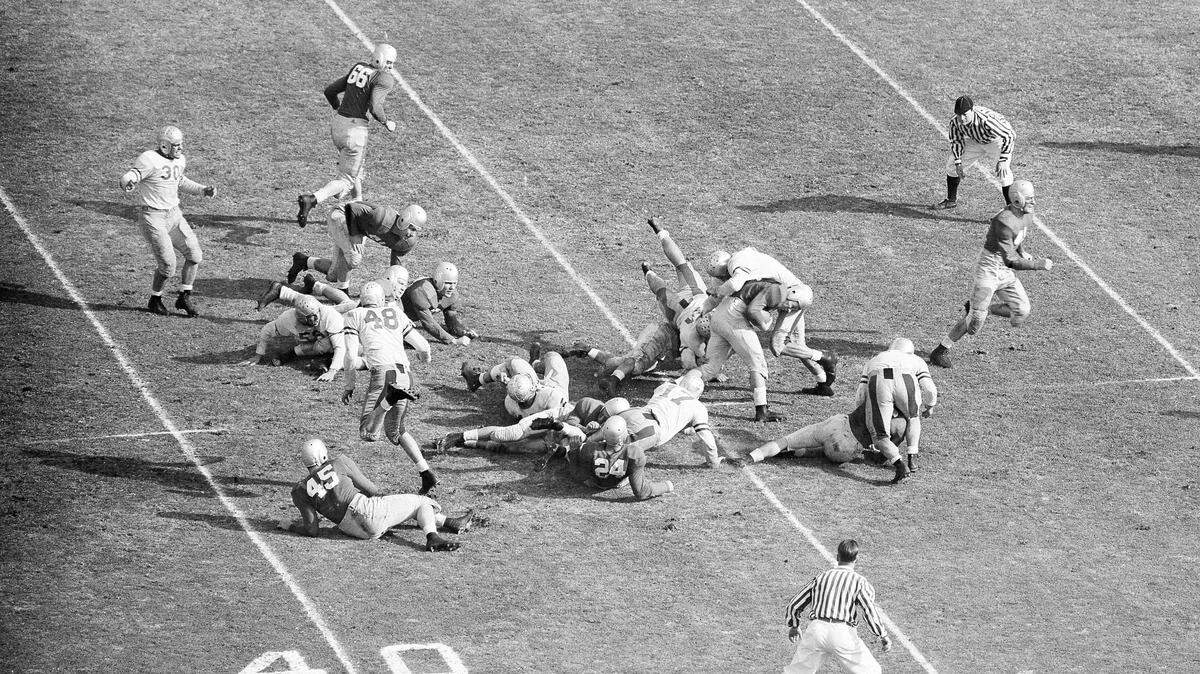
While the 1942 national title team is well-known for being the last Georgia team to play in the Rose Bowl, another team from Athens almost went in its place.
The Georgia varsity team was led by names marked in Georgia lore – Frank Sinkwich and Charley Trippi – and was coached under the legendary Wally Butts en route to an 11-1 season and a 9-0 blanking of UCLA in Pasadena, California.
But on the other side of Sanford Drive stood the U.S. Navy Pre-Flight Georgia Skycrackers, who attended the program at the university in preparation to fly for the Navy in Pensacola, Florida. The second team with affiliation to the University of Georgia was just as star-studded as the Bulldogs with an assortment of All-American, All-SEC and All-Pro athletes.
The legacy of the second collegiate football team in Athens is known to very few, and former Georgia head coach Vince Dooley was within that group until he learned of a particular football great associated with the Skycrackers – Paul “Bear” Bryant.
Yes, that Bear Bryant who led the Alabama Crimson Tide to six national titles within his 25 seasons in Tuscaloosa.
“I knew that Bear Bryant had been in Athens and within the program,” Dooley said in a phone interview with The Telegraph after he arrived in Los Angeles Saturday night. “I didn’t know that he had a football team, and I took interest in researching it when I knew he was a coach. They sure did have a football team, and a heck of a football team.”
Dooley conducted the research four or five years ago, according to his account, and wrote a 25-page scholarly piece in the “Georgia Historical Quarterly,” which reflects upon historical moments in the state since 1917.
Bryant was one of two coaches who carried the memorable nickname on the Georgia pre-flight team – and the Alabama legend didn’t even lead the Skycrackers. Instead, Raymond “Bear” Wolf was the head coach while Bryant was an assistant coaching the offensive and defensive line units.
The two “Bears” created quite the duo and led the other University of Georgia team to significant success.
The Skycrackers finished 7-1-1 in 1942 and played both pre-flight and traditional football teams – including a 41-14 win over Auburn, the only program that Georgia lost to that season. Georgia’s pre-flight team played only two games at Sanford Stadium, with the rest taking place away from Athens. This schedule was considered one of the nation’s toughest that season.
Butts’ Bulldogs compiled a similar body of work with a 10-1 regular-season record. A majority of polls concluded at the season's end that Georgia was the No. 1 team in the nation.
As Georgia held the top spot, the “other” team at its own university was at No. 2 in several polls such as the Houlgate, Sagarin and Litkenhous. The Associated Press – the most widely-known poll – didn’t rank pre-flight teams during the 1942 season, but overturned the decision in the following campaign.
“In the fall of 1942, between the national champion Georgia Bulldogs and the highly-ranked Georgia Pre-Flight Navy Skycrackers, there were more all-star football players than ever assembled on one college campus in the history of the sport,” Dooley wrote in his research piece. “There were six consensus All-Americans, numerous All-Conference players and several pro players.”
The Bulldogs practiced at Sanford Stadium while the Skycrackers practiced at the Woodruff football practice fields, which the pre-flight team built and current Georgia teams practice at. After a series of practices, the teams would gather before the season and sporadically throughout the campaign for a scrimmage.
Bulldogs’ place-kicker Leo Costa told Dooley that those sessions were “very intense.” Trippi followed by remembering that the Skycrackers had more great players than Georgia’s main team did. The pre-flight team’s star player was Macon native Quinton Lumpkin, who played for UGA on scholarship from 1934-38.
The near-even talent made the ensuing Rose Bowl situation very intriguing. Following the 1941 season, the game was played in Durham, North Carolina on Jan. 1, 1942 after fears that Japan would bomb the West Coast following the Pearl Harbor attacks on Dec. 7, 1941.
The following season, the concerns were still lingering due to the evolving action of World War II, so the location of the 1943 game was undetermined. In October 1942, less than three months before the game, a decision was made for the coveted bowl game to return to Pasadena. But there was consideration for it to become a charity event that featured the service teams.
“They were considering it, very seriously,” Dooley said. “If they had decided to go in that direction, there was no question that the Georgia Skycrackers would’ve been in that bowl game. It is ironic that the Georgia team that ended up going might’ve been replaced by another Georgia team if things went in that direction.”
The landscape of college football has changed vastly since Butts' Rose Bowl team, and even since Dooley claimed a national title 37 years ago. The Bulldogs are now in the College Football Playoff and will attempt to play for a title on Jan. 8 in Atlanta.
But first, Georgia must get past the Oklahoma Sooners in order to be a step closer to taking the crown under head coach Kirby Smart. Dooley made the trip to Los Angeles along with other high-ranking Georgia officials to take in Monday’s action.
For Dooley, it’s his first trip to the Rose Bowl game – and he’s hopeful it’s a special one.
“It’s amazing to see how many Georgia people are out here – and I just arrived,” Dooley said. “They’re everywhere. Because I was a big part of the organization for 40 years as coach and athletic director, it gave me a big sense of pride to be down on the field for the celebration against Auburn. Now, to get to go to the Rose Bowl after already being down at Notre Dame, it’s a special feeling.”
This story was originally published December 31, 2017 at 5:32 PM with the headline "The Skycrackers: UGA’s other football team that nearly played in 1943 Rose Bowl."