
Why UGA athletes are using platform to speak, take action against social injustice
Over recent months, Georgia’s Jermaine Johnson watched the gut-wrenching events unfold in Minneapolis. Eighteen miles separated him and the death of George Floyd and the hands of a police officer as Johnson watched from his hometown of Eden Prarie.
He realized the proximity, but knew the deep emotions could be felt within Black men and women witnessing the fatality — and the events following it — across the country.
Seven minutes, 46 seconds elapsed as officer Derek Chauvin pressed his knee against Floyd’s neck. Johnson felt pain while learning of each passing second. He thought of his teammates on his predominately Black football team. He didn’t want the next victim of injustice to be himself or a loved one.
“It definitely struck a nerve in me,” Johnson said. “You look at that and you see your uncle’s face or your father’s face on that man. For that to happen over essentially $20 of counterfeit money, it enraged me.”
Floyd’s death came after the shooting of Ahmaud Arbery in Brunswick, Georgia, Breonna Taylor in Louisville, Kentucky and numerous deaths of Black Americans involving police or racist undertones over recent years. The shooting of Rayshard Brooks in Atlanta and of Jacob Blake in Kenosha, Wisconsin followed it and allowed for more social justice efforts to occur.
For a Black athlete, the emotions become overwhelming while watching acts of racism and injustice unfold. It sticks at the forefront of their minds. There’s little escape from the anxiety tangled within it. Georgia’s athletes know they’re supported on fall Saturdays inside a raucous Sanford Stadium. The moments of claiming a big victory inside Stegeman Coliseum and hearing the roar of a crowd are unforgettable.
Once the uniform comes off, however, athletes believe they aren’t seen in the same light. They’re in the same group of every Black person in America, and they understand the risks of being profiled or experiencing a personal act of racism — whether it be large enough to make headlines or unnoticeable from the public eye.
“It’s different once you take off that uniform and walk out of those doors,” Georgia women’s basketball senior guard Maya Caldwell said. “It’s honestly scary to know that these things can happen to me, my friends or my family because of the color of my skin. It’s very frustrating to see it happen so often. I want that change so badly.”
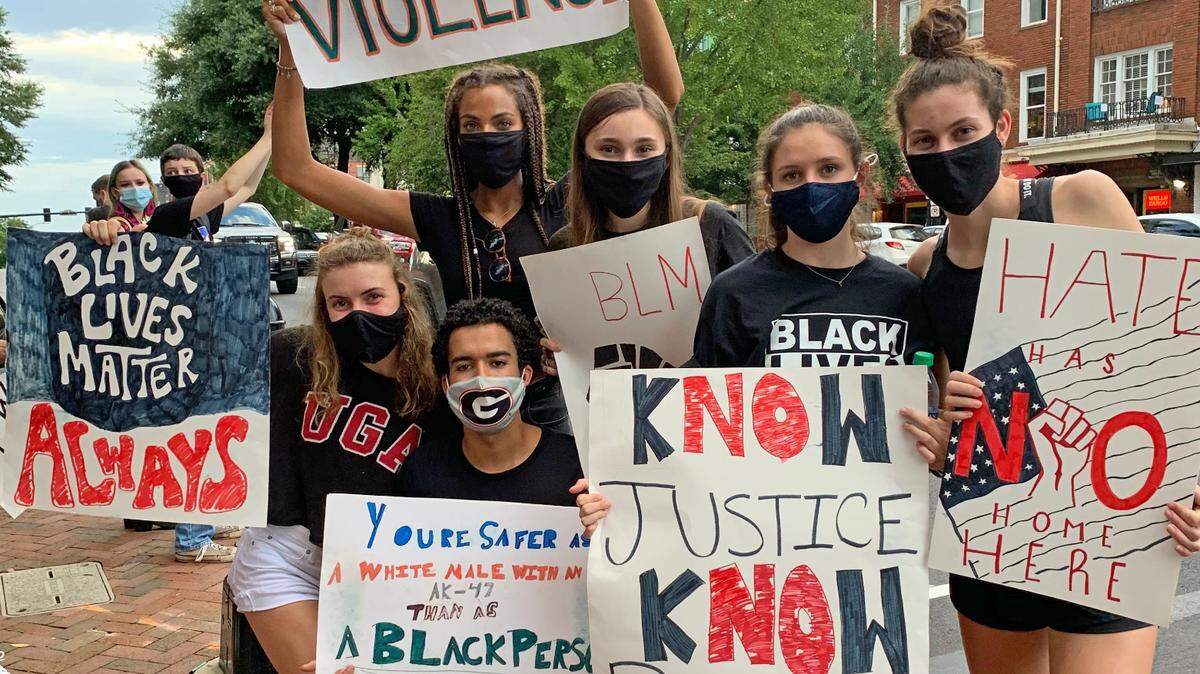
Since returning to campus, Georgia athletes across all sports have aligned their priorities ahead of an upcoming season. They want to use their platforms to be a voice on social justice. The Black athletes want to experience equality, and teammates from different backgrounds have joined the efforts. Their desires to speak loudly on issues with social media posts, statements, rallies and more have allowed the Bulldogs to develop a plan of action.
These athletes see their race as an important identity, and recognize the task in making that known. Georgia is actively using sports to promote a human rights issue.
“The less people speak out about it, that’s the presumption that all of this is accepted,” said Georgia cross country runner Jayda Woods, who is from Cold Spring, Minnesota, 78 miles outside of Minneapolis. “I want to show everyone that we don’t tolerate racism. We don’t stand for this type of hate that goes on.”
USING THE PLATFORM
They’re aware of the backlash.
A football player with NFL aspirations might see his image hindered by speaking out on social justice. A track and field athlete, despite recently bringing a national title to Athens, could alienate some fans if the circumstances are seen as controversial. A basketball player knows the phrase “Shut up and dribble” all too well since it was directed toward LeBron James in 2018.
Dru Milton dislikes all of it. He’s a sophomore cross country runner who has developed a social media following. He believes that platform is earned, so why can’t it be used to advocate for what he stands for? His teammate Kayla Smith, who doesn’t see racial identity recognized equally to an athlete’s standing within their sport, doesn’t want people to “pick and choose” how they perceive a Black athlete in everyday life.
Most Georgia athletes didn’t have much of a choice.
“I couldn’t stay silent,” Milton said. “I was tired of people twisting our movement.”
Georgia women’s basketball guard Mikayla Coombs used the pandemic shutdown to her advantage. It became an opportunity for her to ponder on how to use her platform, educate herself on the events then choose to become an active voice. Jermaine Johnson needed time to hone in on the proper way to approach his message, because “speaking out of place” could have its consequences with a large following.
One after another, a large group of athletes wanted to ensure their voices could be heard. They posted to social media. They had hours of meetings with teammates to bounce thoughts off of each other and formulate a plan of action, one that went as deep as 18 tasks for the football program. All of their sentiments centered around one focus: Recognize Black athletes after the games are over.
“I’m a male of African-American descent and that has a lot to do with me,” Georgia cornerback Tyson Campbell said. “It is important for me to use my platform and become an encouraging voice. That can help cause change in this country.”
“I know my voice matters,” Johnson said. “I didn’t want to hold anything in.”
“I became aware of how life and death these situations can be,” Smith said. “They see us as a Black person. That’s the identity they acknowledge. Negativity, hate and suspicion come with that. We can’t sit around and say nothing.”
Georgia has implemented many ways for athletes to use their platforms collectively. There have been posts by team social media accounts. There’s a diversity and inclusion council within the athletic department for athletes to discuss issues. The football program held a team-wide march at the Hunter-Holmes Academic Building on north campus. Individual athletes are using social media to spread their own messages.
The Bulldogs are speaking together to fight for a cause they believe holds a heavier weight than sports.
“There are people who choose not to believe it, even though there’s a mountain of evidence,” said senior track and field athlete Alec Collins, who has lived abroad and experienced different cultures. “It really shouldn’t be a political issue, because this is civil rights. It baffles me how people think this is politics and it gets me frustrated.”
THE (VIRTUAL) RALLY
Four athletes on the Georgia track and field and cross country teams wanted to translate statements and thoughts into action. Smith, Milton, Collins and Woods formed a squad to develop a way to gather athletes across all sports to discuss social justice.
Smith scrolled through Instagram in mid-August and saw her friend — Tennessee sprinter Vanessa Watson — organizing a protest in Knoxville. There had been marches at Alabama, Missouri, Florida State and others since racism became a main point of awareness in June. They wanted to follow that lead, but Georgia track and field coach Petros Kyprianou had a handbook that stated that athletes couldn’t gather in large groups without the guarantee of social distancing due to COVID-19.
“We needed to do something bigger,” Smith said. “What would be the most influential way to get our message across?”
Similarly to most events in 2020, Zoom became the answer. They invited all student-athletes onto the Aug. 30 call. About 150 arrived. Twelve athletes spoke along with football coach Kirby Smart and women’s basketball coach Joni Taylor, the lone Black coach at the university.
They gave speeches and had dialogue among each other. Some athletes opened up and became vulnerable with their personal stories around racism. Emotions transpired as stories were shared. An unconventional method of a march became a success. Smaller groups of athletes also engaged in in-person protests around downtown Athens, too.
“You change things one day at a time, one person at a time, one vote at a time,” Smart said. “We’ve tried to really impart knowledge on our athletes. We don’t tell them who to vote for and we don’t tell them what to think. That’s a freedom that they have.”
There were some moments that left a lasting impression. Matthew Brown, a walk-on linebacker, has been vocal about issues in America. He spoke on CNN about sports through a pandemic, and had wisdom to share about social injustice and how it ties to sport. Milton jotted down notes throughout the rally and had these words from Brown highlighted: “What you know doesn’t affect you. If it doesn’t affect you, it doesn’t exist.”
“Just because it doesn’t happen to you, it doesn’t mean that it is not happening elsewhere,” Milton said. “I really felt that as a strong message.”
By the end of the event, Georgia’s student-athletes had a blueprint. Smith wanted to ensure goals were in place — ones that could be repetitively accomplished in everyday life, no matter where someone is or who they’re around. That became the primary mission of the rally — evolve the statements made by players and coaches into tangible progression.
Each attending athlete logged out of the discussion with the following objectives:
Call student-athletes to take action by voting this November and having conversations on race and racial justice. Get involved with minority and multicultural students on campus.
Strengthen the line of communication between UGA athletics and the university’s branch of the NAACP.
Showcase that UGA athletes are working for social change and supporting racial justice.
“People have tried to better racism every year,” Georgia sophomore defensive lineman Travon Walker said. “We shouldn’t give up on it. We need to fight for justice and progress as a united whole in this world.”
THE ACTION
Before returning to campus, Joni Taylor asked her basketball players how they wanted to take action. Taylor saw the need for tangible steps within the student-athlete community and around Athens. The Lady Bulldogs decided on an emphasis on voting registration before the general election on Nov. 3.
A council was formed with Coombs, Caldwell and Gabby Connally. The football and track and field programs have borrowed the initiative to help accomplish the task. Georgia wants to have 100% of its athletes registered and submitting a ballot on Election Day.
“The change we want to see is huge, but it’s the little things that get us there,” Caldwell said.
Georgia has teamed up with the “When We All Vote” organization to coordinate the efforts. They meet with a representative over Zoom to get ideas on the logistics of a voting drive. Coombs has become a lead spokesperson for the effort. Milton and women’s basketball forward Jenna Staiti posted a video for student-athletes on how to register in Georgia. A team-wide trip to an early voting facility has been discussed, Coombs said.
Following the voter registration efforts, the football program implemented the “Dawgs for Pups” initiative. This method of action toward social justice focuses on helping groups within the Athens community. The first came with connecting grade-school children in the Athens-Clarke County School District to WiFi hotspots to allow for a wider range of connectivity during online schooling. The athletic association said $50,000 had been raised as of Sept. 10.
The second initiative, which other sports have lent a hand toward, is a “Food2Kids Snack Drive.” The effort gives food to families facing financial troubles due to the pandemic and is coordinated with the Food Bank of Northeast Georgia. Smart said more initiatives are to come but have not yet been finalized.
“It’s important to help the youth at all times,” Georgia linebacker Nakobe Dean said. “Not just right now in times of despair but all the time since they are the future of our country.”
Every meeting, statement or call to action has been led by Georgia’s athletes. The Black men and women experience the pain. They want to be treated equally away from the playing field. They realize the need for change.
They’ll unashamedly use their platforms to speak on social justice, too.
“This is a movement. This is not a moment,” Milton said. “I will not stop until the necessary changes have been made. You’re still going to hear me speak out and we’re just getting started.”