
College Football Playoff coaches opine on four-team format
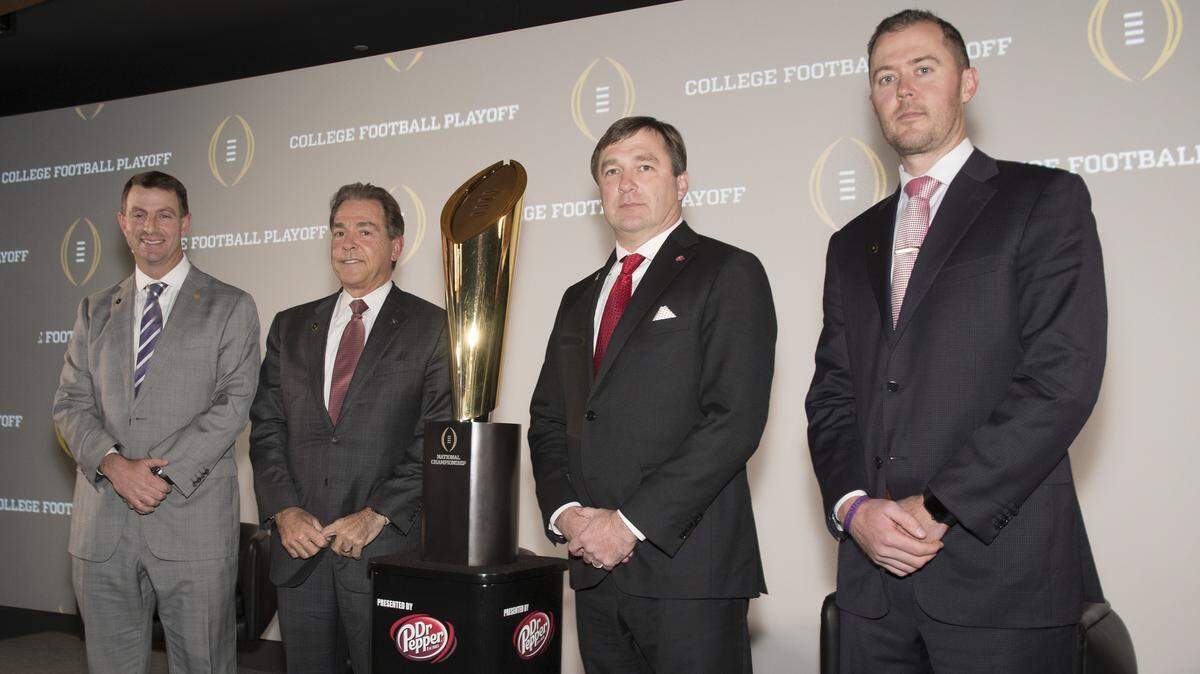
When the College Football Playoff field was selected, it was clear who the top three teams would be.
Clemson, Oklahoma and Georgia won their conference championships and only one loss apiece. When it came down to the fourth spot, it was either going to be Big Ten champion Ohio State or one-loss at-large Alabama.
The Buckeyes lost two games this year -- one at home to Oklahoma 31-16 and one on the road to Iowa 55-24. Alabama's only loss came to Auburn 26-14 on the road. But that lone defeat kept the Crimson Tide from playing for an SEC title.
In the end, the College Football Playoff selection committee went with Alabama, which upset many who felt Ohio State should have been in as a conference champion. And that of course brought this argument: Should the playoff expand to include more teams, especially those who win their leagues?
Each of the four playoff coaches -- Clemson's Dabo Swinney, Oklahoma's Lincoln Riley, Georgia's Kirby Smart and Alabama's Nick Saban -- were asked this question. And each coach appeared to be on the same page with what they thought.
"We sort of started the two-team deal. Now it's a four-team deal. Now all the focus and emphasis is on the playoffs," Saban said. "Teams that go to bowl games, the bowl games don't coexist very well with the playoffs relative to importance, how much attention they get, but yet they are important to positive self-gratification for a lot of players, a lot of coaches, a lot of fans who have a good season. It's a very positive reinforcer."
Swinney said he sees why someone would want to expand the playoff, especially when a deserving team is left out. At the same time, he noted the college football regular season is an exciting product as Power 5 teams know they can't accrue multiple losses and realistically be contenders.
That's the way it was for Clemson after suffering a mid-season loss to Syracuse. Swinney said his team was in win-out mode the rest of the way.
"If you know you're in the playoffs, certain games become very irrelevant," Swinney said. "Now all of a sudden you don't play certain players because know you're in, you don't want to get a guy hurt. There's a lot of unintended consequences that creep in, just like you see in all the other sports."
Given the fact many college football rivalries take place in the final week of the year, an expanded playoff could put games such as Alabama-Auburn, Michigan-Ohio State and Georgia-Georgia Tech at risk of not being played at full strength if any of those teams is safely in an expanded hypothetical playoff field.
Riley pointed out that if the playoff field expanded, there would still be folks upset over a certain team being left out.
"There's never going to be a magic number," Riley said. "If we have eight (teams), nine and 10 are going to be upset. If we have 16 (teams), 17 and 18 are going to be upset."
Said Saban: "I don't care if we have 68 teams in it, we'll still have a two-hour show on who shouldn't have got in it just like they do in basketball."
Smart said that when he played at Georgia, some of his best memories came in bowl games. He believes that by expanding the playoff, it would only further diminish the rest of the bowl season. With college football being unique in that multiple teams end their season with a win, that's something Smart doesn't want to see trivialized.
"You do devalue that as you increase the number of teams in the playoff," Smart said. "You do value the end of the season. You think about the last, probably, three weeks of the season, last two weeks of the season, the amount of attention and the amount of big games. (The committee) probably got it more right this year than ever with a lot of the championship games as de facto play-in games. I think that's the right way to go about it."
This story was originally published December 8, 2017 at 2:47 PM with the headline "College Football Playoff coaches opine on four-team format."