
Butler Brown lives on in the art we loved
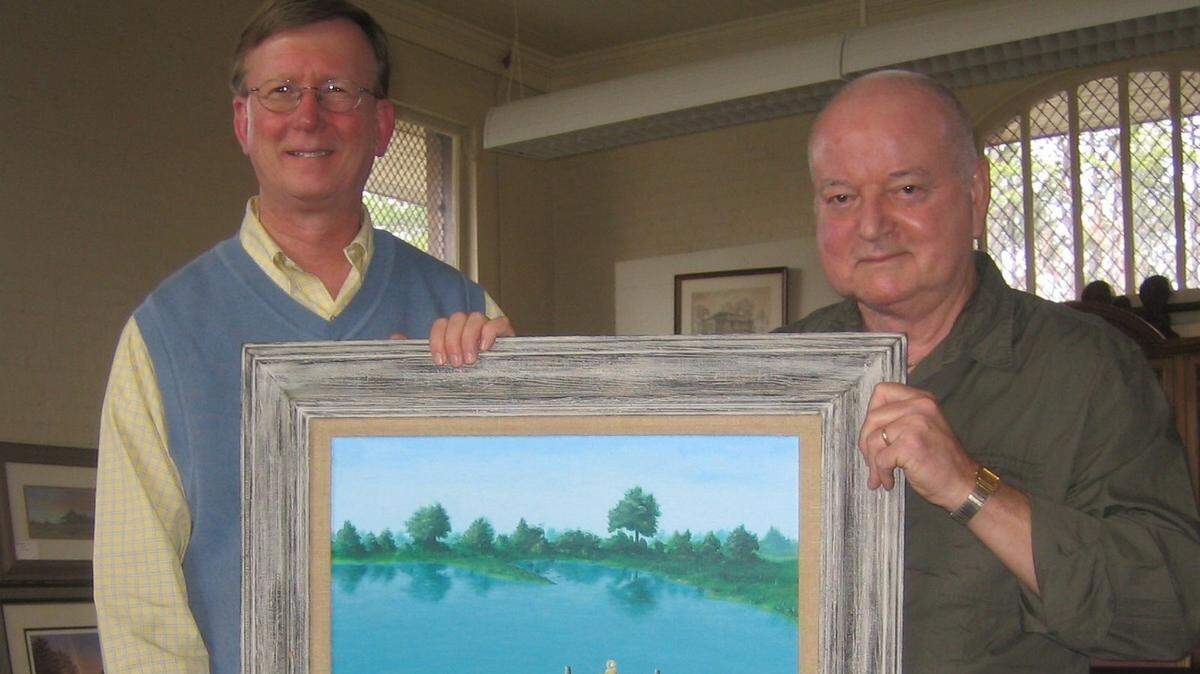
Butler Brown has lived in our home for as long as I can remember.
His brush strokes rise above the mantel in my study. An old farmhouse hangs on a plaster wall above our piano. Dirt roads and wooden fence posts stand guard at the front door.
His work is within arm’s reach across three rooms in our house. He has been our artist-in-residence, so to speak. A painting of a harness buggy in front of a stable is balanced along the brick wall between two windows in the den.
It was with sadness I learned of his recent death at age 82. I considered him a friend of the family, going back more than 50 years. He was among Georgia’s most prominent artists and one of Hawkinsville’s most famous native sons.
He died on May 6, three days before Little Richard. One was a performing artist, the other a visual artist. Little Richard had a star on the Hollywood Walk of Fame. Butler Brown was content to live a quiet life under the stars, with crickets chirping and the wind whispering across the tops of the pines.
In my travels through Middle and South Georgia, I often have driven past a weathered farmhouse and wondered if Butler had dipped his palette there. His body of work included autumn days, green pastures, row crops, farm ponds and barn doors.
I never tried to interpret his art, searching for hidden meaning along fence lines and behind empty windows. There were never many bright colors to draw you in. A man with a color for a last name found power in the plain ones, a who’s hue of soft browns, pale blues, gentle greens and ashen grays.
His paintings have been in the collections of everyone from President Jimmy Carter to Phil Walden of Capricorn Records. In 1977, the year after Carter was elected president, he hung “The Brown Farm” in the White House. It was an oil painting of a rustic house with two barns. The notoriety made Butler somewhat of a household name. He was featured in People magazine and The New York Times.
His introduction to art came in the eighth grade. After he graduated from high school in 1956, he began working in the IBM machine shop at Robins Air Force Base. Whenever boredom took over, he would sketch scenes of rural countrysides on the backs of punch cards.
His wife, Laverne, later bought him a set of paints and he began taking an art correspondence course. That was about the time my family began its long history with him. My maternal grandparents – the late Mr. and Mrs. W.E. Richards – taught school in Hawkinsville from 1948-73.
My grandmother was a second-grade teacher. In 1968, she had Butler’s son, Tony, in her class. Butler contacted my grandparents and asked if he could come over and take some photographs of a lake in front of their house.
He then went to work, painting the lake, trees and sky. In the beginning, those early blues and greens were bold and bright, unlike the more ordinary landscapes that would become his trademark.
The portrait is of a little boy fishing. He is wearing a straw hat. There is a wooden rowboat in the water and a tackle box and can or worms on the dock.
The child is his son, Tony, but my grandmother always told me it might have been me. I caught my first fish on the banks of that lake. If I close my eyes, I can feel it tugging on the end of my cane pole.
Butler gave the painting to my grandmother and, before she died in 1999, she gave the family treasure to me. It is one of two original Butler Brown paintings I own. My parents gave me the other, called “House in the Valley.’’ They bought it from the Anne Tutt Gallery on College Street in Macon in 1973. My all-time favorite is a print of “The Perfect Oak.’’ It depicts a legendary tree that once majestically towered over a dirt road in Houston County along a route that later became U.S. 41.
Over the years, I always would remind Butler of the painting of the boy fishing. He would smile. He was fond of my grandparents and remembered it well. In the spring of 2007, a year after his wife died, we were reunited at the historic train depot in Forsyth during the weekend of the Forsythia Festival. I was there for a book signing. He was there with a gallery of his artwork.
That Saturday, I mentioned the early original to him again and promised to bring it with me the next day. As many times as I had told him about it, he had not seen it in almost 40 years.
I later would describe it as a beautiful reunion, like showing Hemingway the first paragraph he ever wrote.
Ed Grisamore teaches journalism at Stratford Academy in Macon. His column appears on Sundays in The Telegraph.