
Middle Georgia abortion rights group rallies, supports Harris ahead of presidential election
Julia Callahan was excited to have another baby. A mother of one child, she found out she was pregnant in July 2022. She was overjoyed to grow her family, until things took a turn for the worse.
Just days later, Callahan felt a sensation like her water breaking. She felt sick and spoke with health care providers at her next appointment, and while they believed she was miscarrying, tests showed she was still pregnant. Unsure of what to do, doctors sent her home to recuperate.
The next month was excruciating, Callahan said. She vomited so often that she depleted the electrolytes in her body, causing heart palpitations.
“I feared I would die, and my family feared the same,” Callahan said.
After multiple visits to doctors’ offices and hospitals, Callahan finally discovered that she was pregnant with twins. While one fetus was viable, the other was not. Doctors offered her a shot containing medication to help end the nonviable pregnancy.
“I had a child back home I wanted to live for. I had to survive for her,” said Callahan.
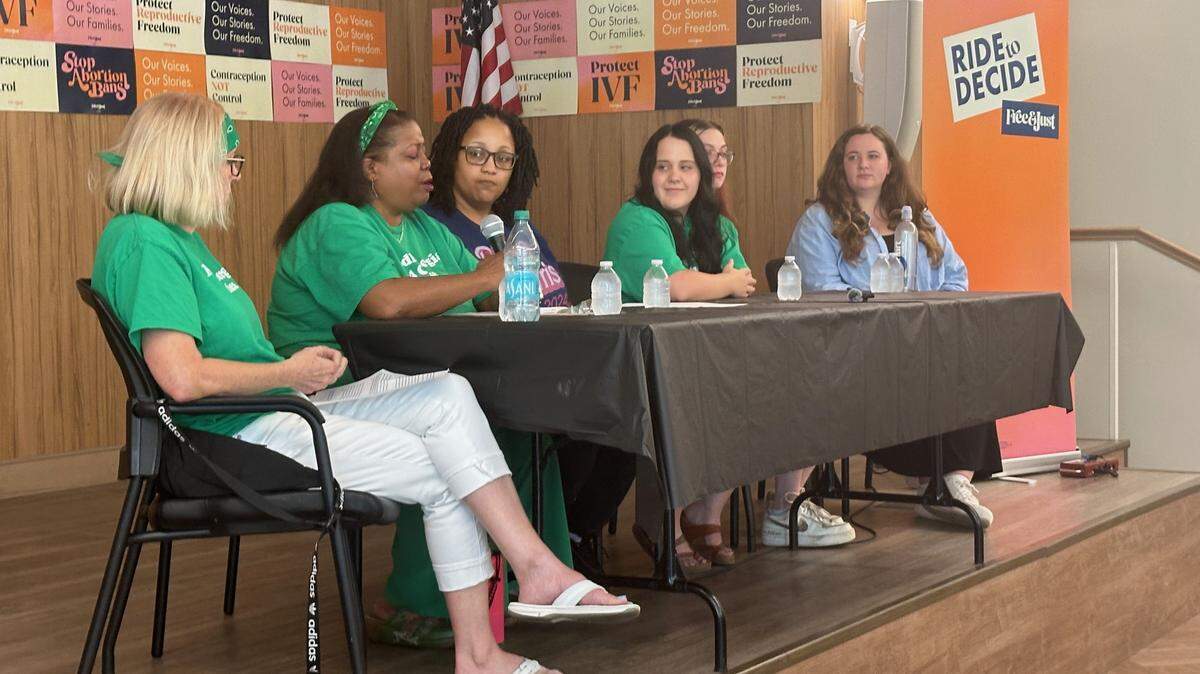
Callahan, who helped found Middle Georgia 4 Choice, shared her story alongside other Middle Georgia abortion rights advocates on a panel Friday. She credits the shot with saving her life, but because the shot could’ve endangered her viable pregnancy, she fears that the overturning of Roe v. Wade in 2022 may mean women in the same situation won’t have access to the same care she did.
The panelists are not alone. Abortion has become a key issue for Georgians ahead of the 2024 presidential election, and has been a major point of contention for years.
A hot button issue
Georgia had already seen conflict around abortion prior to the Supreme Court’s 2022 decision to end federal abortion rights protections.
In 2019, Georgia enacted a law that banned most abortions at six weeks, which is when fetal cardiac activity can be detected. The law was overturned by a federal judge, citing Roe v. Wade, the decision that protected abortion rights.
In 2023, about a year after the ruling was overturned, the Georgia Supreme Court reinstated the legislation banning most abortions at six weeks.
Following the Supreme Court’s 2022 decision, Callahan partnered with other Middle Georgia residents, including Mia Robbins-Aguilar, to organize a protest against the decision. The women eventually founded a permanent group, Middle Georgia 4 Choice, to advance abortion rights at the local, state and federal levels.
Friday’s panelists represented a diverse slate of women, each with their own reasons for being there. Robbins-Aguilar said her reasons for speaking on the panel were the same as when she founded the group: she wants young women and girls to have the same rights she had as a young person.
“I am afraid for my nieces and every young girl that I come into contact with,” Robbins-Aguilar said. “They should all have the same rights that I had. They should all have access to care and medical treatment.”
Others expressed concern for their community. Tina Taft Hobson, who grew up in a rural community in southwest Georgia, said she watched many of her peers become pregnant as teenagers due to a lack of comprehensive sex education and abortion access. Previous reporting by The Telegraph documented similar issues in Middle Georgia.
“If you don’t know what you’re doing, you’re going to end up getting pregnant,” Taft Hobson said. “I think that’s a one-to-one connection.”
Women who have children as teenagers are significantly less likely to finish high school and attend college, according to the National Library of Medicine. They also on average earn lower incomes than their peers who do not become pregnant as teenagers.
Supporters of Georgia’s abortion law say that it would not endanger women’s lives because it has exceptions for medical emergencies that present serious threats to a woman’s life or health.
The election?
While many panelists and attendees wore clothes and carried signs displaying abortion rights slogans, others also bought T-shirts and signs supporting Vice President Kamala Harris’ presidential bid.
Since the overturning of Roe, abortion has become a major electoral issue, motivating some female voters across America to head to the ballot box for abortion rights candidates and to stop amendments to state constitutions limiting abortion rights. Harris has promised to protect abortion rights if elected.
The panel was organized by Ride to Decide, an abortion rights advocacy group visiting a range of locations to host events with local activists. After Macon, they made a stop in Atlanta. Georgia is especially key to abortion rights advocates because it stands to be a major player in this year’s presidential election, and abortion has already been a key issue in other races in the state.
Drawing on her own experiences, Callahan emphasized her belief that electoral power is key to protecting abortion rights. She said she hopes to restore abortion rights in Georgia through the ballot box.
“Women in the same position are being denied life-saving care and being threatened with prosecutions,” Callahan said.
This story was originally published August 7, 2024 at 10:44 AM.