
Beyond pro-life or pro-choice: What the ‘heartbeat bill’ means for women in Georgia
Reyna wasn’t ready to be a mother. She was 21 years old, working her way through college in Macon and struggling to pay rent. When her period was five days late, she panicked.
Reyna is the first in her family to attend college. Her parents, both immigrants, raised her on custodian’s and factory worker’s salaries. She knows what it’s like to live paycheck to paycheck. And she wants more for her children.
Alone in her pajamas in the bathroom of her residence hall, Reyna stared at the two little lines on the pregnancy test she’d bought with her fiancé a few hours before. Her first thought: “I need to get an abortion.”
Reyna is not her real name. She shared her story with The Telegraph on the condition of anonymity, out of fear for her safety in a city that hasn’t welcomed an abortion clinic in nearly 40 years. But she’s one of the approximately 500 Bibb County residents who terminate their pregnancies each year, according to data from the Georgia Department of Health.
Reyna didn’t want her first pregnancy to end in an abortion.
“But that was the situation,” she said. She cried in her dorm room as she told her fiancé, “I want to graduate. I want to be able to provide for our child.”
So the couple drove 100 miles to a clinic in Atlanta, past two protesters out front, and paid $375 for a surgical abortion.
Reyna was six weeks and three days pregnant on the day of the procedure. The embryo was about the size of a blueberry. Under new Georgia legislation, slated to take effect in January 2020, Reyna’s doctor could have been arrested on criminal abortion charges and sentenced to up to 10 years in prison.
The Living Infants Fairness and Equality (LIFE) Act bans virtually all abortions after six weeks, when an ultrasound can detect “embryonic or fetal cardiac activity,” also known as a fetal heartbeat. In a state with the highest maternal mortality rate in the nation and a severe shortage of OB-GYNs, physicians and activists fear the law could put Georgia women at risk.
The representatives who voted for House Bill 481 didn’t listen to the physicians and patients “screaming from the rooftops that we’re concerned,” said Dr. Julianne Adams Birt, a Conyers-based OB-GYN. The Georgia OBGyn Society, the Medical Association of Georgia and the Georgia chapter of the American College of Nurse-Midwives all opposed the legislation.
Adams Birt called the bill, signed into law this May, “unacceptable” and “unethical.”
“We took an oath to first do no harm,” she said. “This is extremely dangerous for our patients.”
If the law takes effect, Adams Birt said, women might take extreme measures to end their pregnancies — whether they’re legal or not.
In Macon and smaller cities and towns across the state, abortion providers are already largely out of reach.
Many want to keep it that way. Macon residents have successfully advocated to keep abortion clinics out of town for decades, determined to protect, what they view as, the lives of unborn children.
Limited women’s health access in Georgia
Georgia’s new abortion law comes on the heels of a wave of restrictive abortion bills surging through statehouses across the country. Nine states have approved new prohibitions on abortion this year, including Alabama, Missouri and Ohio. But those laws likely won’t take effect before a lengthy legal battle, which could make its way to the Supreme Court.
“Believe you me, there’s going to be a fight,” Adams Birt said.
The American Civil Liberties Union and Planned Parenthood have both announced they plan to sue the state of Georgia, and other advocacy groups have ramped up their efforts to protect abortion rights in recent weeks. But they also point to the fact that abortion is already inaccessible for many women in Georgia.
“We’re talking about this really egregious attack that will all but eliminate states of abortion access here in the state,” said Laura Simmons, Georgia state director of NARAL Pro-Choice America. “But we have to remember that access has already been chipped away at, and it’s already a problem.”
Though about 27,000 Georgia women terminate their pregnancies each year, there are only 11 abortion clinics in the state accredited by the National Abortion Federation. Several other women’s health centers provide medication abortions. All are concentrated in four of Georgia’s major metropolitan areas: Atlanta, Augusta, Columbus and Savannah. About 60% of Georgia women live in a county with no abortion provider, according to a 2017 Guttmacher Institute study.
Georgia women also face a severe shortage of maternal health care providers. Nearly half of the state’s 159 counties have no practicing OB-GYN, the Georgia Board for Physician Workforce reports.
The number of labor and delivery units in Georgia decreased 40% between 1994 and 2015, and more have closed since. The Georgia Department of Public Health listed 90 perinatal hospitals in a 2013 report on perinatal care in the state, but at least a dozen have since merged with other health systems, closed their maternity units or no longer list labor and delivery on their websites.
More than 80% of rural Georgians must leave their county to give birth, according to a 2015 report by the Medical College of Georgia, Augusta University. Between 1999 and 2009, about a quarter of Georgia women outside of metropolitan areas had to drive more than 45 minutes to access prenatal care, the Georgia Obstetrical and Gynecological Society found. Those women were 1.5 times more likely to deliver preterm than their counterparts who lived within 15 minutes of an OB-GYN.
Georgia has the third-highest rate of uninsured women in the country — 19.4% of women between 18 and 44 — and only one in five pregnant women in the state is insured through her employer. Given Georgia’s high rates of maternal and infant mortality, some physicians wonder why the state would further hamper women’s abilities to end unwanted pregnancies.
“In all the corners of Georgia, there is a huge lacking of women’s health specialists — gynecologists included,” Adams Birt said. The OB-GYN said the shortage of maternal health care is only exacerbated by a dearth of knowledge about birth control.
“What kind of family planning conversations have they been having prior to now being at this point of, you know, trying to go down this decision tree?” she asked. “What options were they told?”
In many Georgia school districts, sex education is still abstinence-based. And despite a scarcity of OB-GYNs in the state, there’s no shortage of pregnancy resource centers, also known as crisis pregnancy centers, which offer counseling to women facing unexpected pregnancies. There are at least 92 such centers throughout the state, according to a Telegraph analysis.
Most crisis pregnancy centers are faith-based and do not provide abortion referrals. Articles in the AMA Journal of Ethics and Women’s Health Issues have deemed them unethical and misleading.
“These are ideologically based centers that are pretending to be actual health care providers and basically misleading women into coming into a place in which they are intentionally manipulated and withheld information in order to keep women pregnant,” Simmons said. “They have an objective in mind, which is to limit reproductive options.”
Ann Beall said she would never encourage a woman not to follow a doctor’s advice. The director of the Kolbe Center in Macon knows some abortion rights advocates question the intentions of her pregnancy resource center. But she said her goal has always been “helping protect and defend life in our community.”
‘I have a real heart for women and babies’
Beall never gave much thought to the topic of abortion before she started her own family.
“It wasn’t until after I had my own children that I became really pro-life,” Beall said, “as I held my own child and looked at her and I just couldn’t fathom that anybody wouldn’t want that.”
Like other pregnancy resource centers throughout the state, the Kolbe Center offers pregnancy tests, diagnostic ultrasounds, referrals for prenatal care care and community agencies, adoption information and peer counseling. The center also provides post-abortion therapy for women who have already terminated their pregnancies, as well as maternity clothing and baby supplies.
The Kolbe Center opened in 2014 to fill a gap in a community that Beall said had become “complacent.”
“I have a real heart for women and babies,” she said. “I want to help women be the best moms they can be.”
Beall said she has guided many women through difficult decisions over the years. The day before she spoke with a Telegraph reporter, a young woman had visited the center with her mother, prepared to have an abortion. After looking through a set of models depicting the fetus at different stages of gestation, the woman changed her mind.
“She looked at me and she said, ‘I can’t. I can’t kill that,’” Beall said. “I think adoption may be a good option for her. But she certainly left my office prepared to figure that out as opposed to have an abortion.”
Beall doesn’t want to see an abortion clinic in her city. When Summit Medical Centers, an abortion provider with locations in Atlanta and Detroit, tried to open an office downtown, about 100 protesters demonstrated outside of the proposed site on Walnut Street. Several more protests and a request from neighboring business owners to revoke the center’s approved Planning & Zoning application ensued.
In December of 2018, Beall said, a couple associated with the Kolbe Center bought the Walnut Street building, on the condition that the prior owners break their lease with the women’s health center.
Summit Medical Centers did not respond to multiple requests for comment.
“This building had been planned to be a building of death, to be a center of death,” Beall said. “And now it’s gonna be a beacon of hope and life for our community.”
‘The baby deserves a chance to live’
Jasmine Gerald didn’t expect to have a baby at 18.
When the McRae native got pregnant in the fall of her senior year of high school, she didn’t hesitate to make an appointment for an abortion.
“This was my chance to finally be free. I was fixing to join the military. I was fixing to able to live for Jasmine, not having to worry about anybody else,” Gerald said. “And here I am fixing to have this responsibility that I’ll have to have for 20 years and then some.”
Gerald wasn’t prepared to have a child. She felt completely alone.
The week of Thanksgiving in 2016, she drove three hours to a clinic, ready to put her unplanned pregnancy behind her. Gerald maneuvered through a crowd of protesters and checked herself in at the front desk, where she learned that her doctor had called in sick and wouldn’t be able to perform the procedure that day.
In that moment, Gerald said, she realized “God wasn’t gonna let this happen. This is something that he didn’t want to let me do to myself and to my child.”
Gerald drove home and “gave my life to God.”
“I trusted him,” she said. “And he just provided everything from that point on.”
The pregnancy wasn’t easy, Gerald said. Not on speaking terms with her parents, Gerald moved out of their house and into a home for girls. She was juggling two jobs and a high school course load in between prenatal care appointments and scrambling to find a place to live once the baby was born.
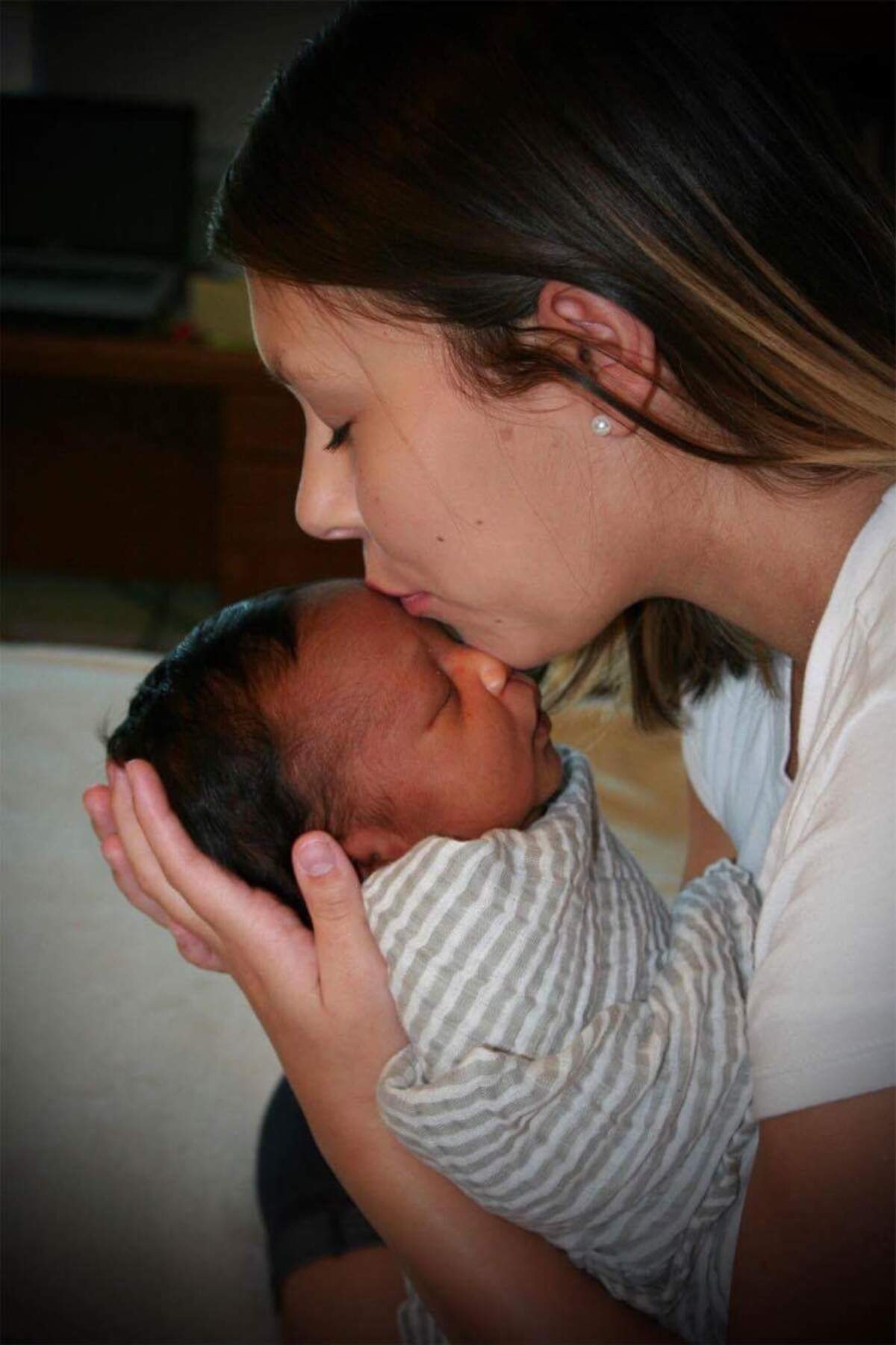
Last fall, the young mom married Caleb’s father, who’s serving in the Navy. Gerald is studying criminal justice at Middle Georgia State University and hopes to join the National Guard after graduation. Each day she feels a bit more confident in her maternal instincts. But she still calls Walker for guidance.
“It takes a village to raise a baby,” Gerald said. And she understands why other women choose abortion.
“I don’t want to support it but I have to be respectful of the fact that I once was there, and I once did think about it,” Gerald said. “And I understand what people are going through when they think about this.”
But she doesn’t regret the decision she made nearly three years ago. Every time Caleb snuggles up against her or learns a new word, she’s grateful she chose to bring him into the world. Gerald said she would advise any young woman in her shoes to think about doing the same, or at least consider letting someone else adopt their baby.
“I don’t think at any point anybody’s really, fully ready for a child,” Gerald said. “I just feel like the baby deserves a chance to live.”
‘It gets scary to think about’
Reyna doesn’t regret her decision, either.
It’s been over a year since her abortion, and she still hasn’t worked up the courage to tell her parents. They’re both Catholic. But Reyna thinks her parents will understand that she did what she thought was best for her future family.
Georgia’s new abortion law scares Reyna. She’s afraid she or one her younger sisters will get pregnant and won’t have the option to get a safe and legal abortion. Or that they’ll drain their bank accounts traveling to another state to end a pregnancy they already can’t afford.
When the state legislature approved House Bill 481, Reyna said, she was angry at first. Now she’s terrified.
“It gets scary to think about what other options you have,” she said, “because if abortion’s not there — a safe abortion’s not there — then, what else can you do but do it yourself?”
Reyna wants to have her first baby when she’s 30. By then, she hopes to have graduated from college, earned her nursing degree and saved enough money to start a family.
Reyna got married in a courthouse a week after her abortion, still bleeding from the procedure, afraid she would stain the white dress she’d rented for the occasion. She said her husband stood by her side through every step of her pregnancy — securing two different tests from Publix and Walmart, driving her to and from her appointment in Atlanta, buying her chicken nuggets and fries from Wendy’s on the way home.
Reyna wants to raise children with the man she loves. Just not yet.
“I wanted to give them all the choices I could possibly give them,” Reyna said. “I wanted to give them all the attention I could give them. I wanted to not resent them for being an obstacle in my future.”
By the time she’s 30, she thinks she’ll be ready.
“I think once I take that pregnancy test eight years from now, I think I’ll just be super excited about it,” Reyna said. “I think I won’t be able to hold it in.”
Samantha Max is a Report for America corps member and reports for The Telegraph with support from the News/CoLab at Arizona State University. Follow her on Facebook at https://www.facebook.com/smax1996 and on Twitter @samanthaellimax. Learn more about Report for America at www.reportforamerica.org.
This story was originally published May 31, 2019 at 12:24 PM.