
Abrams, Kemp dispute health care, tuition, more in Georgia gubernatorial debate
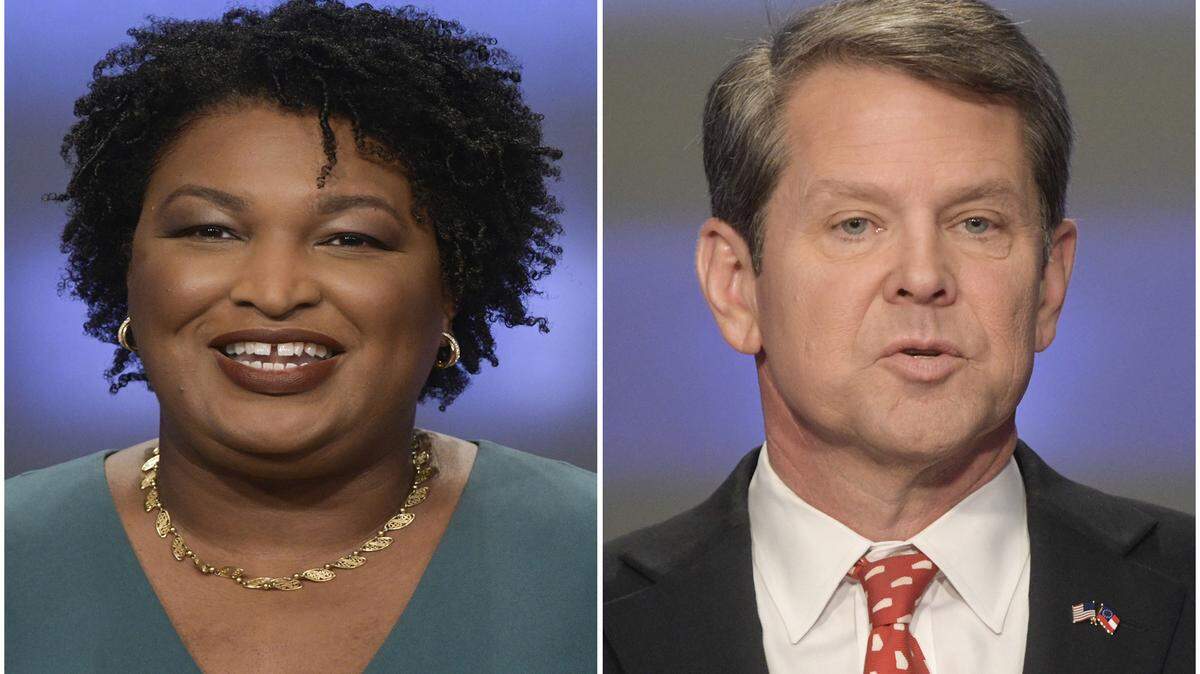
In a debate Tuesday night, Democrat Stacey Abrams and Republican Brian Kemp competed to convince voters to come out for them, as Georgians already are casting early ballots in an expensive race to lead the state.
The two major-party candidates for Georgia governor split early on the question of in-state college tuition rates for young people who were brought to the United States illegally as children and who have temporary protection from deportation.
“I’ve been running my whole campaign on putting Georgians first,” said Kemp, adding that “free” tuition for such students is the wrong position.
Abrams said she supports in-state tuition rates for such students, and Georgia has to take every chance to improve its economy and fill in-demand jobs.
Libertarian Ted Metz said he’s in favor of more immigration for the good of the country.
The divide continued all evening at the Atlanta debate.
Abrams defended her marquee policy: expanding publicly subsidized Medicaid health insurance to more Georgians who don’t have a way to pay for health care.
“I’m so bullish on Medicaid expansion because I know it works,” said Abrams, adding it would help shore up rural hospitals and mean health insurance for many who don’t have it now.
On health care, Kemp said expanding a “broken government program” is not a solution for rural Georgia.
A long-running split between the two major-party candidates on voting administration also emerged.
Kemp, as secretary of state, is also the state’s top election officer. Kemp’s critics have long accused his office of unfairly separating people from their right to vote, by, among other things, a name-verification system that incorrectly excludes some voters.
Abrams said that on Kemp’s watch, eligible Georgians have been purged, suppressed and scared in a way that amounts to voter suppression.
Kemp countered that he’s followed the law in the name of keeping an accurate voter roll, and while, for example, some registrations are on hold, it’s for reasons like trying to register as “Jesus” from “Heaven Street.”
They may be far apart on policy, but Kemp and Abrams are close in a recent poll.
They were only one point apart in a poll of 1,232 likely Georgia voters conducted Sept. 30 through Oct. 9 by the University of Georgia for the Atlanta Journal-Constitution and WSB-TV. Kemp had 47 percent, Abrams 46 percent, Metz had 2 percent and “don’t know” came in at 3 percent. The poll had a 2.8-point margin of error.
Abrams spent most of her roughly 10 years in the state House as its highest-ranking Democrat, before leaving last year to concentrate on this campaign. Her marquee strategy has been turnout of what she’s called a “new American majority:” non-whites, single women and folks aged 18 to 29.
Kemp spent four years in the state Senate in the early 2000s. In 2010, he was appointed secretary of state, an office to which he was subsequently elected twice. He’s called himself an “unapologetic conservative.” At the top of his policy list is an image from an ad in his Republican primary earlier this year: him with a chainsaw meant for “burdensome regulations.”
Donors put more than $16 million in Abrams’ campaign and almost $17 million in Kemp’s through Sept. 30. And that doesn’t count millions more in spending by the parties and outside groups on both sides.
Politicos across the country are watching as Democrats are making a coordinated charge on the highest offices in Georgia, which have been held by Republicans for more than a decade. GOP candidates themselves have responded by coordinating their campaigning with each other more than in recent years.
But if several years’ worth of state Legislature elections are any indicator, the state’s not as reliably red as it once was. As Republicans watch their margins decline in former strongholds like Cobb and Gwinnett counties, that makes turnout among the base as important a strategy for Republicans as for Democrats.
Political stars from other states have campaigned for both sides, like Republican U.S. Sen. Marco Rubio from Florida and Democrat U.S. Sen. Cory Booker from New Jersey.
Early voting is underway, and Election Day is Nov. 6.