
He voted in every election for 40 years. Georgia warns him he might be an inactive voter
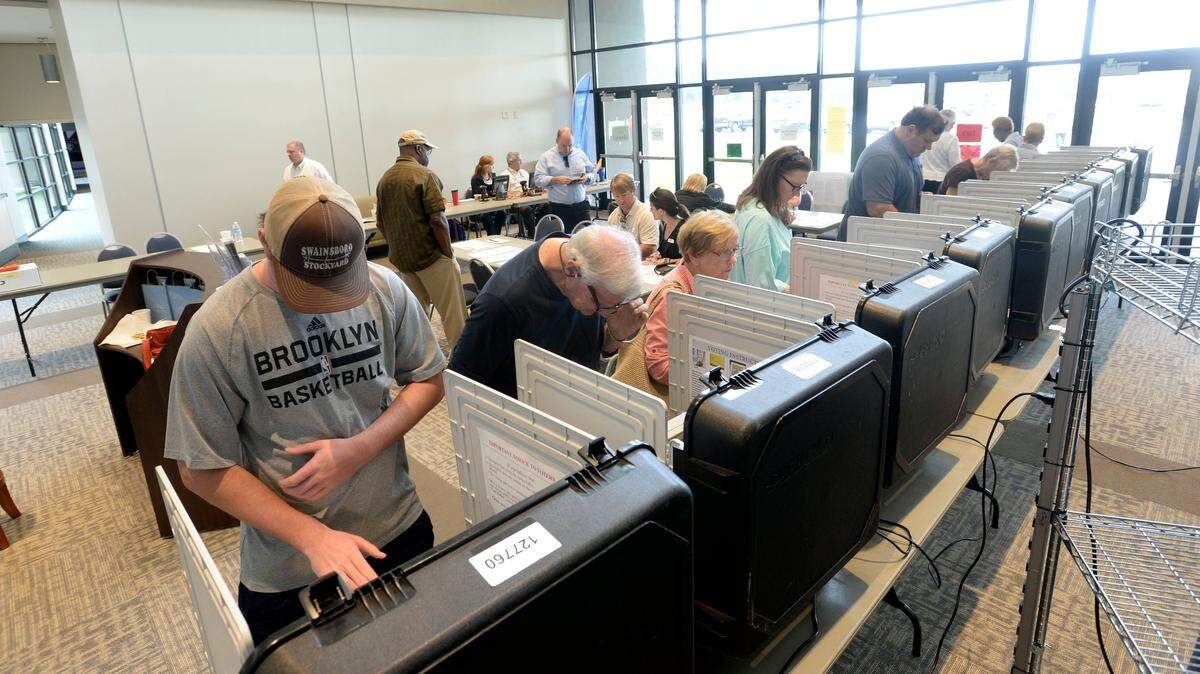
Lindsay Holliday is serious about politics.
Holliday, who many in Macon know as “Doc,” was once a fixture at Macon City Council meetings where he made good use of the public comment periods. He has run for office. To call him politically active is an understatement.
“I’m definitely an activist, and I’m ready to get active about this,” he said during a recent break at his Macon dentistry practice.
By “this,” Holliday meant the letter he got in the mail about a week after the second round of Georgia primary voting this year.
The letter stated Holliday fell into one of three categories. Either he had moved, didn’t respond to election-related mail or he hadn’t voted in a long time. He said none of that was true.
“I’ve voted in every Georgia election for the past 40 years,” Holliday said.
The letter stated that if he didn’t take action in 30 days, Holliday ran the risk of being labeled an “inactive voter.” The whole thing left him unnerved and angry.
“I think it is an illegitimate attempt to defraud me,” he said.
Between Russian election interference and fears of electronic voting machines vulnerable to hacking, there’s a lot to worry about these days in the realm of election security. Sometimes, though, the things that move the needle on elections are far less exciting. Sometimes all it takes to affect an election is a piece of paperwork, like Holliday’s letter.
Heather Bowman Cutway, also of Macon, got one, too. And like Holliday, she wanted to know what it was about. She let a reporter listen in as she called the number for the Georgia Secretary of State printed inside.
“About a month ago I received a form saying they are updating voter lists, and it gave three reasons why I am getting this notice,” she said before getting cut off by the voice at the Secretary of State’s Office.
“You can disregard that,” the voice said.
A small card included in the letter was self-addressed and postage paid to the Secretary of State, but “it didn’t come from this office,” the voice insisted.
The back and forth continued until Bowman Cutway was told to call her local board of election. That’s where the conversation stopped.
“I’m very unsatisfied,” Bowman Cutway said afterward. “Telling me that they didn’t send it to me just simply doesn’t make any sense.”
The Macon-Bibb County Board of Elections did have answers.
When her polling place moved this year, Macon-Bibb County sent Bowman Cutway a new voter registration card, which it says was returned by the post office. That automatically triggered the follow-up letter she received.
About 2,500 other people in the county got one, too, according to the Secretary of State’s Office.
But it turns out disregarding the letter, as she was advised on the phone, was exactly the wrong thing to do. The right thing was to either return the information card to the Secretary of State or, even more simply, just show up and vote in November.
Sean Young is an attorney with ACLU Georgia, and he has gone to court over situations like this. All of it is familiar to him.
“These kinds of intimidating, legalistic, confusing notices that people get in the mail that read like subpoenas ... I mean this is the kind of thing that has kept marginalized groups from the polls for centuries,” he said.
How can a letter keep you from the polls?
While Bowman Cutway is calling offices in Atlanta to make sure she can vote and Holliday is sure to kick down the door to his polling place on Election Day, other people have to be coaxed to the polls. Letters like this can be a powerful disincentive to them.
The Secretary of State’s Office said 35,000 letters like this have gone out in the state this year.
Based on how a similar Ohio practice — upheld a few years ago by the U.S. Supreme Court — was shown to work, one could imagine about 2,000 of those forms going to people who are reluctant voters, said Michael McDonald, head of the United States Election Project at the University of Florida.
And there are things that Ohio case can tell us about who those reluctant voters probably are.
“These people will be disproportionately persons of color,” McDonald said. “They’ll be younger people, and they’ll be more likely to be Democrats.”
And they will also be people who change addresses a lot. They could be Republicans, too.
Just over half of the voter confirmation letters sent out this year by local election boards went out in solidly Republican counties, according to the Secretary of State’s Office. In fact, the heavily Republican Paulding County mailed more confirmation letters than any other county this year.
And what about those 2,000 people who could be persuaded not to vote?
On first glance, it might not seem like a big number.
But “in the very close elections these numbers become meaningful,” McDonald said.
Especially when they are combined with other rules.
“Even though any one of them sounds like it’s not a particularly interesting or meaningful policy, when they start mounting up on top of one another, these policies can actually deter a large number of people, thousands potentially, from voting,” McDonald said.
Right now in the governor’s race, candidates Stacey Abrams, a Democrat, and Brian Kemp, a Republican and current secretary of state, are about two points apart in the polls.
Using the results from the last Georgia gubernatorial election as a guide, that scales out to about 60,000 votes.
McDonald said this isn’t nefarious or about one person tipping the scales. He said this is just how Georgia law has been put together over the years to balance the right to vote against the need to keep voter rolls accurate.
The fact that some people throw up their hands in frustration and stay home is just a side effect.
That is precisely the problem, Young said.
“This is like a death by a thousand cuts approach to democracy,” he said.
McDonald said having voter registration at the polls on Election Day would be better than a patchwork of voter roll maintenance.
Until that happens, there is some good news: If you’ve been warned in a letter you might be an inactive voter, all you have to do to fix it is vote.
Grant Blankenship is a reporter with Georgia Public Broadcasting.
This story was originally published August 24, 2018 at 11:22 AM.