Is renewable energy a priority in Georgia’s statehouse? 4 key bills proposed on solar.
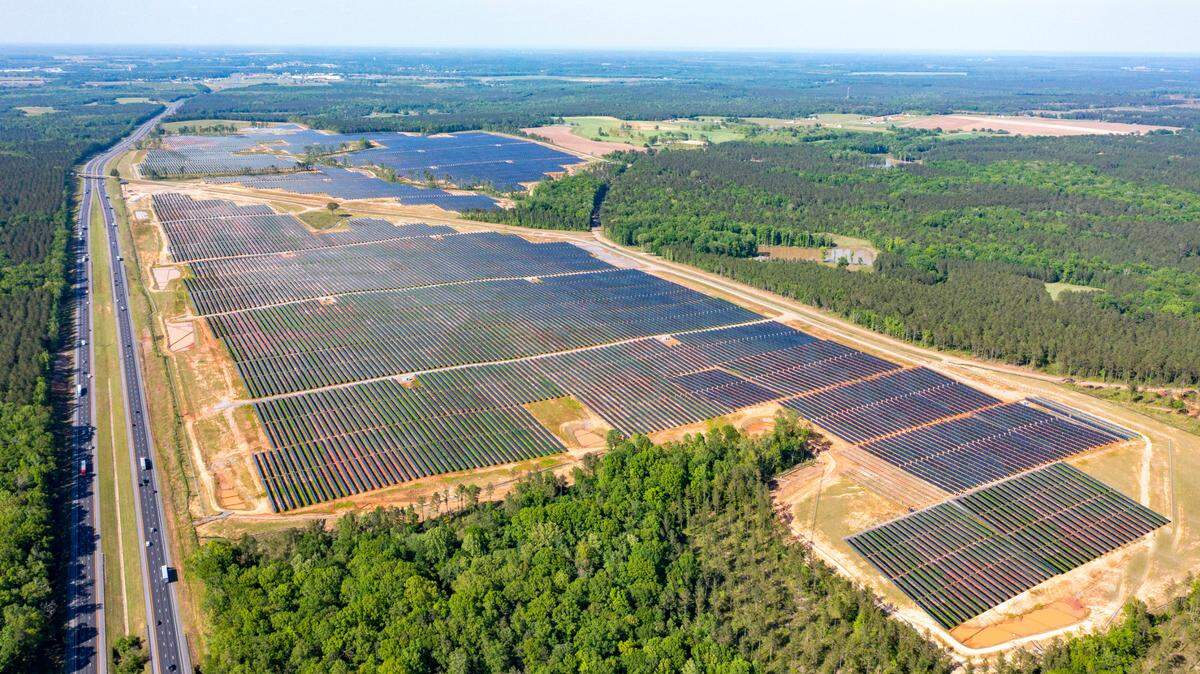
Georgia lawmakers have put forward a handful of bills this year seeking to change laws around solar energy in the Peach State.
Four bills focused on land use, solar facility closures, recycling and more are snaking through the state’s legislative system, some with better chances to pass than others.
Here’s what to know about each bill.
HB 169: Prioritizing preservation, or solar?
House Bill 169 looks to remove a solar exemption from the Conservation Use Valuation Assessment, which offers reduced property taxes to people if they agree to use their land for agriculture or forestry purposes for a 10-year period.
Having solar panels on a property disqualifies someone from getting a tax break under the assessment, but law currently lets Georgia landowners put solar panels on a portion of the property, without fully violating the statute, and still get a tax break.
If HB 169 was passed, residents no longer would have that option.
“(CUVA) is really meant to preserve agricultural land and timber land,” said state Rep. Chas Cannon (R-172), who is the primary sponsor of the bill. “We’re just removing that exemption and taking it back to where the law was originally written.”
“It’s not really an anti solar deal,” Cannon said. “It’s more of a shoring up the CUVA statute, because the key issue is the preservation of the land.”
The bill was recently approved by full House Ways and Means Committee, and Cannon said the outlook of the bill passing is optimistic.
But conservationists are worried about the timing of this bill, if enacted. It could be costly for farmers just trying to scrape by after natural disasters.
“This is a very bad time for HB 169,” said Mark Woodall, the conservation chairman for the Georgia chapter of the Sierra Club. “Hurricane Helene wiped out farms and tree farms from Valdosta to Augusta. Some of those landowners might need solar leases to stay in business.”
Only agriculture and timber land located near high-voltage transmission lines are eligible for solar leases, which is a small percentage of land, and those leases can pay farmers $1,000 or more per acre for 20 or 30 years, according to Mark Woodall, the Georgia Chapter of the Sierra Club’s Conservation Chair.
Utility-scale solar energy also is “very cheap,” reduces costs for bill payers and provides millions of dollars in property taxes to rural counties with no burden on schools or county services, according to Woodall.
“HB 169 hurts all Georgians, not just the ones that own land near high voltage lines,” Woodall said.
HB 249: What happens when a solar facility closes?
House Bill 249 was designed to “tack-on” more regulations related to House Bill 300, passed last year. The new bill is meant to require solar developers to have enough financial resources to decommission a solar facility once it needs to be closed, according to state Rep. Robert Dickey (R-145), the primary sponsor of this bill.
HB 300 already set a framework for decommissioning solar facilities. HB 249 just tightens up HB 300, adding more specific requirements, introducing oversight from the Environmental Protection Division and refining certain definitions and provisions.
“I thought we needed a little more teeth in the bill to ensure that those companies did what that bill said it would do,” said Dickey, who is the chair of the state House Agriculture & Consumer Affairs Committee. “So that is what 249 is about, to make those companies show the state that they actually have ... the financial products in place to ensure (proper) decommissioning many years in the future.”
House Bill 249 recently passed the House Energy Special Committee on Solar Decommissioning, but the outlook for the bill becoming the law is less optimistic due to issues with state agencies willingness to take on the responsibility of examining and ensuring that developers abide by the rules laid out in the bill, according to Dickey.
“We’ve never had a solar facility become obsolete and need to be decommissioned yet, so we don’t know what that looks like or what it’s going to cost,” Dickey said. “Actually, that’s probably one of the biggest questions — what will it cost to get those panels off and the posts and wires out of the ground?”
If passed, this bill would directly address those concerns, assuring that the cost to decommission and restore the land to doesn’t fall on anyone other than the solar developers.
HB 320: Recycling solar panels in Georgia
If passed, House Bill 320 would require solar panels to be recycled instead of thrown in landfills. The bill places this responsibility on the solar facility owners and operators, with fines as a consequence for not following the rules.
The bill says if a solar power facility throws away solar panels instead of recycling them, they can be fined up to $1,000 per offense, and that the attorney general or a district attorney can sue to collect the fine.
State Rep. Trey Kelley (R-16) was the primary sponsor of the bill, but he couldn’t be reached for comment.
“It’s really another little instrument that we’re looking at to try to make sure we don’t have issues in the future for these large scale solar things,” said Dickey, who also signed onto this bill. He said passage looked optimistic, “because that one doesn’t involve any oversight by an agency.”
Environmental groups are in favor of this bill, too.
“As Rep. Kelly has a large new solar panel recycling facility that has put many hands to work in his district, this bill is good for both the environment and for Georgia businesses,” Woodall said.
HB 507: Renting solar panels
If passed, House Bill 507 would allow community solar projects owned and operated by Georgia businesses to offer clean, low-cost energy to Georgia Power customers through a subscription process. It’d be comparable to renting a solar panel in a shared array.
Community solar involves a small-scale series of solar panels, generating up to 5 megawatts on 25 acres of land or less, which gives nearby residents and businesses the option to save money on their energy bill.
Subscribers still would receive their regular Georgia Power bill, but it would include a credit for the power generated by their portion of the solar array, according to the Southern Environmental Law Center.
“Community Solar is a great option for people who are unable to put panels on their roof because they rent, can’t afford upfront costs for solar or don’t have a suitable roof or electrical system,” the SELC said. “Similar programs have saved customers 5-20% on their bills.”
The Sierra Club also strongly supports this bill, according to Woodall.
“All Georgians should be able to benefit from solar power,” Woodall said. “Georgia Power customers have seen six rate increases in the last two years. People need help with their utility bills. This bill is one way to deal with the energy burden so many Georgians face.”
This bill was just introduced on Feb. 18, so it is in the earliest stages of legislation. State Rep. Beth Camp (R-135) was the primary sponsor for this bill, but she couldn’t be reached for comment.
In addition to these four bills, a new House committee was formed this year “to look at electricity and water demand increases in our state, and ... try to get a handle on what kind of generation we need,” Dickey said. It’s called the Special Committee on Resource Management Committee, and it’s chaired by Rep. Brad Thomas.
“The growth of our industries and those type things in the state are going to put a real crunch on our water resources as well as our electric resources,” Dickey said. “And so that committee is busy working, and I believe we’ve elevated the concern about it to a higher level.”
This story was originally published February 26, 2025 at 2:20 PM.