
US begins blockade of Strait of Hormuz
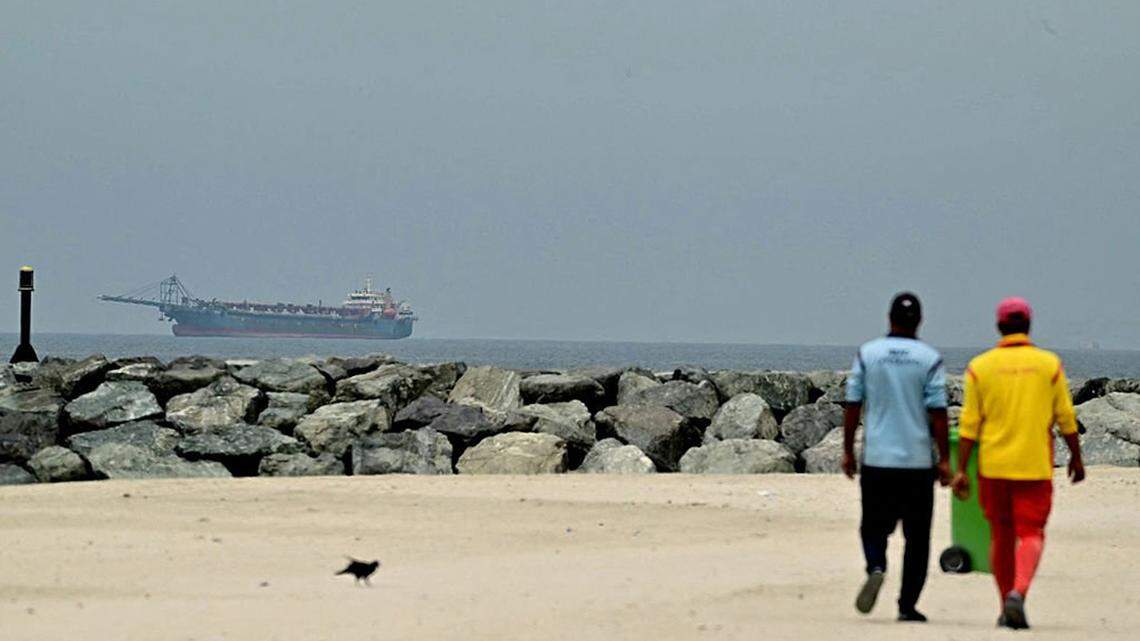
President Donald Trump’s effort to strangle Iran’s economy took effect on Monday as the U.S. military confirmed it had begun enforcing a blockade of all maritime traffic to and from Iranian ports in the Persian Gulf.
European countries rejected involvement in the blockade, announced by Trump on Sunday in what was seen as a way to pressure Iran into concessions after weekend peace talks with Tehran ended without a breakthrough.
The United States had been allowing Iranian tankers to transit the Strait of Hormuz as a way to temper the sharp increases in oil prices since the war started. Its decision to block Iranian trade from the strait, the gateway for Gulf energy exports, sent the price of Brent crude, the global benchmark for oil, back around $100 a barrel on Monday, reversing the sharp drops after a ceasefire in the war was agreed to last week.
Trump said Monday that Iran had reached out to the United States about another round of negotiations, but he declined to say whether the administration had responded.
“We’ve been called by the other side,” he told reporters outside the Oval Office. “They’d like to make a deal very badly.”
The standoff between Iran and the United States in the Gulf has spread renewed concern that the oil shock rippling through the global economy could be further prolonged. Many Asian countries, the largest consumers of Gulf oil and gas, have begun rationing fuel and are warning of the depletion of their reserves within months if the crisis continues.
The U.S. military did not offer precise details on how it would enforce its blockade, but Trump said on social media shortly after it started that any Iranian ships that approached the blockade would be “immediately ELIMINATED.”
Trump noted that while the Iranian navy had been “completely obliterated,” Tehran still had “fast attack ships.”
He said those boats would be dealt with “using the same system of kill” that the United States used against vessels off the shores of Central and South America, which the Trump administration claimed were carrying illicit drugs.
Hours before the blockade took effect on Monday, two Iranian-linked ships exited the Persian Gulf via the Strait of Hormuz, according to Kpler, a global ship-tracking firm.
Overall, the war in Iran severely curtailed shipments through the strait, from an average of 120 vessels before the hostilities to only around a dozen daily passages in recent days.
But that data comes with a significant caveat: Shipping to and from Iranian ports in the Gulf has remained relatively steady through the war.
Iran was able to sell its oil after the Treasury Department last month gave both Russia and Iran one-month reprieves on sanctions that had restricted their oil sales.
The U.S. move allowed buyers around the world to legally purchase oil that the United States had previously blacklisted. The sanctions waiver on Russia expired Saturday morning, while the temporary license allowing Iran to sell oil expires April 19.
In explaining the blockade, the U.S. military said Sunday that it would block ships “entering or departing Iranian ports and coastal areas,” while allowing other vessels to transit the Strait of Hormuz on their way to or from non-Iranian ports.
But shipowners and shipping experts said Monday they did not expect a large number of vessels to return quickly to the Strait of Hormuz, in part because the U.S. plan lacked details on how commercial vessels would be protected if they decided to transit the waterway.
“It is still unclear how the safety of the passage of commercial ships will be ensured,” said Jerry Kalogiratos, CEO of Capital Clean Energy Carriers, a shipping company that operates oil and gas tankers.
The uncertainty of protection, and the fear that Iran may attack commercial vessels in response to the United States’ move, meant that the number of ships going through the strait would be likely to remain low, analysts said.
Iran warned of repercussions to the U.S. blockade, with a spokesperson for the Iranian armed forces saying Monday that security in the Persian Gulf “is either for everyone or for no one.”
“If the security of the ports of the Islamic Republic of Iran in the waters of the Persian Gulf and the Sea of Oman is threatened, no port in the Persian Gulf and the Sea of Oman will be safe,” the spokesperson said.
Trump said Sunday that “numerous countries” would be helping with the blockade, but it was unclear to which ones he was referring. Only Prime Minister Benjamin Netanyahu of Israel has publicly supported the idea.
European leaders, already frustrated by the American and Israeli military campaign in Iran, distanced themselves from the blockade. Prime Minister Keir Starmer of Britain said in a radio interview that the United Kingdom would not participate, and Spain’s defense minister said the maneuver “makes no sense.”
President Emmanuel Macron of France said Monday that France and Britain would organize a conference in the coming days to assemble a multinational mission to secure passage for ships in the Strait of Hormuz. The two countries have already held planning meetings for a coalition of up to 35 countries. “This strictly defensive mission, distinct from the belligerents, will be deployed as soon as the situation permits,” Macron said on social media.
A peace deal between Iran and the United States appears to turn to a significant degree on the question of Iran’s nuclear program, which Trump on Sunday called the “single most important issue.”
During the peace negotiations in Islamabad over the weekend, the United States asked Iran for a 20-year suspension of uranium enrichment. The Iranians, in a formal response sent Monday, said they would agree to up to five years, according to two senior Iranian officials and one U.S. official.
Trump has rejected that offer, the U.S. official said. The official said the U.S. has also asked Iran to remove highly enriched uranium from the country and that the Iranians have insisted the fuel stays inside Iran. But they have offered to dilute it significantly, so that it could not be used to produce a nuclear weapon. The Iranians would still have possession of the fuel and in the future might be able to re-enrich to bomb grade.
In other developments:
Congressional hearings: Republicans in Congress have scrapped an opportunity to publicly question senior Pentagon officials next week on the war in Iran, postponing a scheduled hearing until late May as they continue to resist exercising oversight of the far-reaching military operation. The House Armed Services Committee had scheduled testimony by Adm. Brad Cooper, the head of U.S. Central Command, and Gen. Dagvin R.M. Anderson, leader of the military’s Africa Command, on April 21. But the majority Republicans put off the session until May 19, citing Cooper’s availability and his being “busy with the war.” And it was not certain whether a Senate panel scheduled to hear from the same officials on April 23 would go forward with that hearing either.
Lebanon: The Israeli military said that its forces had encircled and raided the Lebanese town of Bint Jbeil, one of the largest communities near the border between the two countries. Israel’s attacks there have become a sticking point in the ceasefire negotiations, as Iran has demanded that the truce extend to Lebanon. The Israeli and Lebanese ambassadors to the United States are scheduled to meet in Washington on Tuesday for rare direct talks.
Death tolls: The Human Rights Activists News Agency said at least 1,701 civilians, including 254 children, had been killed in Iran as of Wednesday. Lebanon’s Health Ministry on Monday said 2,089 people had been killed in the latest fighting between Israel and Hezbollah, including 357 in a wave of Israeli strikes last Wednesday. In attacks attributed to Iran, at least 32 people have been killed in Gulf nations. At least 22 people had been killed in Israel as of Sunday, as well as 12 Israeli soldiers fighting in Lebanon. The American death toll stands at 13 service members.
This article originally appeared in The New York Times.
Copyright 2026 The New York Times Company
This story was originally published April 13, 2026 at 2:23 PM.