Mars is brightest and closest to Earth in 15 years, NASA says. Here’s what to look for
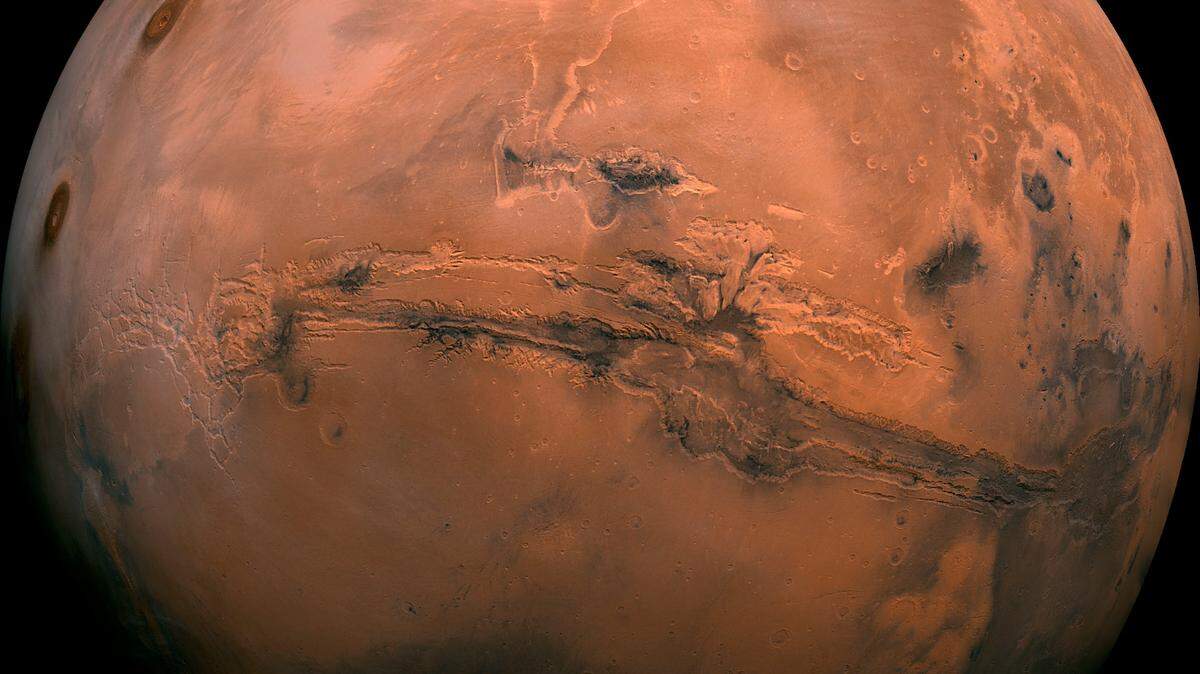
Tonight may be a good time to step outside and look at the sky — Mars will be shining brighter than it has in a while as the Red Planet makes its closest approach to Earth in 15 years, NASA says.
Although close might be an overstatement. Mars will still be about 38.6 million miles from Earth as it orbits around the sun. The closest it’s ever been was just four miles less in 2003, breaking a 60,000-year record, according to the space agency. It won’t be that close again until the year 2287.
This “close approach” means Mars can be seen more easily Tuesday night with a telescope, or even the naked eye.
Mars will be visible for most of the night as a bright dot in the eastern part of the sky, reaching its highest point at about midnight.
NASA says the phenomenon lines up with what they call “opposition,” which happens every two years. This is when Mars and the sun are on directly opposite sides of Earth. The two planets are able to get so close to each other because of their egg-shaped orbits .
Gravitational pulls from surrounding planets like Jupiter also change the shape of their orbits.
When Mars and Earth are closest together, it’s also the best time for spacecraft to visit the Red Planet for scientific missions to collect rock and soil samples, NASA says: “That’s why, depending on budgets, you’ll often see that Mars missions launch about every two years.”
The next time a close approach will happen is December 2022, according to the agency.
But a “very” close approach similar to the one occurring Tuesday isn’t expected for at least another 15 years because Earth’s orbit is getting further out of alignment with that of Mars, ScienceAlert reported. The planets won’t match up again until about 2035.
Don’t worry if you can’t take time to gaze at Mars on Tuesday night, however. Because of where the Red Planet lies on its orbit, the entire month of October will showcase Mars at its brightest, according to EarthSky. It’s usually the fourth brightest object in the sky after the sun, moon and Venus, in that order.
“It is now shining more brilliantly than the planet Jupiter, and it’s not very often that Mars outshines the king planet!” EarthSky reported.
You also might be able to see Olympus Mons, a volcano sitting on Mars’ surface that is the tallest one recorded in the solar system, according to Forbes. This sight, however, will require a telescope.
The volcano is about the size of Arizona with a volume 100 times larger than that of Mauna Loa’s, Earth’s largest volcano, NASA says. “In fact, the entire chain of Hawaiian islands (from Kauai to Hawaii) would fit inside Olympus Mons!”
There are two clues to look out for while searching for the Martian volcano: white clouds of carbon dioxide wrapped around the summit and/or a shadow cast by the mountain, Forbes reported.
Although Mars will be bright just about every night this month, its light will become fainter as it travels further away from Earth. So keep your eyes to the sky Tuesday night and throughout October — because if you miss the celestial show, you’ll have to wait a while for your next chance.
This story was originally published October 6, 2020 at 3:06 PM with the headline "Mars is brightest and closest to Earth in 15 years, NASA says. Here’s what to look for."