
Remembering the day they brought ‘Sugar Boy’ home
Some came back to a hero’s welcome. They marched in hometown parades, waving as the crowds saluted them.
They returned to the arms of their families. They joined grateful hearts around supper tables, piling their plates high with corn bread, collard greens and answered prayers.
They endured the tragedies of war, forever blessed to kiss their girl, hug their mama and watch their nieces and nephews run barefoot in the yard.
Others came home in pine boxes, their final resting places in the cemeteries of churches where they were baptized as young boys and took brides as young men.
Thomas Jefferson “Sugar Boy’’ Barksdale was among those who made his final journey in a flag-draped casket. He fought in the Korean War, sometimes known as the “Forgotten War,’’ but he should never be forgotten.
Barksdale took his last breath in a foxhole in North Korea on a December day in 1950, as the cold winds swept across the snow-covered hills along the Chongchon River.
His funeral was on a sweltering summer day in Georgia — 62 years later.
It was almost 50 years before his skeletal remains were found, and another nine years before Army forensic officials located a niece living in Macon to make a positive identification through DNA testing.
It took another three years to bring him home, and that’s when his story became part of my story.
He grew up on Boone Street in Macon’s Fort Hill, the next-the-youngest of Ben and Vilena Barksdale’s 11 children. No one could recall how he got the nickname “Sugar Boy,’’ except that he carried it with him to the other side of the world as a 21-year-old soldier.
Barksdale was on the front lines with the 503rd Field Artillery Battalion of the Army’s 2nd Infantry Division. He was killed after engaging in heavy fighting with the Chinese.
When he first was listed as missing in action, his family clung to prayerful hope. Many were no longer still alive in August 2000, when military excavation teams from the U.S. and North Korea uncovered the human skeleton of a 5-foot-10 African-American male along a hilltop about 50 miles north of the capital of Pyongyang.
In my 20 years of writing columns for The Telegraph, few stories have impacted with me like the day “Sugar Boy” came home.
On the last day of July in 2012, I rode with some of his relatives to a cargo gate at Hartsfield-Jackson Atlanta International Airport. After an eight-hour flight from Honolulu, his coffin arrived shortly after dawn. I got choked up as I watched more than two dozen Delta employees standing nearby, many holding their hands over their hearts.
Under a slate-gray sky, we followed the hearse as part of a half-mile long motorcade on an interstate that hadn’t been built when Barksdale went off to war.
Heading south on I-75, we were escorted by 87 Georgia Patriot Guard Riders on motorcycles. We were met by the Georgia State Patrol and deputies from the Bibb County Sheriff’s Department on our way to Jones Brothers Mortuary on Millerfield Road.
It was a Tuesday and there was a local primary run-off election that day. I also had one of my first experiences with Twitter, and it had nothing to do with politics. I tweeted updates as we rolled past the green exit signs, never dreaming so many folks would be following us remotely across the miles.
As the hearse climbed the hill on Gray Highway, cars and trucks pulled over out of respect. Although it was the middle of summer, I got chill bumps as the motorcade traveled east on Shurling Drive, where a man driving in the far lane stopped, got out of his van and saluted.
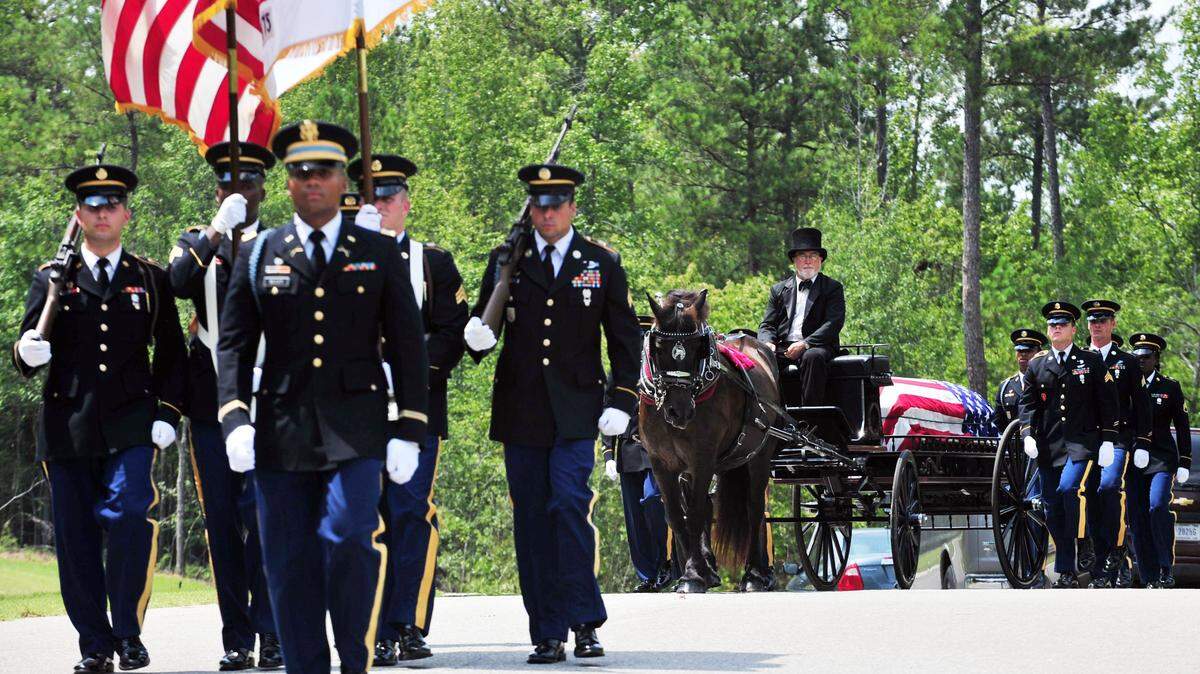
At the funeral home, 62 American flags lined the driveway – one for every year it had been since Barksdale’s death. Seven members of the Georgia Army National Guard carried the casket inside, where it remained in state for four days until the funeral. Barksdale was buried, with full military honors, at the Georgia Veterans Cemetery in Milledgeville.
Among those waiting at the funeral home that morning was my wife, Delinda, and our youngest son, Jake, who had graduated from high school two months earlier. Along with others, they wanted to be there.
Of course, no one in my immediate family had known Barksdale. He died before any of us were born. Still, we felt an emotional connection to this man — and to this moment — we would never forget.
Monday is Memorial Day, a time when we remember those in the military who made the ultimate sacrifice for our freedoms.
They came from different schools and neighborhoods. They lived across the generations. They fought in different wars on different battlefields.
But all for the same cause.
We are here because they were there.
Ed Grisamore teaches journalism at Stratford Academy in Macon and is the author of nine books. His column appears on Sundays in The Telegraph.
This story was originally published May 25, 2018 at 2:05 PM with the headline "Remembering the day they brought ‘Sugar Boy’ home."