
J-STARS pilots are in for the long run
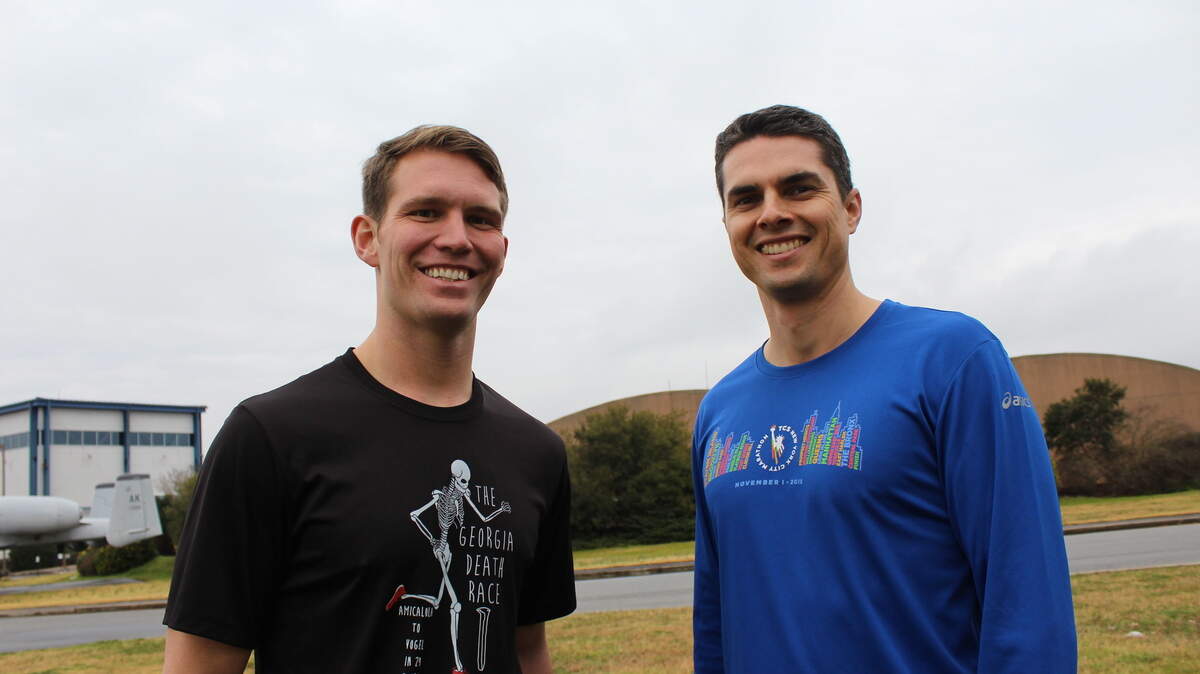
WARNER ROBINS -- Two of the top long-distance runners in Middle Georgia are both J-STARS pilots.
Last year Capt. Richard Elmore won the Museum of Aviation Half Marathon, which featured 398 runners from across the nation. This year he was a close second in the same race held Jan. 16, finishing 71 seconds behind the leader. He also was the top runner from Middle Georgia.
Capt. Matthew Krauss finished fifth in the museum's marathon a year ago and was the top local finisher, with a time of two hours, 59 minutes, 38 seconds. Had he run the same time this year, he would have easily taken second place, the top local finish and been only five minutes off the lead. But he skipped the race this year to run a 50 kilometer race, which is 31 miles.
Both are planning to run the Boston Marathon in April.
While it might not seem that flying an airplane is something that requires a high fitness level, both said long-distance running helps them do their job. The J-STARS, or Joint Surveillance Target Attack Radar System, flies long missions providing an overhead view of combat areas to ground commanders.
A mission can last for 12 hours or more.
"The healthier you are, the more mentally sharp you are," Krauss said. "The lessons you get from endurance in a marathon can translate to long missions you fly."
Elmore has been a long-distance runner since high school, and he also ran while at the Air Force Academy. For him, running is a getaway from life's stresses.
"I like the fact of getting outside and unplugging from the world," he said.
But Krauss had been only a casual runner until he arrived at Robins in 2009. His grandfather had run a marathon, and it was something Krauss has always thought about. When he heard about the museum marathon, he started training for it. Despite just four months of training, he finished in 3 hours and 36 minutes, an excellent time for a first marathon.
"I did better than I thought I would, and then I thought, 'I wonder if I could do it faster,'" he said.
And then he started wondering how far he could go, and that turned out to be pretty far.
Running a marathon, which is 26.2 miles, is ridiculous enough to most people. But Krauss took it well beyond that. He has run two 100-mile races.
And yes, that's 100 miles at one time, not in stages over a few days. He ran his first one in 22 and a half hours and his second in 19 and half hours.
For the second one, that would a pace of 5.1 miles per hour.
Elmore isn't sure yet if he wants to try a 100-miler, but he has started getting into marathons, having run two since 2014. He didn't run the museum's marathon this year because it didn't fit into his training plan for the Boston Marathon.
Going from a half marathon to a marathon is a bigger step than it might seem. It's twice the distance, he said, but it's more than twice the mental toughness required.
"I think with a marathon, mile 20 is the halfway point," he said. "You have to be mentally strong to get through to the finish."
Leading up to the Boston Marathon, Krauss is running another 100-mile race as well as the Georgia Death Race. That's a 68-mile run at Vogel State Park in Blairsville with 40,000 feet of elevation change.
Although Krauss runs more and longer races, Elmore actually runs more often in training. He averages about 40 miles a week while Krauss does about 25, but that can vary depending on their work schedules. Krauss also concedes that Elmore is faster.
Elmore is shooting for a time of 2:40 in the Boston Marathon, which would put him in about the top 1 percent of its runners.
The race draws some of the top marathoners in the world, however, so he said he's not even thinking about a win. Last year's winning time was 2 hours 9 minutes and 17 seconds.
Krauss' upcoming runs in the 100-miler and Georgia Death Race probably won't help his time in the Boston Marathon, but he enjoys the challenge of the ultra-long runs.
He compared it to climbing Mount Everest, a feat few people can claim. But that mountain climb costs about $45,000, and running only costs him in shoes.
Asked what it's like to run 100 miles, he said, "At first, crossing the line is euphoria, and then the pain starts to set in, and it catches up to you, and then you walk funny for about a week and half."
To contact writer Wayne Crenshaw, call 256-9725.
This story was originally published February 9, 2016 at 8:04 PM with the headline "J-STARS pilots are in for the long run ."