
Georgia child care industry adds $4.7 billion in economic activity
Caring for little kids is big business in Georgia.
A recent economic impact study totaled a $4.7 billion impact from the child care and early learning centers.
“That’s an awful lot of money going into an industry in the state of Georgia every year,” said Sally Wallace, an associate dean of research and strategic initiatives at Georgia State University, which developed the study along with the University of Georgia’s Carl Vinson Institute of Government.
Centers provide more than 67,000 jobs and support another 17,000 jobs.
The industry also pumps in $374 million in federal taxes and $161.7 million in state and local taxes.
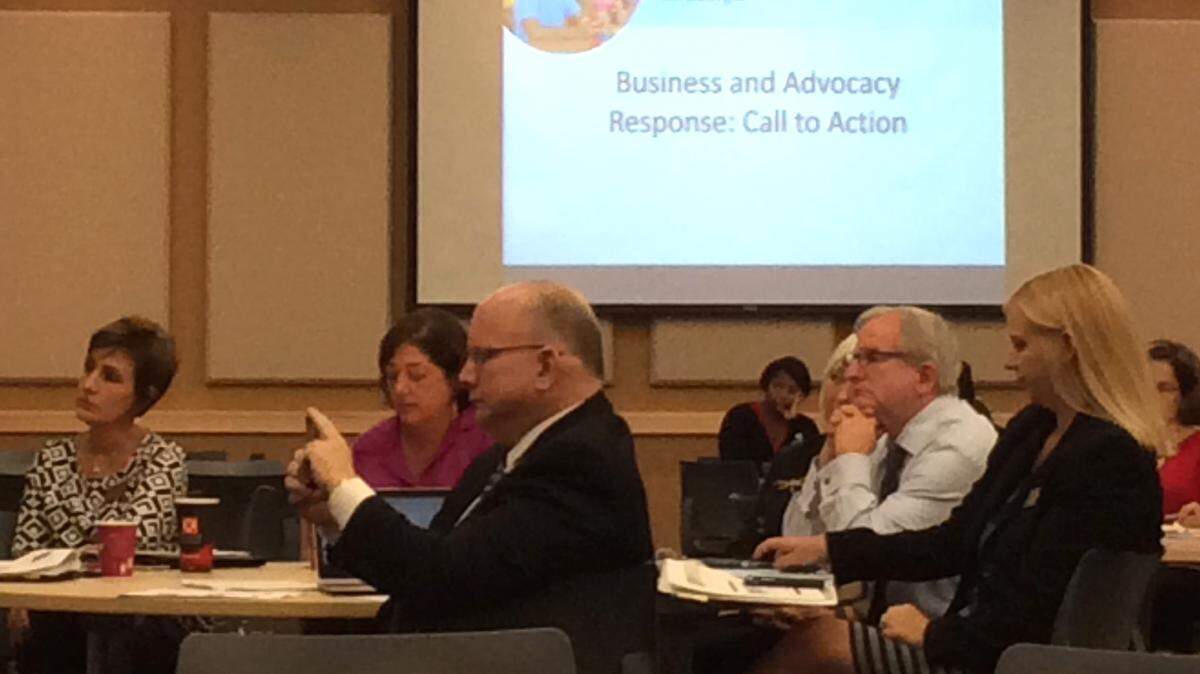
“We expect this is growing as the economy gets stronger,” Wallace told dozens of people gathered Wednesday morning at Middle Georgia State University to learn more about the universities’ report for the Georgia Department of Early Care and Learning.
The results inspired Lisa Garrett, a Springdale Elementary School teacher who is the the former coordinator of pre-kindergarten programs for the Bibb County School System.
“Early care is my passion,” said Garrett. “We’ve got to understand that we’ve got to reach kids early and pre-k is too late.”
Studies show high-quality child care and early learning centers can have a dramatic impact on preparing students for school, which helps them stay on track to graduate from high school and go onto higher education before finding and retaining jobs.
Post-secondary education will be even more crucial in Georgia’s workforce of 2020, studies show.
“Think about the connection about how a strong early education system impacts the state and local economy,” said Dana Rickman, a policy and research director for the Georgia Partnership for Excellence in Education.
The state should focus on getting all children ready for kindergarten, Rickman said.
“It’s nothing like we had in kindergarten,” she said. “They hit the ground running.”
Georgia sees challenges in high poverty communities and those with a growing percentage of students with language barriers to learning.
“The issues and problems we’re seeing in Georgia are not unique to Georgia,” Rickman said. “This is a problem everyone is facing.”
What can’t be easily measured is the impact that better early education will have on the “cradle to career path.”
Mindy Binderman, of the Georgia Early Education Alliance for Ready Students, said when students are reading at grade level, they are less likely to wind up in the juvenile justice system and more likely to graduate from high school.
Dollars spent enhancing curriculum at child care centers are a long-term investment that also will pay off in higher salaries for successful students, Binderman said.
“We’re preparing to go to Atlanta under the gold dome and talk to legislators every single day during the session,” she said.
In addition to hearing the results of the study, those gathered Wednesday in Macon, and in other similar meetings across the state, are learning how communities can bolster early education providers to enrich learning opportunities for all.
Rickman explained how the owner of a Hardee’s restaurant funded scholarships for Advanced Placement exams for financially struggling students.
He invited the students to work a night in the eatery and donated proceeds to the fund.
DECAL’s chief communication officer, Reg Griffin, said the community meetings are designed to get more people involved in improving early education in Georgia.
“This is not just a cause that can be carried out by the education community. It really has to be supported by the business community because of the impact on the local economy,” Griffin said.
Bob Easter of the One Macon! Business Education Partnership stressed that everyone is obliged to “wrap our arms around these kids.”
“Our kids are our responsibility, not the teachers’ responsibility and not the schools’ responsibility,” Easter said.
He encouraged those at the meeting to support entrepreneurs to boost their quality rating and talk to lawmakers about the importance of early education funding.
Bibb County has been chosen for a few pilot programs designed to improve access to quality care.
Early Education Empowerment Zones encourage team building through colleges, local school systems and chambers of commerce, said Valerie Blackmon, the local E3Z coordinator.
Some qualified Bibb County children will be eligible for subsidies that will amount to only $5 weekly out-of-pocket expenses for the highest rated, or three-star centers. Costs would be reduced to $10 weekly for two-star centers and $15 weekly for one-star centers.
Grant money also is available for child care providers to purchase new materials and fund training.
More information on the E3Z incentives, visit the Bright from the Start: Georgia Department of Early Care and Learning at www.decal.ga.gov.
To contact writer Liz Fabian, call 744-4303 and follow her on Twitter@liz_lines.
This story was originally published October 14, 2015 at 12:50 PM.