
Macon parents seek ‘understanding,’ help from district as student absences persist
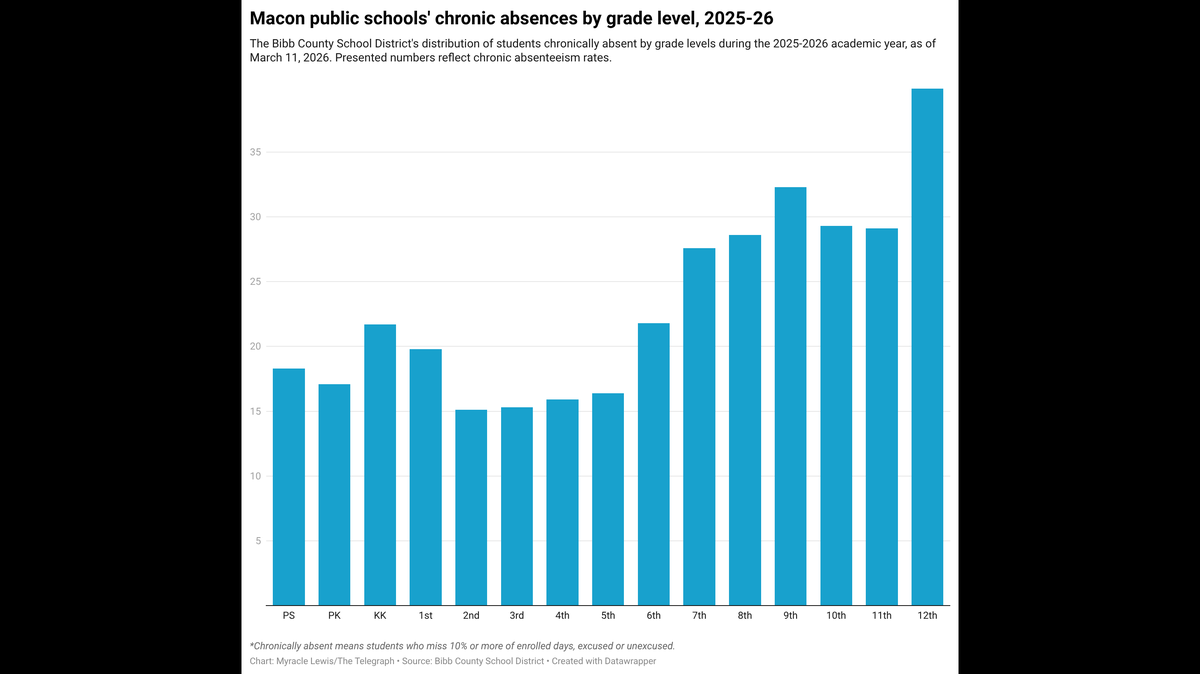
High school students have the highest levels of chronic absenteeism in the Bibb County School District, with seniors missing school more often than any other grade level, according to recent data from the district.
As of March 11 , 40% of seniors were chronically absent during the 2025-26 school year — meaning they have missed more than 10% of the 180-day school year, excused or unexcused.
Chronic absenteeism affected 29.1% of juniors, 29.3% of sophomores and 32.3% of freshmen, data shows.
Districtwide, the data suggests attendance problems grow as students get older, but a district leader said this was not always the case.
Jamie Cassady, BCSD assistant superintendent of student affairs, said the district has long struggled with high absenteeism in kindergarten through third grade students. What is new, however, is a surge in missed days among high school students.
“Pre-Covid, it was typically our ninth graders who had the highest absences, and then the sophomores would be next,” Cassady said. “Typically, by the time they become a junior, they’ve got it all figured out.”
But recent data showed a marked shift, with juniors and seniors emerging as chronically absent. Freshman absenteeism also remains high, he added.
The district’s chronic absenteeism rate has slightly decreased compared to previous school years, dropping from 53.1% in 2021 to 28.5% in 2025, but still surpassing state averages.
On March 6, BCSD Superintendent Dan Sims said 24.7%, or 5,130, of all students had been chronically absent so far this school year.
Southwest High has the highest chronic absenteeism rate at 42.2%, followed by Northeast High at 41.8% and Westside High at 41.2%, as previously reported by The Telegraph.
“There has been a shift in perceptions of attendance,” Cassady said. “Since the pandemic, many families feel that in-person attendance is less crucial if schoolwork can be done online.”
Many barriers families face, including stress, work responsibilities, transportation problems and health issues, are drivers of empty classroom desks, Cassady said.
“I would say there’s just a lot there, but no one common theme where most of the kids fall into, and I guess that’s what makes the attendance issue complex,” Cassady said.
What barriers keep students away from school?
Some local families said staying home is, at times, their best — and perhaps only — option, and urged the district to be more understanding of real-world challenges.
Macon native Keneshia Rouse shared that her relative, a high school senior, began working full time after losing her mother.
.“She wanted to be able to pay her senior dues and do the normal things seniors do. Her mom’s gone, so she ain’t got no choice. When they say come to work, she’s missing school,” she said.
Rouse said the district should do more to check in with the families of students who are missing class.
“This is real life. These are people’s livelihoods. You want your attendance record to look good, but you have to bend a little,” she said. “You have to get out here and figure out why instead of just marking someone absent.”
Data on Bibb County’s chronically absent students points toward the problem beginning much earlier in the district.
Among elementary students, kindergarteners have the highest rate of chronic absenteeism in Macon’s public school system at 21%.
As Georgia tightens enforcement on absences, some families said policy rarely accounts for the realities of complicated medical needs and transportation gaps.
For more than a year, Rouse has shuttled back and forth between local hospitals and pediatric specialists in Atlanta “at least three times a week,” trying to keep her sick pre-K son stable while also getting him and his kindergarten sister to class.
“It affects all my kids. I can’t be in two places at one time. If he’s missing school, they miss school,” Rouse told The Telegraph over the phone during a commute back to Macon from an Atlanta hospital. She added they miss school about five days each month due to the trips.
She said she contacted the school about bus transportation but was told nothing could be done because they live outside the school zone. But a ride isn’t always guaranteed, she said.
Others like Rebekah Gibson, parent of a 6-year-old elementary student, said families are often made to feel like truants or bad caregivers for missing days they can’t avoid.
“For us, it’s mainly a battle between school and work,” said Gibson, who estimated that her daughter stays home at least three times a month due to car problems. “Employers don’t care that you got kids. Employers don’t care that you have to pick your child up at three (p.m.). They don’t care.
“I know this is our problem as parents, but it’s about having the compassion and understanding of the times we’re living in right now, especially as a single mother.”
Gibson suggested the district invest in more family-geared programs to help with time management and increase after-school support for students.
To help families with barriers, Rouse said the district should set up a pilot program of virtual options for chronically absent younger students .
What’s being done?
Education advocates suggest chronic absenteeism in lower-level students creates significant challenges in early literacy — another widespread problem in Macon public schools.
“Chronic absenteeism ... is linked to lower academic achievement, social disengagement, increased risk of dropping out, and higher poverty rates in adulthood,” according to research conducted by the Professional Association of Georgia Educators.
A strong correlation also exists between chronic absenteeism and failure to graduate high school, which creates limited opportunities for employment and higher education, according to the final report of the Georgia Senate Study Committee on Combatting Chronic Absenteeism in Schools.
To continue combatting this issue, the district hosted a series of family engagement events aimed at improving student attendance and supporting the district’s literacy initiative.
In addition to the district’s new truancy specialist, Cassady said the district also has breakthrough teams where adults in the school system make daily contact with students regardless of their attendance. He added that principals have autonomy to launch school-level attendance initiatives.
Southwest High School recently launched a “Perfect Attendance Challenge” in collaboration with a local barbershop. Free haircuts will be given to male students who demonstrate perfect attendance each week.
During a virtual panel on March 6 that discussed frequent absences, leaders also highlighted the district’s social work team that connects with families to address barriers.
“Help us help you,” school social worker Anna Omachonu said at the panel. “The resources and support is available, but we cannot help a problem that we’re unaware of.”
Efforts to reduce absences also continue at the state level with Senate Bill 513, the “Every Day Counts Act,” which aims to penalize students who skip class. The legislation proposes “consequences for chronically unexcused students, such as ineligibility for interscholastic and extracurricular activities and potential ineligbility to be issued an instruction permit or driver’s license.”
The measure passed the Senate and will go to the House for consideration, as of Thursday.