
Burnout, safety fears fuel early exits for teachers in GA schools. Can it be fixed?
Ruth Daugherty’s final year as a special education teacher is a blur of chaotic memories: stress-related fevers that flared like clockwork every Friday afternoon and a small classroom that grew difficult to manage.
“The toll on my body was quite a lot,” Daugherty, 34, said. “My mental health was just absolute s--t.”
Daugherty taught for seven years, ending her career in a Middle Georgia school district by submitting a letter of resignation in 2022.
Her devotion to students with disabilities drew her to teaching, but she said administrators’ failure to provide support for students with moderate to severe needs forced her to step away.
“I had kids running out of the building, climbing bookshelves that weren’t bolted into the wall or banging their heads against the hard floor and concrete walls,” said Daugherty, who asked that the district not be named. “I felt like I couldn’t keep anybody safe anymore, and I was really worried.
“Will the administration protect me if one of these children get hurt? I felt like I was responsible for the physical safety of those children, and I couldn’t keep them.”
Daugherty left without her district’s approval, and the Georgia Professional Standards Commission suspended her teaching certificate for 90 days in return.
For many teachers like Daugherty, leaving the classroom was a last resort. But in Georgia, stepping away mid-contract brings its own penalties. Former educators say changes are necessary.
The wider problem
In 2025, The Telegraph filed an open records request with the Georgia Professional Standards Commission to find out how many teachers face discipline for violating its Standard 9 of Georgia Code of Ethics for Education.
Contract abandonment violations fall under Standard 9, which addresses professional conduct. The standard defines a wide array of inappropriate behavior, including resignations that constitute a breach of contract.
The commission previously stated it consistently sees a high number of breached contract cases among certified educators. Previous reporting from The Telegraph also found an increase ethics investigations against Georgia teachers.
From 2019 to 2024, nearly 70% of more than 300 cases examined by The Telegraph involved a teacher leaving a public school without permission — with reasons ranging from overcrowded classrooms and violence, to frequent panic attacks, and obligated family matters.
A recent survey by the Professional Association of Georgia Educators found that 32% of teachers said staff attrition is a major problem at their schools, and 27% cited teacher hiring shortages. The association offers legal support for teachers facing state investigations, including contract abandonment claims.
“At PAGE, we work hard to try to help educators who are in more acute situations to counsel them based on their individual circumstances,” said Margaret Ciccarelli, the association’s director of legislative services.
While emphasizing that every educator’s reasons for leaving a classroom are unique, Ciccarelli said the association’s annual surveys show why the profession is losing its star players.
“We are finding in our surveys that burnout caused by excessive workload is high,” she said, noting that teaching does not stop at the bell. “Student misbehavior — violence against other students or educators — also continues to be a major challenge, in which a lot of that is driven by student mental health needs.”
Rising chronic absenteeism in the state also contributes to the emotional exhaustion of trying to help students catch up academically, she said.
Although Georgia’s current statewide teacher retention rate is 90%, retention is lower in smaller districts such as Macon (67.1%) and Twiggs (66.7%) counties, which lose roughly one-third of their teachers annually, according to state data.
Worsening the crisis, about 6,000 teaching positions statewide remain vacant or are filled by instructors without proper certification — further challenging efforts to keep qualified teachers in classrooms, according to an April 2025 state report.
‘Educators are expected to honor their contracts’
The Georgia Professional Standards Commission is responsible for adopting standards of performance and a code of ethics for educators. Educators who leave a district without permission can be reported to the commission, which may investigate and take disciplinary action on their teaching licenses.
Most contract violations result in a 90-day suspension of a teaching certificate — the customary sanction for this type of breach.
Anne Fenton, the commission’s interim ethics investigator, said the state agency is unable to prove or disprove any connection between contract breaches and teacher retention.
The 18-member commission, however, does recognize that student learning can be disrupted when teachers leave midyear, Fenton said in an email.
“Educators are expected to honor their contracts and school systems are expected to work with each other to resolve issues and concerns that arise from employees wishing to leave their current contractual obligation and enter into another,” she said.
Despite evidence of teacher departures in Georgia, the commission maintains strict penalties for contract abandonment.
PAGE’s Ciccarelli said teachers facing contract breach cases tend to have better outcomes when their personal circumstances are clearly explained to the commission, compared with more common issues such as burnout.
“Every situation is fact-specific, but because these are impacting so many educators, the PSC may not be as sympathetic to these circumstances as they would be to more kind of unexpected situations that might occur during an educator’s personal life, such as a spouse getting sick,” she said.
That aligns with state policy: after June 1, the commission generally will not sanction a certificate if an educator leaves due to a spouse’s job transfer that creates an unreasonable commuting distance; a documented illness of the educator or of an immediate family member that prevents the educator from performing their duties; or a promotion in the field of education.
The reported realities inside classrooms raise the question: Is it necessary for state leaders to reconsider sanctions when teachers leave for reasons beyond their control?
When asked whether the state plans to update its Standard 9 breach-of-contract guidelines to address educators’ experiences such as insufficient support, school violence or burnout, Fenton said the commission has no changes planned at this time.
She also emphasized that the state agency carefully considers each case when making its decision and ensures full due process for all cases, including the right to appeal, to each educator.
Suspensions don’t stop all teachers from leaving
Four years after quitting, Daugherty, who has since moved out of state, said she will never teach in a Georgia classroom again, emphasizing the grueling conditions of the job.
Daugherty’s experience highlights a tension at the center of Georgia’s teacher shortage. While the state penalizes educators for breaking contracts, many leave anyway.
In addition to safety concerns, Daugherty’s job often involved filing lots of mandatory paperwork that followed necessary physical restraint on a student.
“Every time you restrain a child, you have to document that restraint and have them checked by a nurse,” she said. “One day, I restrained the same child 13 times in two hours. So then I go back to the classroom, and I have 13 pieces of paperwork to fill out.”
Daugherty said attempts to maintain balance between classroom safety and study time became overwhelming.
“When was I supposed to teach these children?” she said. “Between changing diapers and keeping them clean and safe, when do we actually get to educate them?
Daugherty said she notified her principal before resigning and was later contacted by the state commission about submitting medical documentation to support a leave of absence. While she believes the Professional Standards Commission was doing its job, Daugherty said her mental exhaustion kept her from pursuing that option.
“I just did not have the energy to do that,” said Daugherty, who admitted that she did not know what the sanction really meant. “At that point, I had another job outside of the school district. So, I didn’t really care.”
Education advocates say Daugherty’s experience reflects a broader pattern in which burnout outweighs the threat of suspensions.
Ciccarelli said some teachers are unfazed by teaching certificate sanctions because they don’t plan to return to the classroom, but for those who do, disciplinary action can jeopardize their ability to teach in Georgia — or even in other states, due to license reciprocity.
‘Trapped’ by contracts, impacts of leaving
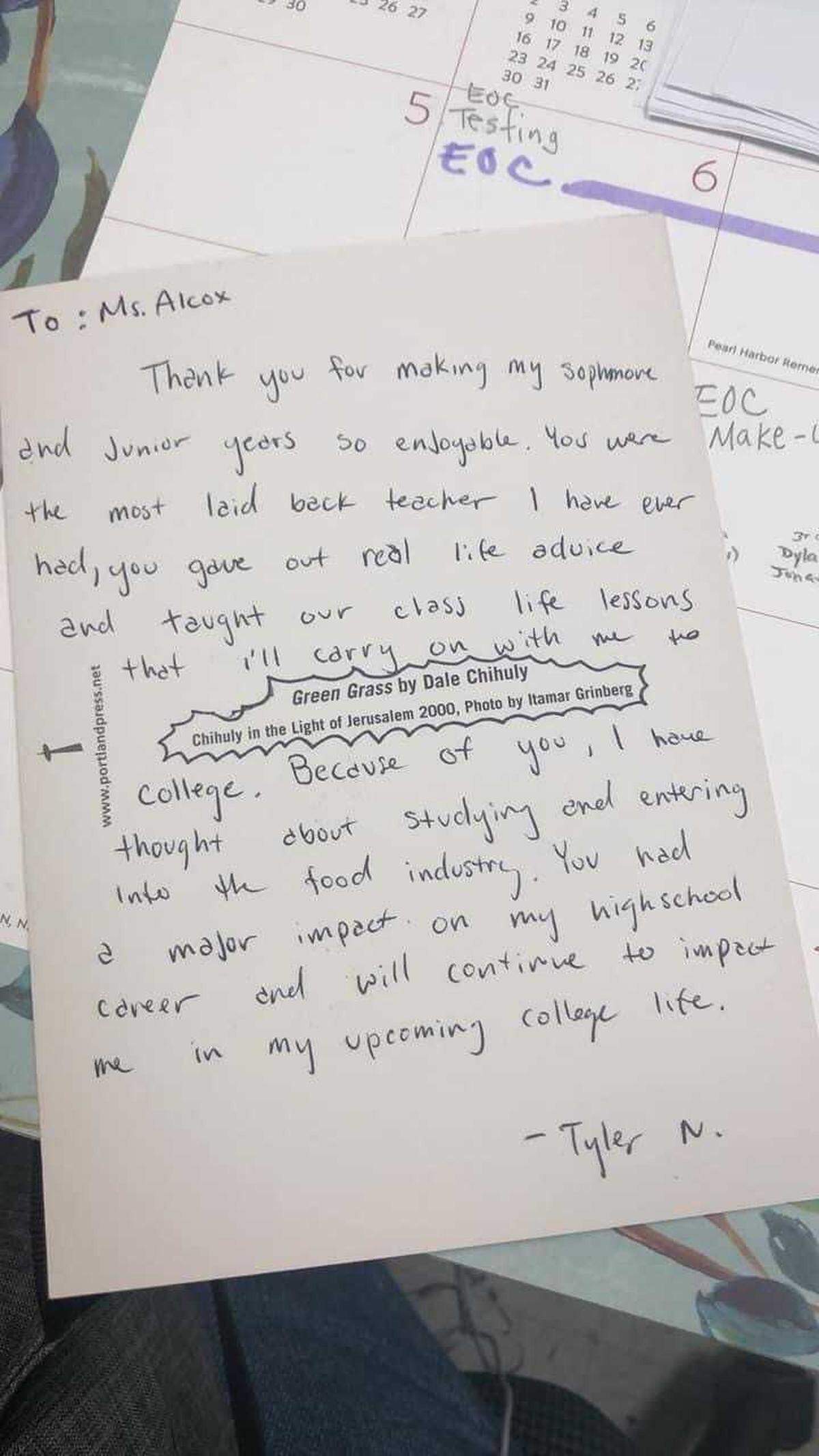
Erica Alcox, a former high school nutrition teacher in DeKalb County, calls for state and district leaders to make systemic changes that will fully address the root causes of teacher turnover, improve the quality of life for educators and avoid penalizing those forced to leave due to unfair conditions.
Alcox resigned from her position in August 2022 because she “did not feel safe at work” despite loving her students.
The mental anguish caused by daily bullying from administrators can be overlooked, she said.
That includes “things that a person could experience to where they feel like they have to watch their back,” Alcox added.
Alcox said her teaching experience also included working in obsolete classrooms plagued by unaddressed rodents and flies. Her breaking point came when a principal allegedly asked her to change the grade of a failing student-athlete despite creating assignment accommodations for the student to academically succeed, she said.
“Whenever my integrity is being jeopardized, or if I feel like I’m not there in students’ best interest, I’m going to leave,” she said.
Alcox said she submitted the required resignation paperwork to her district but did not receive notice of its rejection.
Citing contract abandonment, the state commission suspended Alcox’s teaching license after she failed to appear at an appeal hearing. Alcox said the notice was sent to an outdated address, preventing her from receiving the paperwork in time to advocate for herself.
The suspension lasted from February to September 2023, according to PSC records. Alcox said the sanction caused a domino effect of financial consequences for her as a single parent, including not being able to secure another teaching position.
“I have slept in my car ... I had to use my life savings to take care of myself (and) my son,” she said through tears. “The side gigs that I could get ... (were) hourly wages. I’ve lost my home. I did my best to just take care of basic needs, so you have to let go of things you can no longer afford because no one is hiring you.”
Alcox stressed that she is not opposed to contracts, but they become problematic when teachers feel unprotected after overextending themselves.
Alcox also said she was required to teach two classes simultaneously without additional pay, which she described as a major contributor to her exhaustion and a sign of disregard for teacher morale.
“It is a breach of contract when (schools) don’t provide safe work environments where you can do your job,” she said. “The contracts begin to, in my eyes, feel like a trap because how is it that I’m going above and beyond my contract, but you don’t hold up your end of the bargain?”
What GA is doing to fix ‘a drastic situation’
Former Georgia teachers say the fix is clear: stronger state and classroom standards are needed to keep educators from walking away.
Daugherty said her teaching experience mirrors that of many educators, with little planning time, skipped lunch breaks and low pay. She emphasized the need for greater respect for the profession.
“When I left (the profession), I had a master’s degree and seven years of experience, but I was making $46,000,” she said. “That’s rude. ... I should have made better money and had better support in the classroom.”
Alcox is also calling for true advocacy within the profession — one that recognizes teachers manage more than academics, but also help students navigate puberty, heartbreak, job loss, bullying and questions about gender identity.
“It doesn’t make sense that the business of educating students is treated like it’s not important and that there’s no real consideration for the people who come in to do that task that nobody else wants to do,” she added.
And even when teachers want to stay, the stress of the job can make it impossible.
“I love teaching…. Every other day I think, ‘God, I miss doing that,’” Alcox said, tearful as she reflected on the connections she formed with her students. “When you know you have something to offer, but you are protecting your peace and your mental health, it’s just so infuriating.”
State lawmakers and leaders continue efforts to address factors driving teacher attrition in Georgia.
“This is a drastic situation that we’ve got to address very, very quickly,” Sen. Billy Hickman (R–Statesboro), chairman of the Senate Committee on Education and Youth, said during a November meeting. “If we don’t have great teachers, we won’t have great students.”
Fenton said the state commission is highly committed to supporting the state’s educator workforce.
The 2024 legislative session produced Senate Resolution 237, which required state education departments, including the Professional Standards Commission and PAGE, to provide recommendations to strengthen the state’s education workforce. Toward this aim, the agencies developed a collaborative strategic plan for teacher recruitment and retention.
The plan includes an estimated $23 million funding request and recommends several changes, including expanding mental health services for school leaders to reduce burnout, raising substitute teacher pay, and protecting teacher planning time by increasing Georgia’s decades-old Quality Basic Education funding formula by $6.25 per teacher per day.
The strategic plan also outlines longer-term goals aimed at making Georgia the top state for the education profession in the next 20 years.
Ciccarelli said Georgia’s struggle to retain K-12 educators stems from too few people entering the profession and too few staying, problems that require comprehensive policy solutions and often revolve around low pay.
“Parts of the Georgia pay scale need attention to ensure the educators have salaries that are economically feasible for them and enable them to enter the profession and stay in it,” she said.
Telegraph reporter Lucinda Warnke contributed to this story.
This story was originally published January 13, 2026 at 6:00 AM.