
Macon program helps people in mental crisis stay out of jail. How it works.
AI-generated summary reviewed by our newsroom.
- River Edge clinicians and Bibb County deputies launched a co-responder program in April 2024.
- Co-responders diverted all crisis cases away from jail and into to treatment.
- Dispatchers, courts and deputies trigger clinician responses during mental health crises.
A program that was created to deter people in mental health crises from winding up in a cell is working in Macon.
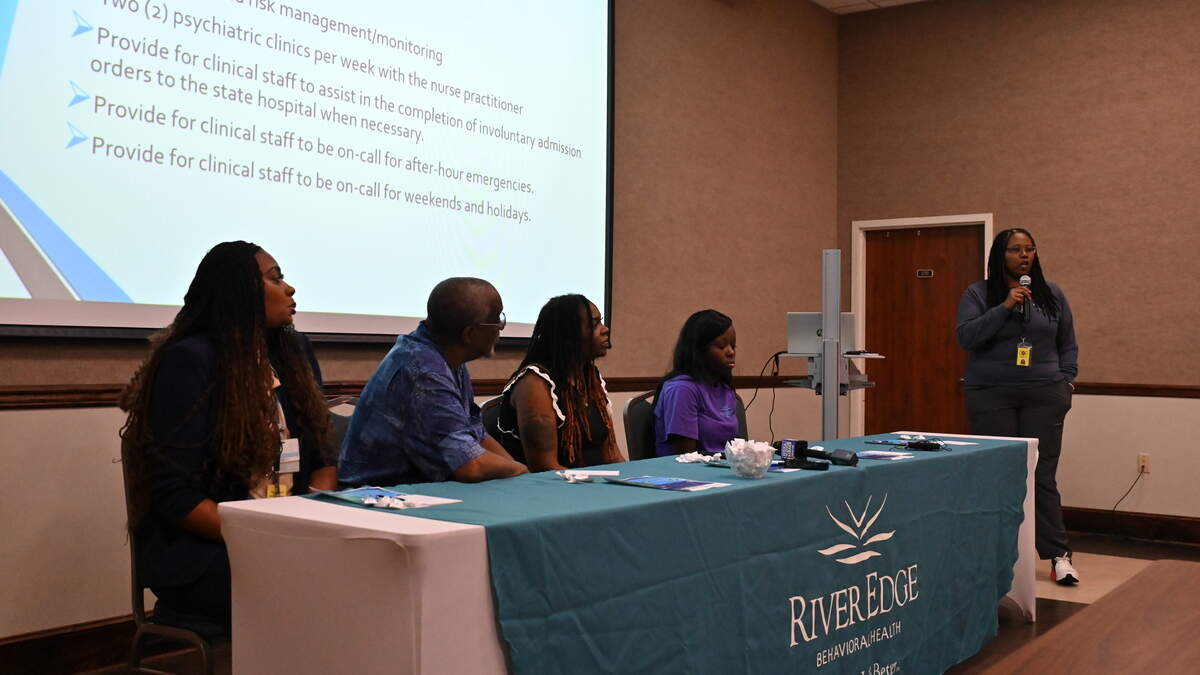
Local mental health outreach has increased since April 2024, when River Edge Behavioral Health and the Bibb County Sheriff’s Office, which runs the jail, “officially” started a program to encourage people in crisis to get psychiatric treatment instead of serving jail time, according to Tamara Leslie, one of two co-responders at River Edge.
Co-responders are clinicians and counselors who are dispatched to a scene when someone is having a mental health crisis, such as severe distress, psychosis or psychological turmoil.
No one that co-responders have encountered was incarcerated during a crisis incident in Bibb County, according to Leslie.
“Instead, we have them go into treatment and/or services that meet their needs,” she told The Telegraph.
But many people with behavioral health issues end up incarcerated because they don’t know they have a psychological disorder or don’t get help before they’re behind bars, according to Parrin Cowan, the in-reach program director and a clinician for River Edge.
“As a therapist, I had to understand that resistance is part of the process,” Cowan said. “Sometimes people do want the care but just don’t know how to receive it.”
Leslie and another co-responder tended to about 10-12 of these calls in July, and 15 total in June in Bibb County, Leslie said. It was unclear how many total crisis incidents have been reported, and which involved co-responders since the program launched.
How it works
The co-responders are usually notified of mental health crisis situations through 911 dispatchers, according to records from River Edge.
When someone calls 911 and reports they are in severe distress or psychological turmoil, dispatchers are expected to request a deputy, a co-responder or both, to respond to the scene.
In eight of the 15 incidents in June, co-responders were notified via 911 dispatchers and responded to the scene.
Another way co-responders learn about a person in a mental crisis is through probate court orders, which usually involve issues of guardianship and conservatorship.
In five of the 15 cases that involved a co-responder in June, Bibb County Probate Court Judge Sarah S. Harris deemed the person committed a crime and could be a danger to themselves or others.
In these incidents, the court issued orders to apprehend, which required a deputy and co-responder to approach the person and perform an involuntary mental health exam, or a 1013 evaluation. Depending on the results, the person can choose between continued medical services instead of going to jail, according to Leslie.
“The deputy and co-responders are dispatched as a team/unit to assist with the individual that has a 1013 previously initiated,” she said in an email. “These orders are picked up at the courthouse, and we locate the individual.”
In “rare” cases, a deputy from the sheriff’s office or another agency will request, or self-dispatch, a co-responder to tend to an individual, rather than the co-responder being called to a scene via 911 or a judge’s order, Leslie said. This only happened twice out of 15 incidents in June.
“Co-responders self-dispatch alone without deputies present to assess individual’s needs,” Leslie said. “During self-dispatch, BCSO is aware of our location (and) the individual’s identification, and contact is continuous until the co-responder’s assessment is complete.”
When the co-responders aren’t assisting people in crisis, Leslie said they also do crisis prevention outreach at community events like neighborhood watch meetings.
They do not respond to incidents or detainees inside of the jail.
How it started
The program didn’t “officially” start until April 2024 – two years after co-responder programs became mandated for some agencies, and optional for law enforcement in Georgia, Leslie said.
Georgia law required all community service boards, or agencies that serve people with behavioral health and addiction issues, to create co-responder programs. This was optional for law enforcement, as per the Georgia Behavioral Health and Peace Officer Co-Responder Act, which took effect in July 2022.
The sheriff’s office and River Edge signed a memorandum of understanding, or an agreement to collaborate on a co-responder program, on Jan. 18, 2022.
River Edge opened a job position for its first co-responder clinician in January 2023, according to an online job posting.
The clinician was expected to “de-escalate presenting symptoms and/or current stressors, resolve crises and link individuals and their loved ones to most appropriate community-based care and support,” the position description said.
The services were expected to be available “for individuals not placed under arrest,” the job post said.
If you or someone you know is struggling with depression, suicidal ideation or a mental health crisis, you can call 911 or 988 to access the 988 Suicide & Crisis Lifeline or find help online at https://988lifeline.org/.