
Attorney: Man accused of killing guards in Putnam County is guilty but mentally ill
On Wednesday, five years to the month that Ricky Allen “Juvie” Dubose allegedly helped stage a terrifying and murderous escape from the Georgia prison bus he was on as it motored through rural Putnam County, testimony began at the courthouse here in a trial that will determine whether Dubose will be sent to death row.
Dubose, who turned 29 on Sunday, has spent about a decade of his life behind bars. That includes two stints in prison, the last of which began in the summer of 2015 for an armed robbery and assault in Elbert County northeast of Athens.
Dubose was 23 months into a 20-year sentence when he and fellow prisoner Donnie Russell “Whiskey” Rowe Jr., who was serving life for a holdup in Macon in 2001, allegedly murdered correctional officers Curtis Billue and Christopher Monica.
The killings happened the morning of June 13, 2017, along a highway east of Eatonton near Lake Oconee.
Dubose and Rowe slipped out of their handcuffs while they were being ferried from a prison near Milledgeville to one near Jackson. The two burst through an unlocked gate on the bus. Prosecutors say Dubose grabbed one of the officers’ Glock pistols and shot Monica, the watchman, in the head and then did the same to Billue, the driver.
Rowe and Dubose then allegedly commandeered a passing car and then fled to Tennessee where they were captured a few days later. Last September, a jury brought in from Grady County convicted Rowe of murdering the officers but spared him the death penalty. He was sentenced to life in prison.
Dubose is the accused trigger man in the officers’ slayings. The bloody episode was recorded by a security camera mounted in the rear of the bus.
Dubose’s lawyers, whose main role is to spare him a death sentence, do not deny his hand in the killings. But they say he had an abuse-filled childhood that included molestation and other trauma.
Defense attorney Gabrielle Amber Pittman on Wednesday in her opening statement to the jury — which was bused in from Glynn County — said flat-out that Dubose “is guilty.”
But, she said, he is also mentally ill.
Guilt is not the question
If jurors in the end agree with that claim, a verdict of “guilty but with intellectual disability” or “guilty but mentally ill” would keep Dubose off death row and likely send him to prison for life. The trial would never reach a penalty phase, where jurors would decide whether Dubose should be executed.
“No matter what the state may allege,” Pittman told the jury, “Ricky Dubose wasn’t a criminal genius who was planning and plotting an escape in the weeks leading up to the crime.”
Moments earlier in Putnam County Superior Court, District Attorney T. Wright Barksdale III had described Dubose as “a predator” and “an intelligent, calculated criminal,” one whose actions were so swift and decisive that in less than a minute he brought a prison bus to a halt on a highway and bolted to freedom after carjacking a passerby.
“Forty seconds,” Barksdale said, “is all it took.”
The prosecutor said Dubose also had the guile to ask another of his alleged victims, a woman who was tied up in her home in Tennessee during the alleged escapees’ days on the lam, for a way to disguise his face.
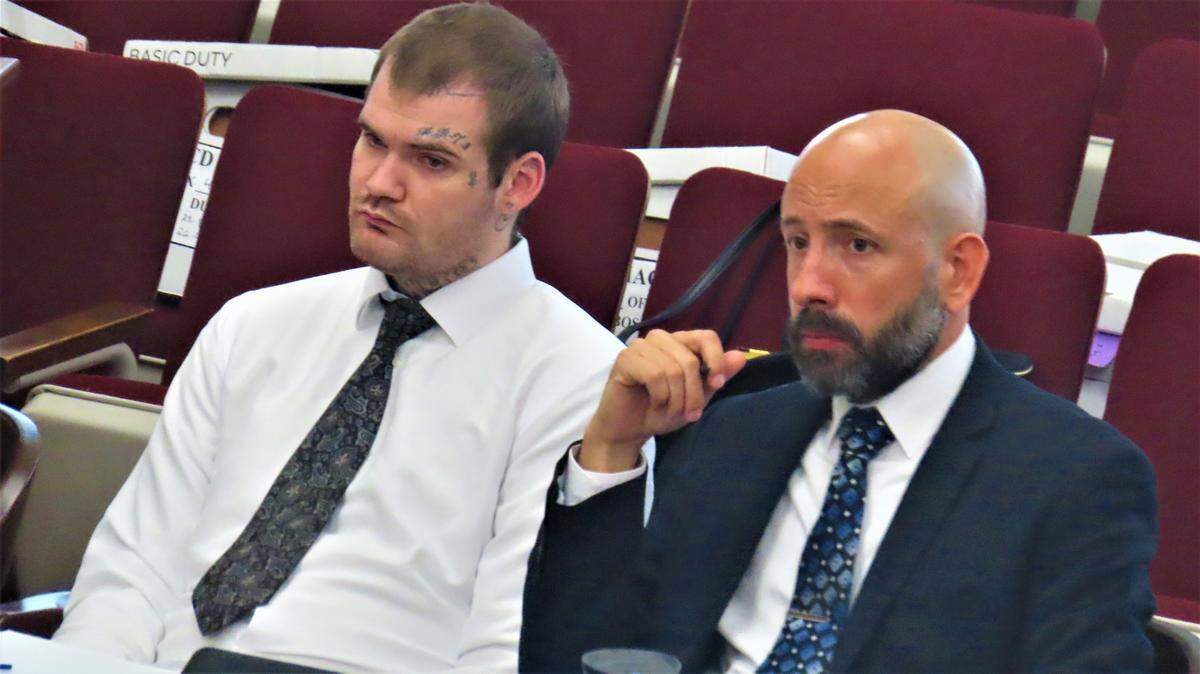
Dubose, who is said to be a member of the Ghostface Gangsters, a notorious whites-only prison gang formed in Georgia two decades ago, has facial tattoos that include devil-like horns inked atop his forehead.
As Barksdale put it, Dubose told the woman, “I need makeup.”
Telling the whole story?

The DA’s opening remarks lasted about 20 minutes.
Pittman, who in a past death penalty case represented Christopher Calmer, convicted of murdering Monroe County sheriff’s deputy Michael Norris in September 2014 but spared capital punishment, spoke to jurors for about 45 minutes.
She explained that Dubose had committed “a terrible crime,” but that he was “an intellectually disabled man suffering from untreated mental illness. ... And we’re here to tell you the whole story, because the whole story matters.”
She described Dubose as a follower who was led by Rowe, his accomplice, “into making serious, terrible decisions with tragic consequences.”
Pittman acknowledged the officers’ deaths and said to their friends and co-workers and families that “our hearts go out to you.”
She told also of medical records for her client, including a report from two weeks before the deadly escape in 2017 in which a prison doctor diagnosed Dubose as suffering from post-traumatic stress disorder attributable to sexual abuse that Dubose endured between the ages of 9 and 12.
Pittman said Dubose was at the time experiencing flashbacks to that abuse and also “hearing the voice” of his molester.“
“The doctor recommended that (Dubose) get treatment” and medication, which Pittman said Dubose had yet to receive when the alleged murders and escape happened.
Trauma and abuse and chaos
Pittman said that when Dubose was born in 1993 his umbilical cord was wrapped around his neck. She said he had received insufficient prenatal care. She said he had an abusive family, that his father was an alcoholic who was in and out of jail and that as a boy Dubose endured “trauma and abuse and chaos.”
She said that when Dubose was in second grade he was failing every class. She said he was diagnosed with depression and attention deficit hyperactivity disorder, and that he had an IQ of 75. She said another test later showed that his IQ was 62. Such scores can indicate mild or borderline mental disability.
“I want to be clear,” Pittman said. “We’re not saying that makes him not guilty. What we’re saying is it matters that he was mentally ill.”
She also spoke of her client’s early brushes with the law, which, though she didn’t mention it, may have earned Dubose his nickname: “Juvie.”
The trial was expected to last two weeks or longer.
This story was originally published June 1, 2022 at 6:00 PM.