
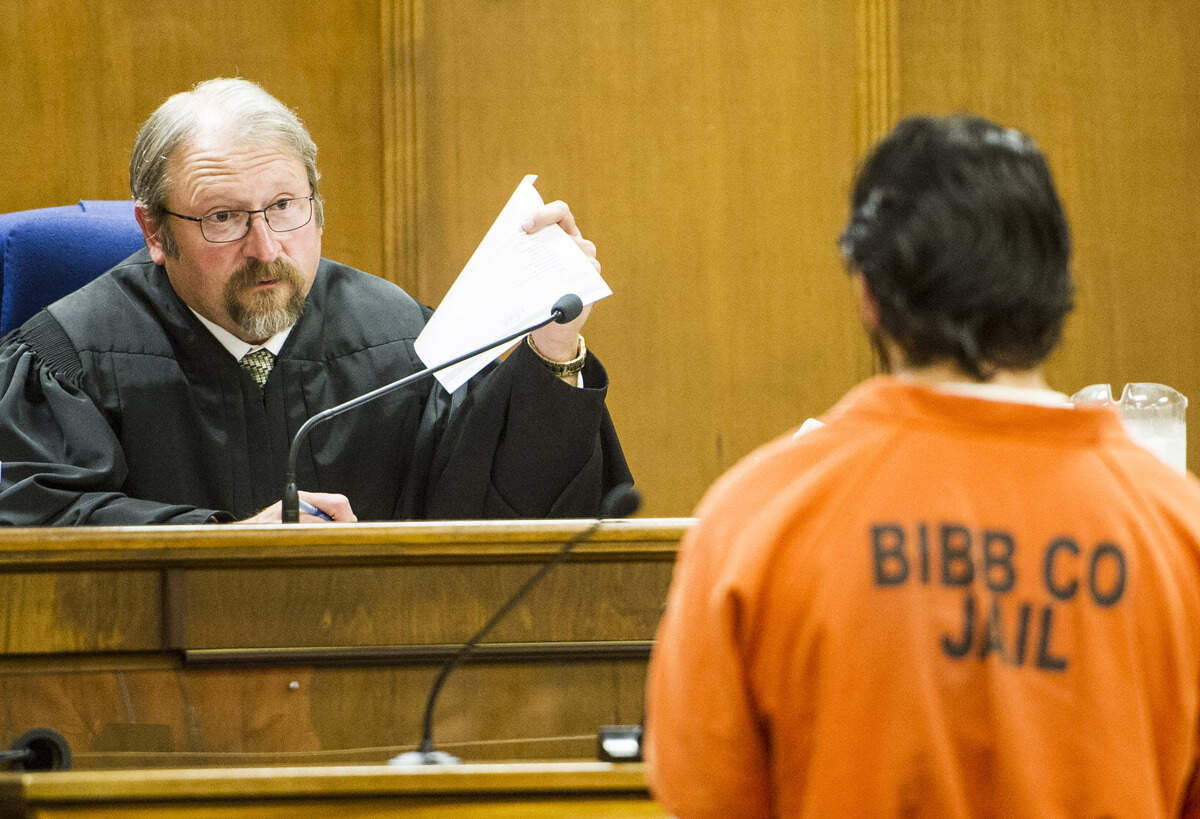
These Macon judges are known for their powerful lectures, but is anyone listening?
One day last March, a man stood in front of Judge Verda M. Colvin to plead guilty to animal cruelty for hurling a puppy against the side of a house and smashing its skull.
“To treat a puppy that way, that scares me for you, young man. … Something’s going on in you that you can’t control to have anger that much,” the judge said in sentencing the 25-year-old offender to three years in prison.
“You caused the death of an animal,” the judge went on. “And in a civilized society, the soul of individuals is judged by how they treat the weakest. … The weakest in our society have always been children, elderly and animals. … This is outside the realm of normalcy. This is outside the realm of what someone with humanity would do.”
Hardly a week passes in Bibb County Superior Court where judges do not at least try to impart what wisdom they can on the just-convicted.
But is anyone listening?
“I really do think that they hear it,” prosecutor Ché Young, assistant Bibb district attorney in charge of the juvenile division, said. “I don’t think it falls on deaf ears. ... It may not sink in then and there. (The defendants) might be in a daze at the moment, kind of shell-shocked. But at some point I think those words will resonate with them.”
Colvin and fellow Superior Court Judge Howard Z. Simms have reputations as genuine, fair, no-nonsense jurists.
While their sentencing proceedings may be intimidating for some, they are also heartfelt, sincere and authentic.
The judges’ remarks are not shaming sessions. They’re more brutally honest wake-up calls.
The lectures the judges deliver are on occasion noted in newspaper accounts, though it is becoming less common anymore for their orations to reach the masses via local television news or other media outlets.
Still, the messages can, by word of mouth, get out through friends and loved ones of the convicted or via others who might attend the sentencings.
“I’m talking to (the people in the courtroom) as much as the defendant,” Simms said. “I’m hoping word goes out to the broader community.”
He said if he can “get one kid to think twice, I’ve had a good day.”
But often by the time young criminals find themselves standing before him, he said, “it’s too late.”
June O’Neal, executive director of the Mentor’s Project of Bibb County, which pairs young people with adult role models, keeps up with news from the city’s criminal courts.
She considers Simms and Colvin “amazing.”
O’Neal said the judges, in their lectures, sound as if “they’re talking to that young person, hoping that they can reach them and that they can turn themselves around — if they’re ever coming out of prison.”
She said the common-sense chiding can also send a message community-wide: “You don’t want to live like this. You don’t want to be a gang-banger. Orange jumpsuits are not in style.”
According to word on the street, O’Neal said, some teens are getting the message.
“They know,” she said, “that the judges are playing hardball.”
Will that knowledge make a difference?
“God, I hope so,” O’Neal said.
Simms has noticed how some young armed robbers are surprised to learn the severity of the consequences they face for holding someone at gunpoint.
In most cases, the mandatory-minimum sentence is 10 years in prison without parole.
Soon after their arrests, upon arraignment, Simms said there is a look of astonishment on the faces of the accused.
“Like you hit them with electricity,” he said. “They have no concept that this thing they have done is this bad. ... They don’t understand.”
One such scene played out in Simms’ courtroom one morning in late September.
A 17-year-old boy, who a year earlier had held up and pistol-whipped an elderly man on Lakeview Circle in Macon, was pleading guilty to armed robbery.
The convicted teen, Zymir Malik Person, would be sentenced to seven years behind bars and eight more on probation.
The robbery he and some acquaintances tried to pull off had, according to prosecutors, been a failed carjacking try.
All that Person made off with as he rode away on a bicycle was, inexplicably, a pair of scissors.
“Why?” the judge wanted to know. “What is it that you were trying to get?”
“I wasn’t trying to get anything,” Person said.
“Somebody was,” Simms said. “I mean, this 80-year-old man got pistol-whipped in his driveway because you and your buddies wanted something from him.”
Simms didn’t stop there.
He wanted answers.
“I don’t get it,” the judge told Person. “There are a parade of people — 16-, 17-, 18-year-old people (in here) every day for doing exactly this kind of idiocy.”
Simms explained to Person that armed robbery was once a capital offense.
“And now it seems like it’s a hobby around here. ‘I don’t have any money to buy tennis shoes, I’ll just go jack somebody.’ ... And now you’re fixing to be gone off to the penitentiary until you’re all grown up. That doesn’t make any sense to me,” he told Person. “And not a single kid who has stood over there (where Person was standing) has given me any kind of an answer that makes it make sense. None. Were you in school when this happened?”
“I was home-schooled, sir,” Person said.
“And you wound up getting a pair of scissors,” Simms replied. “You beat an old man in the driveway with a gun and you got a pair of scissors. That’s gonna be a great story to tell when you get to the penitentiary. ... You left on a bike. A kid on a bike, who wound up with a pair of scissors. If I live to be 500 years old, I’ll never understand this epidemic of lunacy.”
Before Person was led away, Simms said to him, “Good luck, son. That’s about all I can tell you.”
Travon Girtman, who works with O’Neal at the Mentor’s Project office, has been a crime victim himself. He was shot and wounded in separate incidents in 2013 and 2014.
Girtman, 25, said he thinks the judges’ messages get out, “but it’s more from the parents hearing it and telling the kids.”
He added, “It goes in one ear and out the other, but if a mom says, ‘You heard what Judge Colvin said,’” then perhaps the words will connect and potential troublemakers will think before acting.
“That’s the problem with teens,” Girtman said. “They’re not thinking at all. Until you get caught. That’s when the thinking begins.”
In early October, Colvin was sentencing a man who had written threatening letters to a woman in an aggravated stalking case. It was the man’s third felony conviction.
“If you change your life, then somebody will see you have made a change,” Colvin told him.
She said he needed to ask himself, “Do you want to live on the outside (in the free world) or do you want to live on this inside (in prison)?”
“On the outside,” the man said.
Colvin said privately later that she thinks judges “speak to the pulse of the community ... and our responsibility to each other.”
She said she realizes that sometimes her words to the defendants standing before her might not ring home, so sometimes she is speaking to the defendant’s family.
“I want them to understand my rationale and reasoning,” Colvin said.
She sometimes hands out books to those she sentences, books that offer guidance and insight on finding the right path.
“Maybe it will impact somebody who reads it,” she said. “And maybe they can take that little nugget with them and maybe if they keep it somewhere inside they won’t become part of the madness. That’s my hope. That’s all I can do, because you never know who you might reach.”
This story was originally published January 22, 2020 at 5:00 AM.