
Murder victim’s sister haunted by killer’s Facebook page reappearing from behind bars
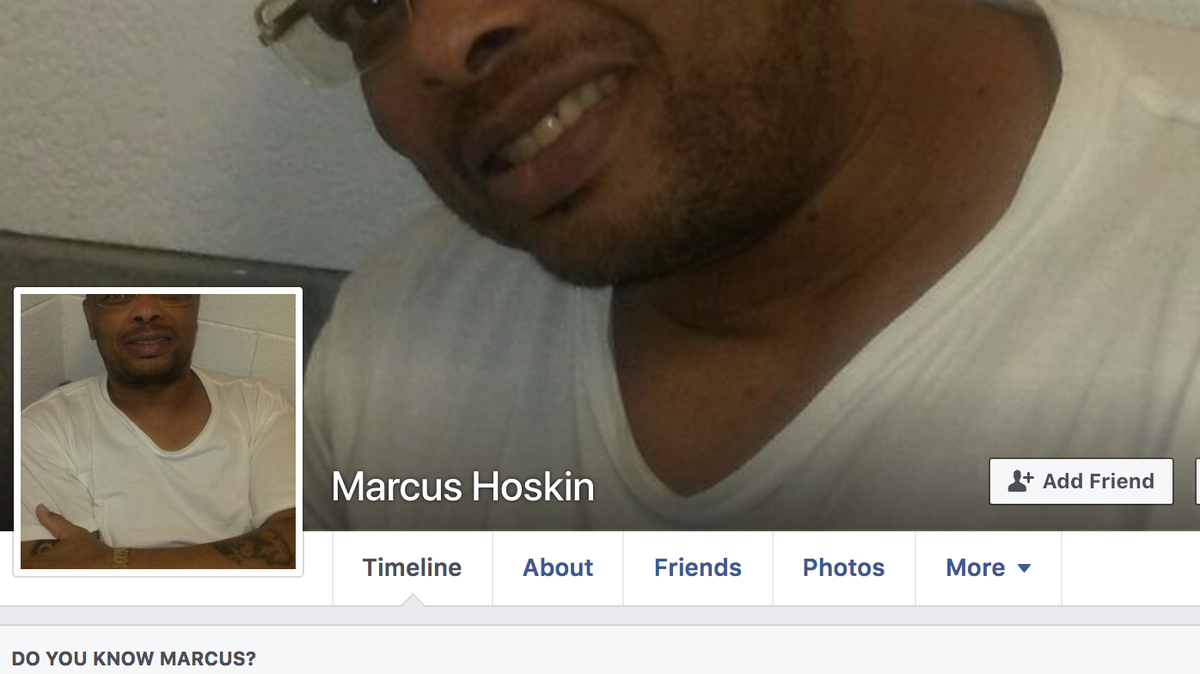
Sandra Williams never wanted to see the man who murdered her sister again, but since last year his picture has been popping up on Facebook from behind prison walls.
“Every time you think you’re over it, bam!” Williams said after finding a third profile page for Marcus Hoskins on the social media site.
He even had the audacity to reach out to his victim’s nephew, she said.
“He sent my brother’s son a friend request,” Williams said. “He did not accept it.”
The scope of social media abuse in prisons is unclear, and a Georgia Department of Corrections official did not say how Hoskins may have signed on to Facebook. But contraband cellphones, which may be used to access the internet, are a persistent problem.
In the first three months of 2018, more than 1,600 phones were confiscated from a prison population of more than 52,000 felons, according to the corrections department’s contraband interdiction report.
They enter prisons in a variety of ways “including through visitors, throw overs around facility perimeters (stuffed inside footballs, bags, dead cats, etc.), and unfortunately sometimes via a small number of staff,” Wendy Howell, manager of the public affairs office for the Georgia Department of Corrections, wrote in an email to The Telegraph.
Prisoners’ access to the internet disturbs Williams, who for five and a half years has struggled to recover from the shock of her only sister’s murder.
Just 19 days after Danielle Kelly Thompson eloped with Hoskins, he led her at gunpoint to a remote trail off Ga. 87 in Twiggs County, shot her multiple times in the back and left her to die.
Earlier that day, Jan. 30, 2013, Hoskins traveled to Atlanta where his new wife was visiting the hospital. She was at the bedside of her teenaged daughter, who had emergency brain surgery.
It was the first time Williams had met Hoskins, who was rocking back and forth in the hallway, apparently upset by the presence of his wife’s ex-husband, the father of her children.
Williams had a gut feeling Hoskins was going to hurt her little sister. She was right.
By the next morning, Danielle Hoskins was lying dead on the Longleaf Trail at Bond Swamp off the Cochran Short Route just east of Macon where the newlyweds were living.
Marcus Hoskins confessed to family members, turned himself in and led sheriff’s deputies to her body.
He was prepared to stand trial in 2014, but struck a plea deal.
Although Williams wanted the death penalty for her estranged brother-in-law, she was willing to compromise with prosecutors.
“We’ll accept the plea if you sentence him today and he’s shipped out today,” she said she told them.
Williams hoped it would be at least 30 years before she saw his face again, but there it was on Facebook.
After Telegraph inquiries to the Georgia Department of Corrections and Facebook, the two remaining profile pages were taken down.
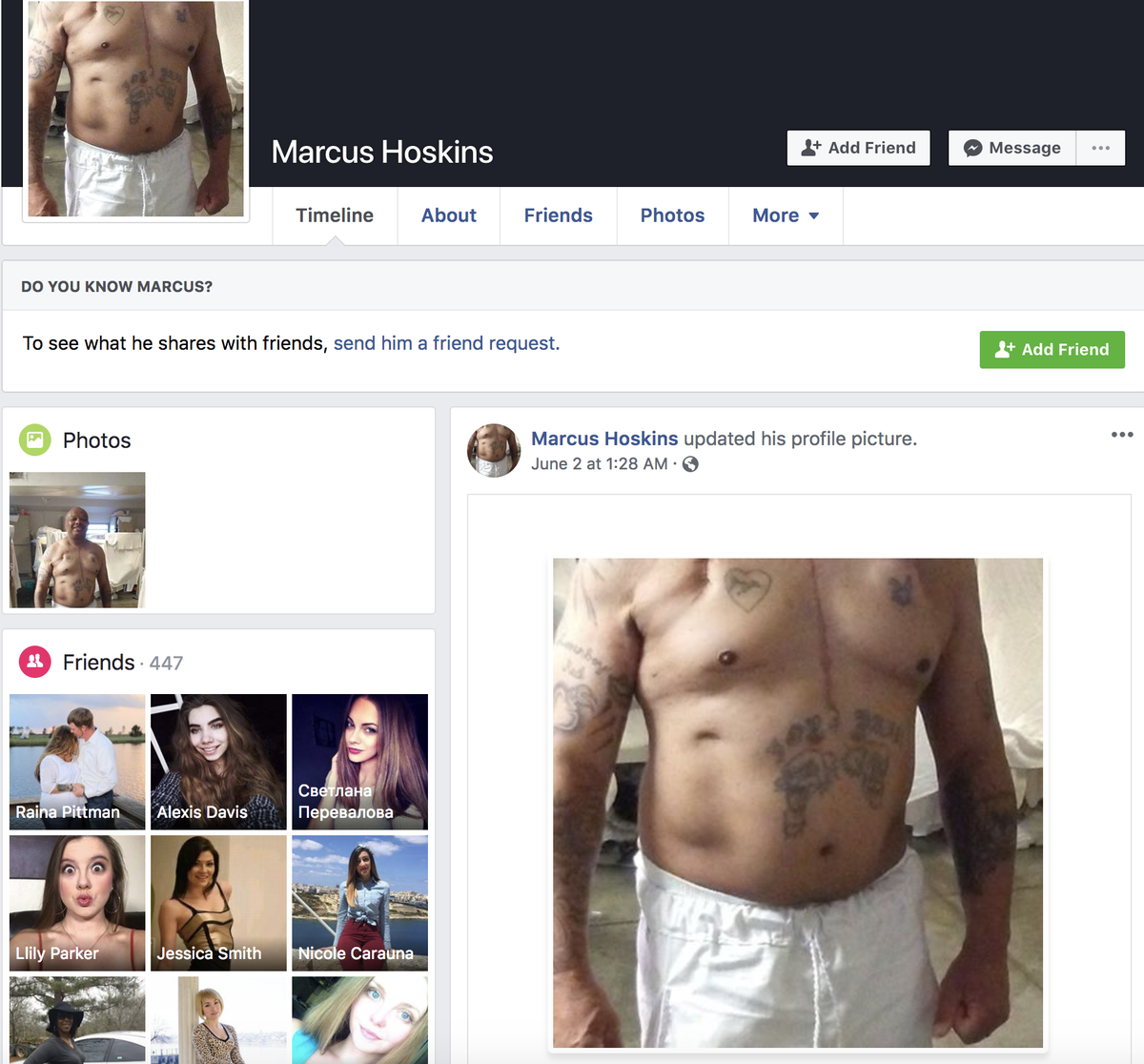
In his most-recent profile picture dated June 2, available online before the page was removed, a grinning Hoskins was standing shirtless in what appeared to be a prison laundry or other facility.
“It was really disgusting knowing he can get on there just like pimping himself with no shirt, all his tattoos and Nike shorts and nice tennis shoes,” Williams said.
‘It’s like he haunts you every day’
Inmate use of social media and cellphones is prohibited in Georgia.
The corrections department asks anyone who sees an inmate on social media or knows of their cellphone use to alert the department through its website.
The Georgia Department of Corrections did not provide The Telegraph with the number of social media accounts reported through the tip line and internal investigations.
Last summer when Williams first saw Hoskins pictured in a white T-shirt on Facebook, she told her local sheriff, Twiggs County’s Darren Mitchum.
The page eventually disappeared.
Earlier this year, she found Hoskins again.
This time, he was wearing glasses and a white T-shirt as he smiled next to a white concrete wall.
“He’ll never go away. It’s like he haunts you every day,” Williams said.
She was in contact with the deputy director of Victims Assistance and filed complaints but still was frustrated that the most recent pages lingered for so long.
After The Telegraph’s inquiry, information about Hoskins’ pages was submitted to the Professional Standards Investigation Division, which works “very closely with social media outlets for assistance with removing these nefarious accounts,” Howell wrote in an email.
Offenders caught with contraband cellphones receive disciplinary sanctions. If convicted of the felony offense, they can be sentenced to one to five years in prison, according to Georgia law. It’s unclear what disciplinary action Hoskins faces for his alleged Facebook use.
Every few weeks, Williams will be checking to make sure Hoskins doesn’t surface again on social media.
She’s uncomfortable with the thought of him potentially stalking her family online, looking at pictures, learning where they go and what they do.
Frequently she checks to make sure he’s still behind bars, and through a victims assistance program, she can see if he’s been transferred to a prison hospital or other facility.
She feels like the system is failing victims of violent crimes.
“I don’t think a murderer should have any rights,” she said. “I can’t get on a tablet and communicate with my sister. My sister is six feet under.”