
Southern magnolia a true sign of the South
As a child, I spent many days during the summer at my grandparents' house. My grandparents had a large southern magnolia in their yard. As a child, this was my favorite tree to climb. My cousins and I spent many hours in that tree. That tree is still there today. Every time I visit my grandparents' house, it brings back good memories of my childhood.
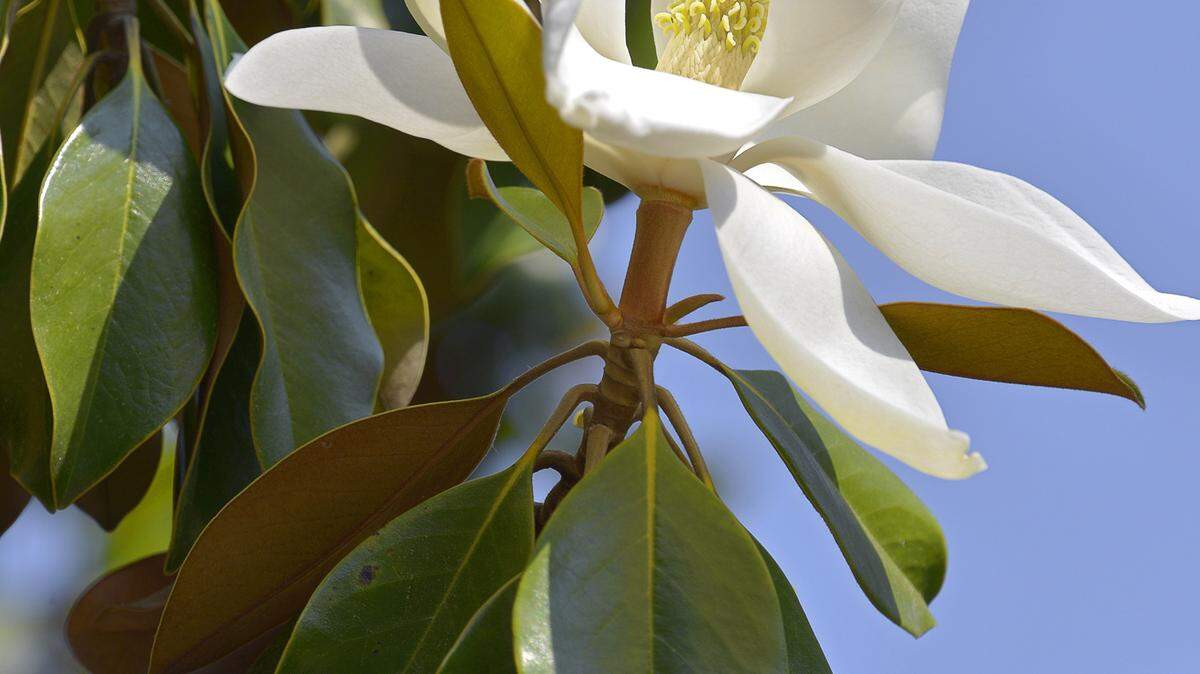
The southern magnolia is a native tree that grows well throughout Georgia. These trees have big beautiful creamy white flowers and large glossy green leaves. Flowers appear in early summer and have a lovely fragrance. The fruit is conelike, with bright red seeds. These seeds are consumed by birds and other wildlife.
Southern magnolias can reach 80 feet high and 50 feet wide depending on the cultivar.
Most southern magnolias are grown as a single specimen in the landscape, but they can be used for screening purposes as well. These trees can be quite messy since they shed old foliage in the spring and seed pods in the summer.
Southern magnolias grow well in both sun and shade but need moist, well-drained, acidic soil. Container grown magnolias can be planted year-round, but balled and burlapped trees need to be planted in the fall. Transplant shock is common among southern magnolias. Because of this do not be surprised when it drops all of its foliage the first year.
After the tree is established, growth can be accelerated through fertilizer applications. During the first year, apply one cup of 10-10-10 around the planted area. Increase the fertilizer amount to two cups the second year and apply around the canopy drip line and three feet beyond. In the third year, increase the rate to four cups and apply around the drip line and six feet beyond. By the fourth year, the tree's roots system should be able to forage for nutrients itself.
Fertilizer application should be done in March, May and July. Fertilizer is applied past the drip line because the southern magnolia's roots have been shown to extend more than three times further than the canopy width.
Southern magnolias have few pests. One of the most common things I see is algae growth that causes leaf spots. The effect on the tree minimal, but excessive amounts can be a sign of other issues. Algae growth can be managed by removing infected leaf debris and selectively pruning to encourage leaf drying. Scale insects can also be a problem. Please contact your extension agent for treatment recommendation.
Southern magnolias are beautiful trees, and in my opinions a true sign of the South. I hope this information will encourage you to plant a southern magnolia or take pride in the one you already have. Please remember that these trees can be quite large, and good planning is important for successful growth and to avoid overcrowding.
DATES TO REMEMBER
Friday and Saturday: Spring Home and Garden Show, fairgrounds in Perry
May 3: Propagation Class, Perry, 6-8 p.m.
May 12: Pollinators Class, Perry, 6-8 p.m.
For more information, contact Houston County Extension at 478-987-2028 or visit the office at 801 Main St., Perry. Office hours are 8 a.m.-5 p.m. Monday-Friday. Visit www.caes.uga.edu/extension/houston for more news about your local Extension office.
This story was originally published March 30, 2016 at 8:21 AM with the headline "Southern magnolia a true sign of the South ."