
Effort seeks to shrink digital divide in Macon's public housing
When Darriale Bradley was a junior at Southwest High School in Macon, home was not the place for homework.
In fact, most of her studying in 2012 took place at the McDonald's on Harrison Road, a spot near her home where she could connect to the Internet at no cost. Her mother, who was unemployed at the time, would drive her there almost daily.
"That's how I used to get my homework done," Bradley said. "Then I found a flyer at school, and I brought it back home to my mom and I said, 'OK, we need to get this Internet.'"
The flyer advertised home-based high-speed Internet for $10 per month for qualified customers.
Upon learning she was eligible for the program, "I was happy as I don't know what," said Bradley, now a 19-year-old computer engineering major at Mercer University. "That Internet helped me to learn more. ... I just know that it was a big, life-changing experience for me."
Less than 20 percent of people living in Macon-Bibb County's public housing have access to the Internet from home. However, that number is expected to increase by 15 percentage points this summer with the ongoing efforts of community partners, businesses and local government agencies.
Macon-Bibb County is one of 27 cities chosen for President Barack Obama's Connect Home initiative, a program that aims to equip low-income families living in public housing with high-speed Internet.
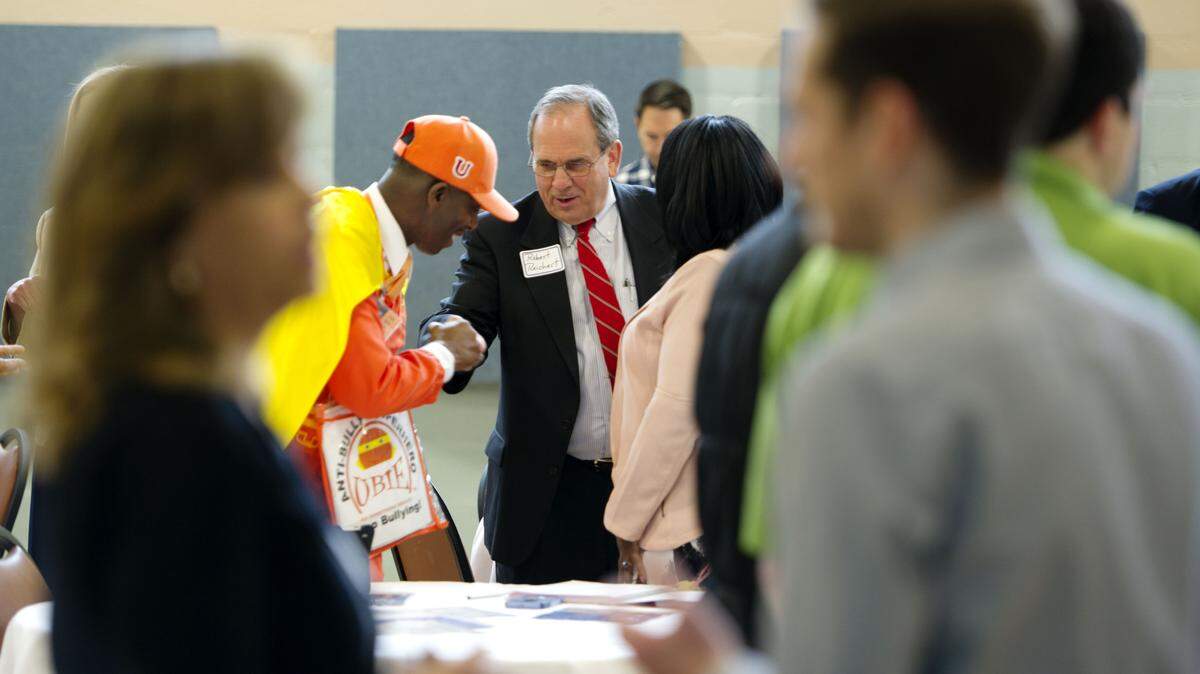
Stakeholders met at the Buck Melton Community Center in Macon on Friday afternoon for a report on the efforts, which began in October with events encouraging people living in public housing without Internet access to buy a digital tablet for $30 and get Internet for $10 per month.
Over nearly five months, more than 117 people qualifying for the program have purchased the tablets, said Karen Middleton, chief of resident initiatives for the Macon Housing Authority.
Of the authority's 900 households, "we have 535 target households with (children) ages K through 12th grade," Middleton said to a crowd of about 75. "Our goal is to at least have 35 percent (of families living in public housing connected to Internet). But of course, we're not going to settle for that. We're going to go beyond that."
The goal of the Connect Home program is to help bridge the digital divide for families across Macon's public housing community. Its efforts compliment those of EveryoneON, a national nonprofit that in 2012 launched a program in Macon called Connect2Compete. Connect2Compete aims to connect low-income families with discounted, high-speed Internet, computers and training. Bradley was a participant of that program.
Though 462 tablets and 56 computers have been sold through Connect2Compete, Ed Jennings Jr., Southeast regional administrator for the U.S. Department of Housing and Urban Development, said Macon was chosen for Connect Home because "we weren't seeing ... the kind of uptick we need to have."
"We want to make sure that every kid in public housing can live up to his or her God-given talent," Jennings said, noting that parents also need access to the Internet to keep up with their children's progress and to stay in touch with their schools.
In September, Connect2Compete partnered with Cox Communications to enhance connectivity by coupling the $30 tablet with Cox high-speed Internet for $9.95 per month. The deals are made possible because of a $300,000 grant from the James M. Cox Foundation, said Jessica Walden, regional manager for EveryoneON.
On the second Tuesday of each month, EveryoneON sets up at public libraries to deliver the tablets to those who have qualified for the program.
Annual progress of Connect Home will be discussed at a meeting set for July 15, but the time and location have not yet been announced.
For more information about the Connect Home program, call the housing authority at 752-5077.
To contact writer Laura Corley, call 744-4334 or follow her on Twitter @Lauraecor.
This story was originally published February 12, 2016 at 6:34 PM with the headline "Effort seeks to shrink digital divide in Macon's public housing ."