
Dublin hospital played a little-known role in World War II
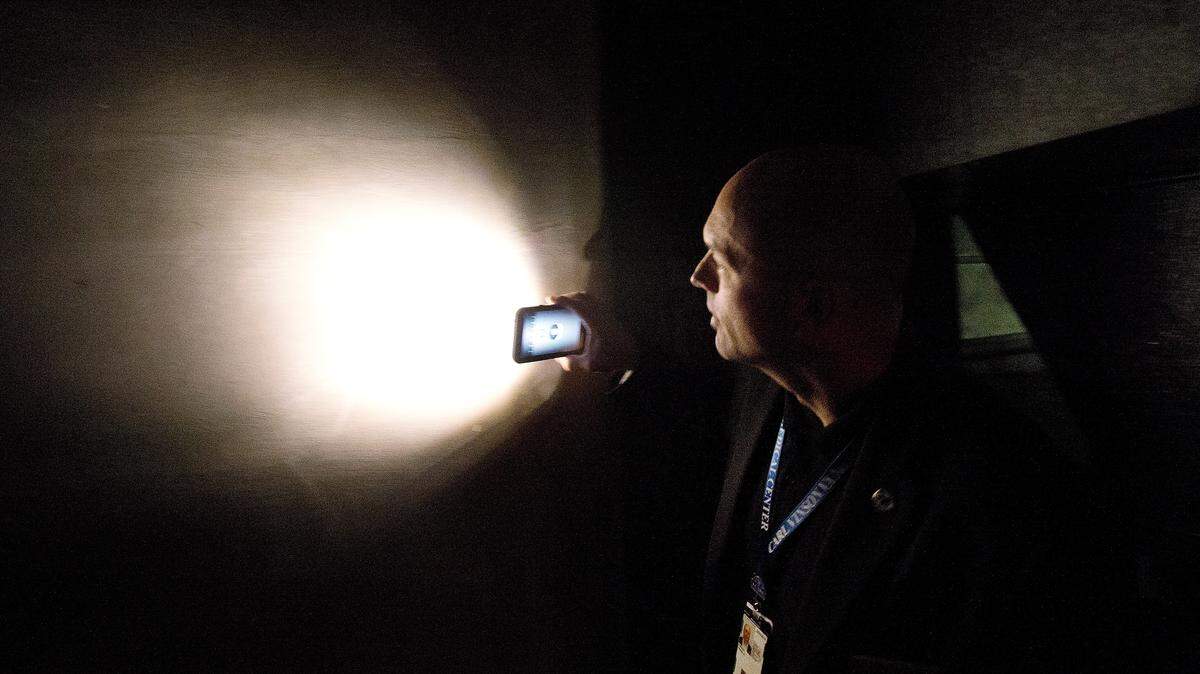
DUBLIN -- In a small dark room in the basement of the Carl Vinson VA Medical Center, Frank Jordan uses his cellphone light to probe for history.
The room, in Building 4, is mostly taken up by a big metal air handler. But against one wall are four concrete cubicles, about 5 feet wide by 10 feet long, with open fronts.
The fronts were once cell bars.
Jordan, the public affairs chief for the hospital, scans the walls of each cubicle before finally finding what he is looking for.
On the wall of the last cubicle that he checks is an etching about the size of a half dollar coin. It faintly bleeds through paint that an overzealous contractor put on the walls a few years ago.
It's a swastika.
Jordan said it was put there by a German prisoner of war held in the cell toward the end of World War II.
The hospital opened in 1945 as a Navy hospital and treated the injured from the great battles of the Pacific.
But a little-known role it also played in the war was that it served as a mini-prisoner of war camp. Jordan estimated that about six POWs were held in the hospital.
The four cells were originally built in the hospital as a brig for sailors. Another piece of graffiti that bleeds through states, "Willis got stuck here."
Due to the fact that it's in English, and Willis is not a German name, Willis was likely a sailor who went astray.
But at one time, Jordan said, the walls were covered in graffiti written in German, clearly from POWs. Unfortunately, a few years ago, a contractor working in the basement took it upon himself to paint the walls.
"Our folks at the time ran down to stop him, but it was too late," Jordan said.
But it was a thin coat of paint and since that time some of the graffiti has bled back through.
Jordan started researching the POWs a few years ago. What he knows is mostly from people who remember the Germans being there. While the Germans were originally kept in the cells under close guard, at least some later stayed in the hospital rooms and roamed the hospital somewhat freely.
"It very quickly evolved into a very casual type thing," he said.
More people in Dublin are familiar with the larger German POW camp that was in the area of Telfair and Troup streets. More than 200 Germans there were used as farm labor, because most of the farmers were off fighting in the war. The POWs came from Camp Wheeler near Macon, which had a similar POW camp, said Scott Thompson, a Dublin historian.
Thompson said the locals treated the Germans well. People enjoyed stopping near the camp to smell the native dishes the Germans cooked and hear them singing, he said.
"The Germans were very much beloved here," he said. "There was no animosity."
On Sundays, the Germans marched to the local Catholic church and sang hymns along the way. One time, Thompson said, a small plane from Macon made a crash landing in a farm field where the Germans were working. The two men in the plane got out to find themselves surrounded by a bunch of men yelling at them in German.
"They thought they had taken a wrong turn somewhere," Thompson said.
Thompson said he wasn't aware that any Germans had been kept at the hospital. He said it could have been that some of the prisoners at the farm camp were sent to the hospital to do some work there.
The cell bars are still at the hospital, but in another building. The bars are used as one wall of a tool storage area.
Jordan hopes the bars can eventually be put back on the cells to commemorate that part of the hospital's history.
"If it were up to me, it would be," he said.
The last remaining barrack from the farm camp was torn down about four years ago, to Thompson's chagrin. So the hospital's cells are the only surviving location where German POWs were kept.
To contact writer Wayne Crenshaw, call 256-9725.
This story was originally published January 3, 2016 at 8:56 PM.