
Houston County man's celestial photo gets NASA attention
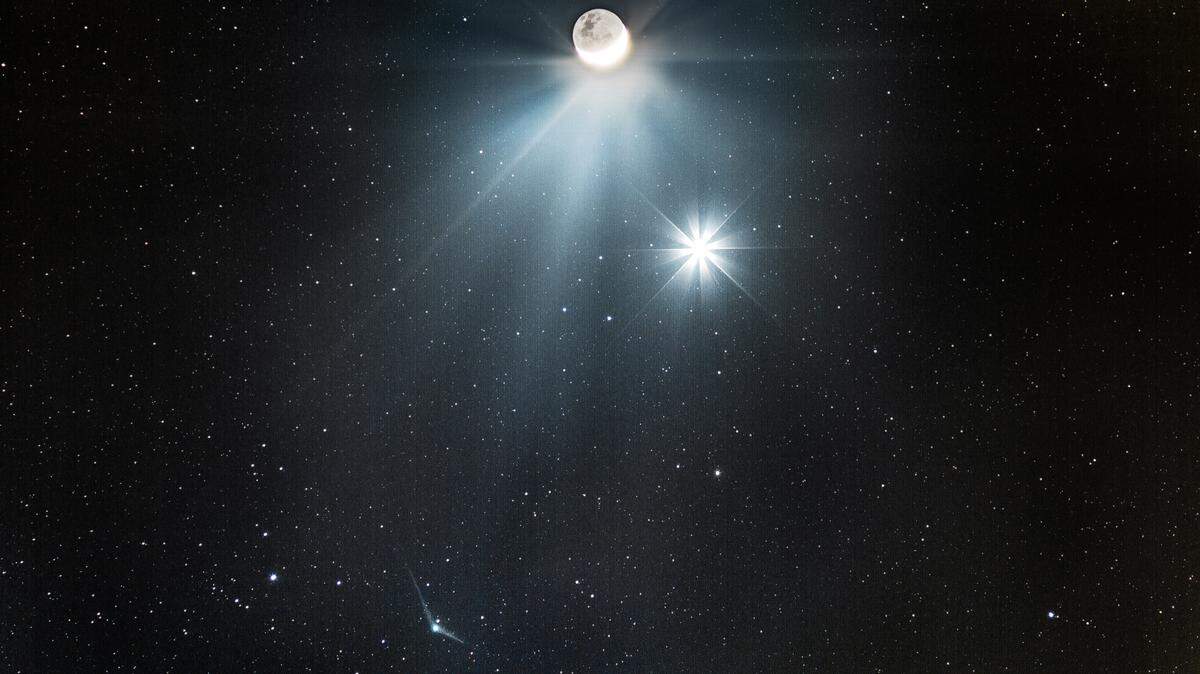
If you've ever been struck dumb at the sight of a night sky spread with stars and wished you could save an image of what you saw forever, you need to meet Greg Hogan.
Hogan's day job is an IT systems administrator for the Houston County school system, but his passion is astronomical photography. By any measure, he's good at it. NASA even took notice of one of his recent images.
The image started with a plan. Hogan knew that on the morning of Dec. 7, there would be a rare appearance of three celestial bodies -- the moon, Venus and the comet Catalina -- all at the same time. As if that wasn't enough, the comet promised to kick the photo up a notch.
"What's unique about the comet Catalina is that it has two tails," Hogan said. "So down at the bottom of the picture is this comet that kind of has wings."
Since the moon was so bright and the comet and stars so comparably faint, Hogan's final image is a composite of two photos. One image was made with a fast shutter speed for the moon, while the other was a much longer exposure that let the stars and comet burn in. He kept the the stars from blurring with a special tripod that moves the camera along with the Earth's rotation during long exposures.
Once he had the final image, Hogan knew he had something good. Something good enough for NASA's Astronomy Picture of the Day Web page. That page is curated by two astrophysicists looking not just for pretty pictures but also something scientifically worthy to spotlight.
"I have submitted to them maybe a dozen times over the last year," Hogan said. "But it's a very, very, very selective process to get in and have them notice your image out of the thousands I'm sure they receive every day."
This time they bit. When the photo was published a week after Hogan submitted it, he found himself in good company. The image the day before his was of mysterious reflections on the dwarf planet Ceres that had armchair astronomers talking about alien truck stops in the asteroid belt between Mars and Jupiter. The reflections turned out to be salt deposits. The day after Hogan's picture, NASA featured high resolution images of the surface of Pluto from the New Horizons space probe that took a decade to reach the edge of our solar system.
"And I'm in a farmer's field with a camera at 4 in the morning," Hogan said.
This isn't the first time Hogan has had a photo published. One of his images even made it into Sky and Telescope, kind of a Popular Mechanics of astronomical photography. But being tapped by NASA was different.
"Wow. ... That was ... I mean that was it," he said. "To have NASA look at your image and say, 'Yeah, this is cool, and we want to put it as the image of the day.' All day? That was it for me."
For Greg Hogan, beating out satellites and space probes, even for one day, that was a really big deal.
To contact Grant Blankenship with Georgia Public Broadcasting, email him at gblankenship@gpb.org.
This story was originally published December 17, 2015 at 10:07 PM with the headline "Houston County man's celestial photo gets NASA attention ."