
Civil rights workers from UCLA recall registering black voters in Macon
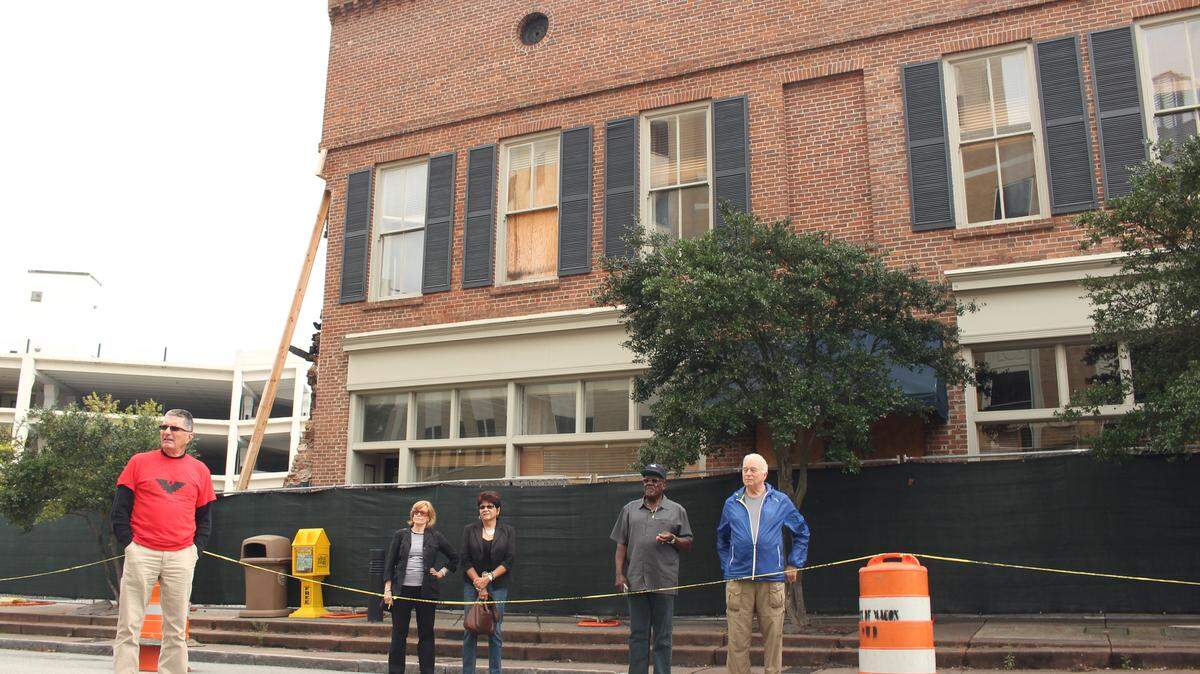
It was the summer of 1965 when nearly 20 civil rights workers made their headquarters above a liquor store on Cotton Avenue.
Macon was far from sunny Southern California and UCLA. Most of the volunteers were students at the college who had heard the words of Martin Luther King Jr. and were inspired to come to the South and register black voters.
"I thought I was pretty well informed on history," Beth Pickens, one of the volunteers, recalled. "I thought the Civil War had sort of took care of all this. When I heard people couldn't vote, to me it was more like, 'Are you kidding? Well, of course I'll go help. That's the most ridiculous thing I've ever heard of.' "
They reunited in Atlanta in early October to celebrate the Summer Community Organization and Political Education voter registration project's 50th anniversary. The next day, they drove to Macon.
Among them was Pickens. The daughter of a conservative Navy sailor, Pickens spent her freshman year at UCLA palling around with the first group of Peace Corps members who ate their meals in her dorm hall and the west African students who were pursuing their PhDs in chemistry on campus.
Neil Reichline also made the trip from California to the Deep South. He was a journalist, cinematographer and the quintessential free spirit. Reichline got involved in the anti-war and draft resistance movement during Vietnam, and he spent 10 years living with Joan Baez at her Struggle Mountain settlement in Los Altos Hills, California.
Kenneth Long came along as well. His virulently racist grandfather would have disowned him, but the straight-laced kid from suburban Los Angeles got in a '55 Ford bound for Atlanta with change on his mind.
Shelby Jacobs took two weeks of vacation to come South. During the early 1950s, he was one of the first African-American aerospace engineers hired by NASA. He was designing the camera system for Apollo 6 at the time.
Like Jacobs, Charles Hammond didn't stay long either. After a brief stop in Macon, he went south to Americus and found himself in a jail cell. But it didn't show up on his arrest record when he went to officer school for the Army. The retired second lieutenant thinks when he posted bail, the judge and the sheriff split the bounty.
Over the years since, some of the group passed through Macon on the way to other places. They never stopped.
But in October, they strolled past the former Macon City Hall and the county courthouse, where decades ago they registered voters. They dropped by their old headquarters near the original Nu-Way Weiners stand as they put the pieces of that long-ago summer back together.
'I WAS SCARED'
The SCOPE project was an initiative of the Southern Christian Leadership Conference's executive council. It aimed to get disenfranchised blacks to the polls.
King, along with the program's leader Hosea Williams and the SCLC, targeted white college students willing to travel south. They hoped the successes of white college students working in the civil rights movement in places like Savannah would repeat themselves across the South.
After getting approval in late 1964, the program officially began June 14, 1965, with a weeklong orientation at Morris Brown College in Atlanta.
Reichline said the training was an eye-opening experience.
"I remember learning how to react to violence, ... how to curl up in a protective position," Reichline said. "I was a real straight kid from the Valley and hadn't had any kind of experience in the world. I was 19 years old, (and) I was scared."
The extent of the segregation surprised the group as well.
Despite having been a victim of prejudice before, Jacobs' short time in the South was harsh, and his first tastes of Jim Crow -- the local laws that upheld the separation of the races -- were bitter.
Jacobs and his group walked through the front door of a recently integrated ice cream parlor in Atlanta. They were looking to buy a gallon for dessert.
"While we were ordering, we decided Georgia had a lot of ice cream flavors that we needed to appreciate. So we each got a different ice cream flavor," Jacobs said. "We cross-tasted each other's ice cream. To us, that was the best way to explain how it tasted. The clerk behind the counter went ballistic."
The group of black and white volunteers left the parlor realizing they couldn't be themselves while in the South. They, too, had to obey the color line.
'FRIED CHICKEN AND GREENS'
After the week in Atlanta, the volunteers split up and were assigned to canvass counties from Virginia to the Florida panhandle. Nineteen students, all from the UCLA group, ended up in Bibb County.
They lived with black families in Macon. The host families were paid $15 a week for their room and board.
The workers praised the host families for their willingness to take risks. Hammond, looking back, referred to them as "the real heroes."
"I stayed in the house of a widow named Ms. Sims," Reichline said. "She was absolutely a lovely woman, and I stayed there the whole summer. It was a lot of fried chicken and greens, which wasn't part of my diet in L.A."
Macon's geography posed some issues for the college students. Unlike some Southern cities, there wasn't a black side of town or a white side. There were, for the most part, just neighborhoods. Segregated ones.
"There were (black and white) communities in different parts of the city," Reichline recalled. "We responded to that by breaking ourselves up into three or four groups and working in those various communities,"
The work wasn't easy.
'CAN'T YOU READ, BOY?'
The SCOPE workers found trouble with Macon police officers who weren't keen on outsiders. Relentless county officials used rigged literacy tests to keep blacks away from the voting box. It grew worse when the volunteers began working in plain sight downtown.
"I was once given a ticket for failure to use a right turn signal," Long said. "The cop who cited me was in his Volkswagen bug. He was obviously on his way home or something."
Long kept running into trouble. He pulled up in front of a pool hall to shuttle potential voters and female SCOPE workers away, but they were taking their time.
The spot he chose was marked as a yellow loading zone. Before he knew it, an officer had pulled up beside him.
"He was yelling in my ear, 'Can't you read, boy?' " Long recalled. "I'll lock your butt up in jail."
Willie Leventhal, Long's roommate, got the officer's badge number, the established protocol called for any time one of the workers was harassed. Leventhal went to call William Randall, a local civil rights leader, and report the matter. But when Leventhal made it to the pool hall telephone, one of the cops followed him in and arrested him.
"The phone was left dangling from the wall," Long said. "One of the other women picked it up and yelled, 'They're taking him away!'"
The living arrangements for the volunteers weren't as spacious as the UCLA dorms.
"The first place we went, we stayed with this young couple," Long said. "We were on such a small couch that if we were lying together on it ... one of us had to sleep with our arms up."
But the difficulties didn't hinder them. The workers were aligned with Randall, who along with other leaders in the community, had made significant strides in the civil rights movement. The Wall Street Journal and other national media outlets were impressed by the desegregation of Macon's public facilities by January 1962, according to "Macon Black and White," a book by Middle Georgia State University history professor Andrew Manis.
When local connections fell short, the workers used whatever ingenious schemes they could cook up. Hammond recalls the measures the group took trying to get some prospective voters to pass the literacy test, which required them to read a section of the Georgia state constitution.
"Most of these folks were poorly educated, but we kind of peered over their shoulder and memorized the paragraph," Hammond said. "When they got to the word 'paramount,' it wasn't a word in most people's vocabulary, but there was a bar here called the Paramount. So, we told them, 'You know, like the Paramount?' and it would click."
Some of the original group stayed in Macon the entire summer. Others, like Hammond, moved on to Americus. The SCLC began to focus on that Sumter County town after the arrests of four black women there for voting in the white women's voting line. Racial violence escalated.
'BACK TOGETHER'
Most left in early August 1965, but at least one of the workers traded in the lights of Los Angeles for Middle Georgia.
Meryl Ruoss stayed in Bibb County and began taking classes at Mercer University. According to Long, Ruoss, who was white, became engaged to a local black woman.
But some locals also left Macon behind. For a black man in the Jim Crow South, the West seemed like a dream. Charles Hammond, one of the students, remembers the day when one of the locals told him he wasn't staying.
"We left from Americus and came back to Macon to get what little stuff we had," Hammond said.
As they packed the car, local resident Willie Bowens showed up with a suitcase of his own.
"He says, 'I'm going with you. ... There's no future (here),' " Hammond said.
When the summer ended, the UCLA group in Bibb County had registered 2,470 voters, involved 13,200 people in political education and gotten 12,800 people involved in community organization. Overall, the project registered nearly 49,000 voters nationally.
Last month, the students -- most of them now about 70 years old -- walked through downtown Macon on a misty afternoon. They couldn't remember where their summer houses were, but they found their office.
Mercer professor David Davis led the group to the building he believes the SCOPE workers used for the headquarters, based on their recollections. They all stopped to stare at the old glass windows and brick facade. Right next to the original Nu-Way, it was where the Barack Obama election headquarters was located in 2008. Much of the city still looked the same.
"When you see the place, it really puts all the memories back together," Hammond said.