
What’s next for Monroe County data centers? Commissioners pause to revise rules
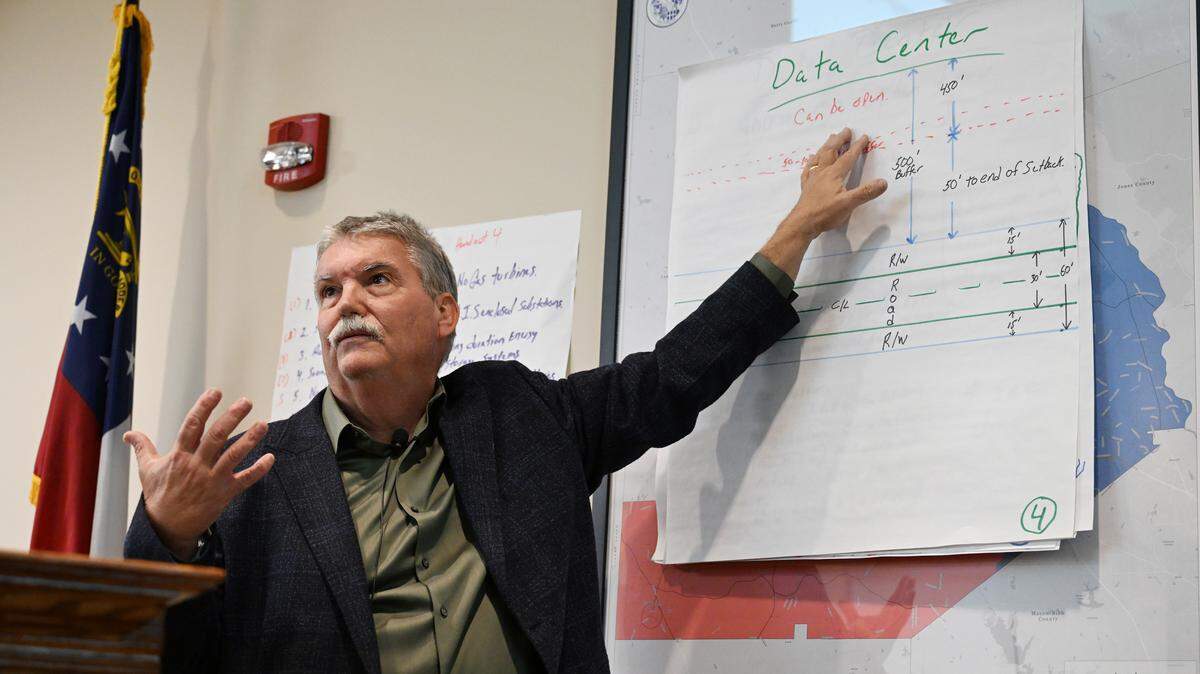
The Monroe County Board of Commissioners tabled a proposed amendment setting new rules around data centers Tuesday night, saying it needed more time to make changes to the legislation.
The proposed amendment would set standards for the construction of data centers, including required buffers, rules around generators and language to curb noise and light pollution.
The amendment comes as localities across Middle Georgia scramble to update local codes to account for the sudden influx of data centers. Monroe County has had a moratorium on new data centers since December 2025, when commissioners put one in place while they determined new standards.
Data centers are already coming into the county, though. A proposal to rezone about 950 acres off Rumble Road for a data center was approved in November 2024, and Google purchased the property for a staggering $42 million in September 2025 for a potential development.
Richard Dumas, a spokesperson for Monroe County, previously told The Telegraph that the new rules, if passed, would apply to future projects as well as the Rumble Road project since that development has not yet been constructed.
What changes do commissioners want to make to the amendment?
While commissioners and residents seemed open to the amendment during Tuesday’s meeting, commissioners wanted to add additional standards and edit the legislation’s language.
At the suggestion of the county attorney, commissioners tabled the amendment for their next meeting to give themselves time to properly adjust the proposal.
The amendment, with suggestions made by the Monroe County Planning and Zoning Commission on Feb. 23, would restrict data centers to industrial zoning districts, require a 200-foot buffer, limit noise to 65 decibels at the property line, mandate generators to be fully enclosed, forbid the use of diesel and gas-powered generators, and limit light poles to no more than 25 feet tall .
Commissioners said during Tuesday’s meeting that they want to add additional rules including increasing the buffer requirement to 500 feet with at least 100 feet of natural growth, as well as language explicitly banning data centers from using wells to get water. Developments would be required to use tier four generators, which are generators that meet the Environmental Protection Agency’s strictest emissions standards.
While commissioners emphasized the importance of strong and enforceable rules, they did express an openness to more data center developments in the county.
District 2 Commissioner Eddie Rowland, who presented information prior to the discussion and vote, said he lives about two miles from the Rumble Road site. He said data centers are safe for nearby residents and can be beneficial to the area due to the tax revenue they generate.
“There’s no drain on your school system, there’s little drain on county services, and it’ll likely cover most, if not all, property taxes,” Rowland said.

The project could generate $20 million in tax revenue annually, according to a development of regional impact report the Rumble Road project developer filed shortly before the property’s rezoning.
While residents did not express opposition to the amendment during Tuesday’s public comment, many suggested making edits.
Robin Morgan, a county resident , asked commissioners to approve the amendment with language banning data centers from C-1 districts. C-1 is a zoning district for commercial developments, such as grocery stores, offices and studios, according to county codes.
“C-1 neighborhood commercial districts are intended to establish and preserve small business areas of limited nature that serve primarily the residential area in which they are located,” Morgan said. “I don’t think I have to explain to you why data centers don’t fit that bill.”
Resident Margo Kenirey asked they add a rule dictating maximum square footage for each building on a data center site, arguing it would help protect the surrounding environment and prevent sprawl.
“There are still a few gaps that create weaknesses for area residents,” Kenirey said.
What happens next?
The commission voted unanimously to table the proposed amendment until their next meeting on March 17.
In the meantime, commissioners will work with the county attorney to add in new standards and language based on discussion and suggestions made during the meeting.
Because commissioners have already held the required public hearings on the proposed amendment, they can go straight to a vote at the March 17 meeting, according to officials who spoke during the meeting.