
Project to unearth history of enslaved people turns up more than 4,000 records in Macon
When she was a child, Nicka Sewell-Smith’s house had an Encyclopedia Britannica set.
“My grandma spent all this money on them, they were nice and red,” said Sewell-Smith.
But those encyclopedias didn’t fully capture Black history in America — when Sewell-Smith needed to go to the library for a school project, her mom questioned why she didn’t just use the encyclopedias at home.
“I said ‘Mom, Martin Luther King Jr. is not in those encyclopedias,” Sewell-Smith said, which her mom laughed at.
Tuesday, Sewell-Smith saw a project come to fruition that she thinks will unearth the true history of more than 183,000 enslaved people. The project, “Articles of Enslavement,” analyzed about 38,000 newspaper articles using cutting-edge technology to find the names, ages, physical descriptions and other crucial details about enslaved people. It’s information that could help their ancestors find out who they were. The project found information on 4,360 names from the Georgia Journal and Messenger, a previous name of The Macon Telegraph. More records were found from Georgia than any other state.
Sewell-Smith, a professional genealogist and senior story producer at Ancestry, hopes it’s a project that will leave people more informed of the history of enslaved people in Georgia and beyond.
“We don’t want to be like my mom with the encyclopedias,” she said.
What was found from Macon’s history?
The articles fill in gaps where local courthouse and community records were destroyed or lost, and they provide a fuller picture of history from 1788 to 1867. The collection contains information on a national scale, allowing the public to trace enslaved people back in time, from location to location. Additionally, the records key in on the people implicated in slavery, including previous slave owners, courthouses and newspapers.
“You’re really getting a bird’s eye view into a community,” said Sewell-Smith.
By providing information to fill in gaps, this collection does what Dr. Chester Fontenot Jr., professor emeritus of English and Africana studies, calls “offering a correction to history.”
Fontenot worked with Bibb County Superior Court Clerk Erica Woodford and Assistant Bibb County Superior Court Clerk Stephanie Woods Miller in the “Enslaved People Project,” an initiative separate from Ancestry’s new project.
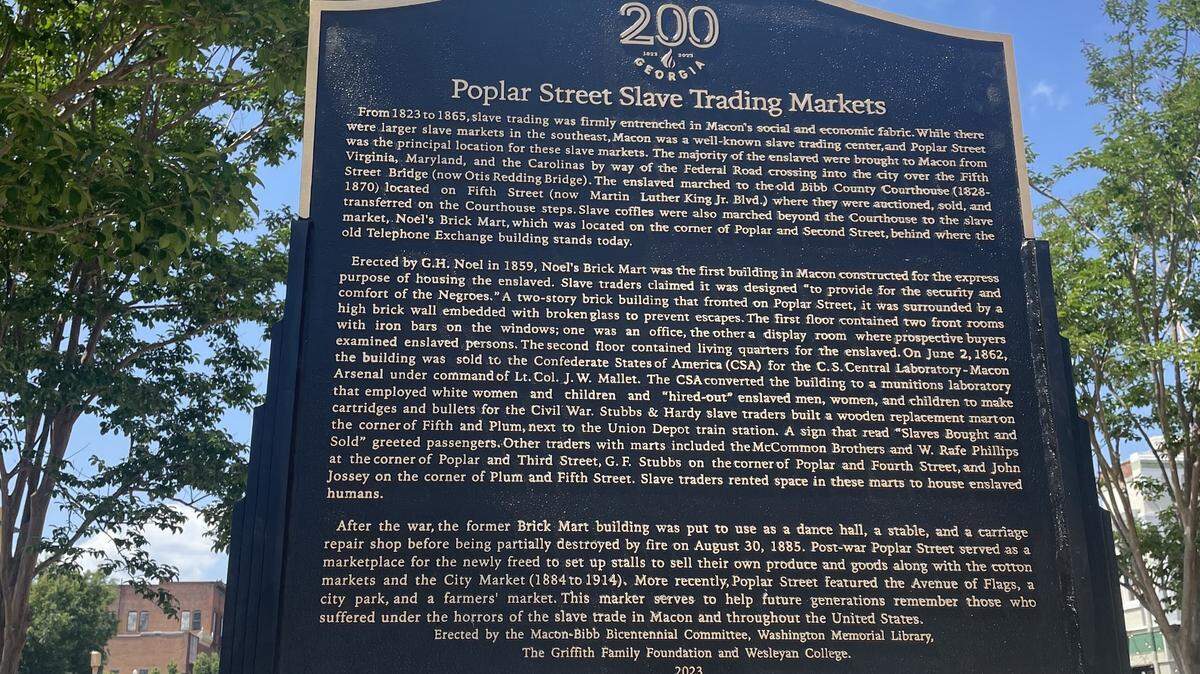
He said for years, Macon’s Black residents were told that Macon didn’t have much to do with slavery in the past. This group was able to correct that when they found the records of 1,000 slave transactions, with each one containing up to 230 slaves.
Fontenot said this collection from Ancestry will add to that significantly.
“Now we have the resources to correct the misrepresentation of the history of this community,” said Fontenot.
That history includes an advertisement published in the Georgia Journal and Messenger, advertising the sale of Charles, Lucy and Lucy’s five children in March 1865, and a sale at Bibb County’s courthouse.
For many, Ancestry says going through these articles may be distressing.
“At some point, it’s going to dawn on a person, that these aren’t just documents, these aren’t just words on a page, these are actual people,” said Fontenot, “When that realization hits … there was a tremendous amount of sadness that overwhelmed me.”
For this reason, Ancestry has provided strategies for critically reading and navigating these heavy materials to prioritize mental and emotional well-being.
While it may be upsetting Fontenot says documents like these show how far the community has come. The world is characterized differently than it was when she was doing her middle school project, said Sewell-Smith.
“We’re just better as people,” she said.
Materials like the “Articles of Enslavement” allow for an even fuller understanding of history, one that brings forward the voices of people who were silenced.
“This is one effort to try to just give their personhood back, and not make them a footnote,” said Sewell-Smith.