
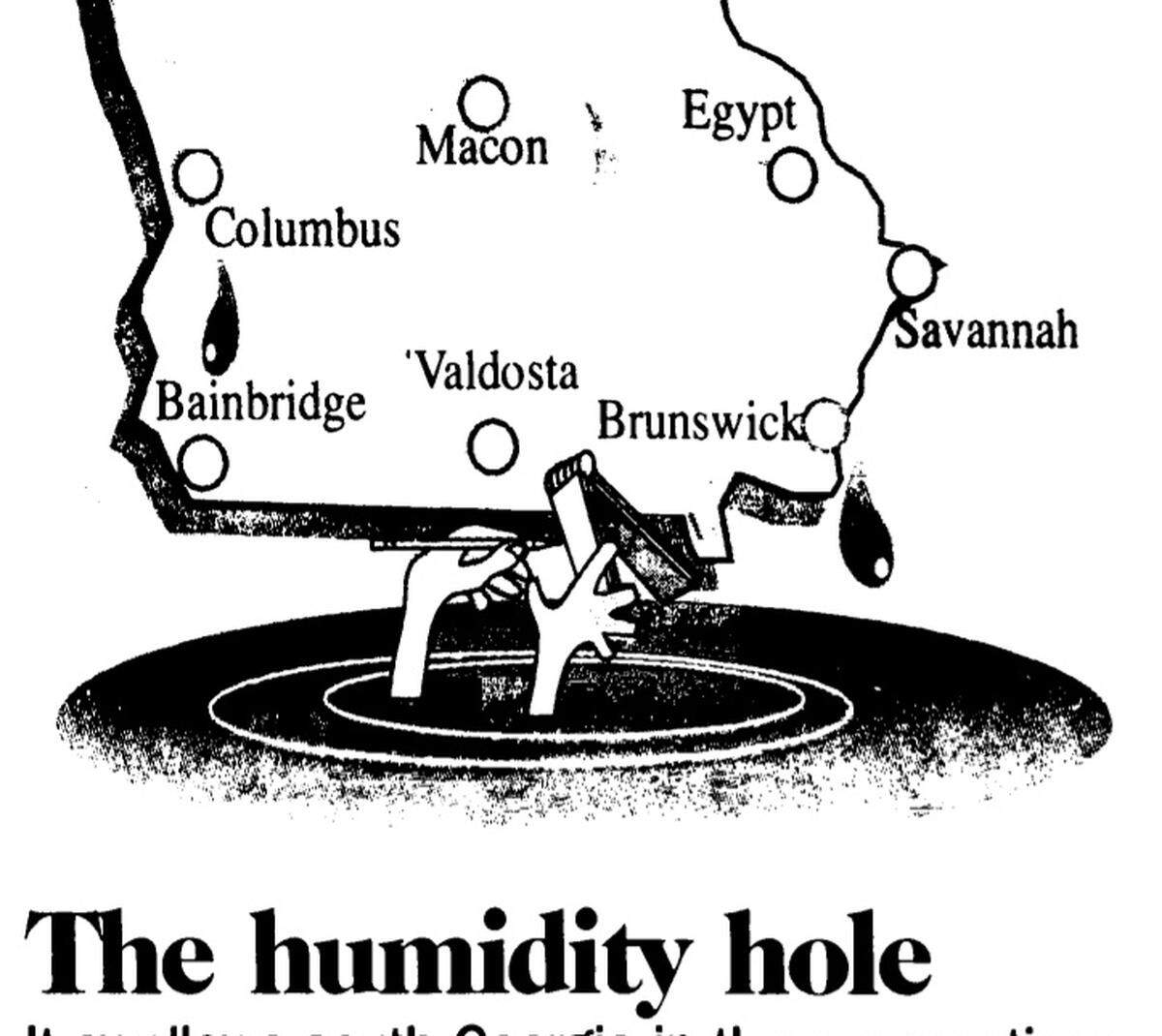
As summer boils over, we take a swampy, sweaty, sweltering dip in Georgia’s ‘humidity hole’
A version of this story appeared in The Telegraph on July 19, 1992.
The man doesn’t sweat. It is 95 degrees in the 1 o’clock shade of his tin-roofed, pine-and-cypress shack planted on 160 acres a mile below the Okefenokee Swamp and its blackwater boil.
But, no, 81-year-old William McKinley Crews isn’t dripping a drop on his century-old plank floor.
Maybe no one told him he is supposed to gripe about the oppressive heat. Perhaps no one told his neighbors either here in the perspiring Podunks across south Georgia.
While McKinley has a Florida address, barely a mile into the Sunshine State, his home on a dirt road in the border town of Moccasin Swamp endures the sapping swelter just the same. It is a swampy stew that comes calling in late spring and leaves the locals that it ingests feeling like someone stuffed their heads in Hefty bags for four months. Somehow, though, the heat is more a respected rival than it is a burning enemy.
“It would bother me if I got out there to stay in it,” Crews said. “If I got out in it, it’d burn my ass up.”
Dressed in Sears overalls and a tattered long-sleeve shirt, Crews gazed out, his breaths more sips than inhalations. It was as if he was sampling the ungodly oxygen, testing its palatability — for palatable it was not. Equal parts pasture haze and tub water, it went down like steam off a brick oven.
As he stood on his porch, the once-torn shoulder of his shirt mended with kite string, he told of his livestock — a bull and four heifers. He also tends 10 skinny cats and three skinny kittens. He has no air conditioner, no electricity. But William McKinley Crews does not sweat.
Day 1: Hanging heat
During this reporter’s three-day, 800-odd-mile odyssey in an un-air-conditioned automobile to chronicle Georgia’s steamy lower half, some inhabitants shared Crews’ don’t-feel-it philosophy.
Some even invoked facets of religion. Heaven and hell are the talk of summer. God made it hot, brother, and it’s hotter than hell.
A man in Taylor County named Vivian Riggins, a staff sergeant waiting his turn outside the National Guard armory mess hall in Reynolds, was asked, “Is it hot?”
“No,” he replied. “I’m just sweating for the hell of it.”
Riggins and his Company B comrades were gearing up for an August trip to Jordan. And, Amman, is it ever warm there. “The government,” Riggins suggested, “needs to come out with some camouflage shorts.”
The government actually needs to do something else here, too. Like outlawing BRIDGE MAY ICE IN WINTER signs, and seeing to it that the Clay County sheriff, whose name is Shivers, removes his re-election campaign signs as soon as possible.
It may, however, require a higher power to address a curious problem that some locals have with the sun.
“I kind of believe it gets closer and closer to the earth,” said Buena Vista gardener Robert Holt, “’cause it’s getting hotter and hotter. I drank some cold water and they had to lay me out on the ground to get the cramps out of my knees.”
During summer here, the earth’s orbit actually places it at its furthest points from the sun. The sun’s rays, due to our planet’s tilt, are more directly aimed at our hemisphere in the summer. Our resulting overheated air can suck up — and hold —more moisture. Bad-hair days abound. Ninety-degree air can slurp up nearly two times as much moistness as 70-degree air can.
Science aside, a lot of folks just wonder and wilt.
“We can’t understand why it’s so hot,” a fellow named Ricky Thomas said as he sat cooling it with his buddies and guzzling Gatorade outside a convenience store in Quitman County. “I guess it’s the good Lord’s work. It’s hotter than hell, but we’re gonna keep drinking and hang in there.”
The humidity hung with them, as it did down Cairo way where a waitress at the Huddle House, Angela Barner, said, “The humidity just comes here and hangs around. Where I’m from in Tennessee it don’t get like this. I came here with my mama in February and it was in the 80s. I’d say, ‘It’s hot.’ She’d say I hadn’t seen nothing yet. And she was right. It’s just miserable.”
Sitting nearby, diner patron Phillip Singletary said, “When you walk outside it feels like a fire hitting you in the face.”
Down the road in Thomasville, Ernest Dow, a customer at the Pack & Sack figured “the ozone’s got something to do with it.”
Then he added, “It’s hot as hell.”
Further down Highway 84 at five minutes to 6 on that Sunday evening, a woman was waiting to step inside the Quitman Church of God. As she stood by for her preacher to unlock the door for prayer service, she clutched a Bible in one hand and gripped a paper fan on a stick in the other, batting it at the 95-degree despair.
“I’ll tell you,” she said, “it’s hotter than hell’s gonna be.”
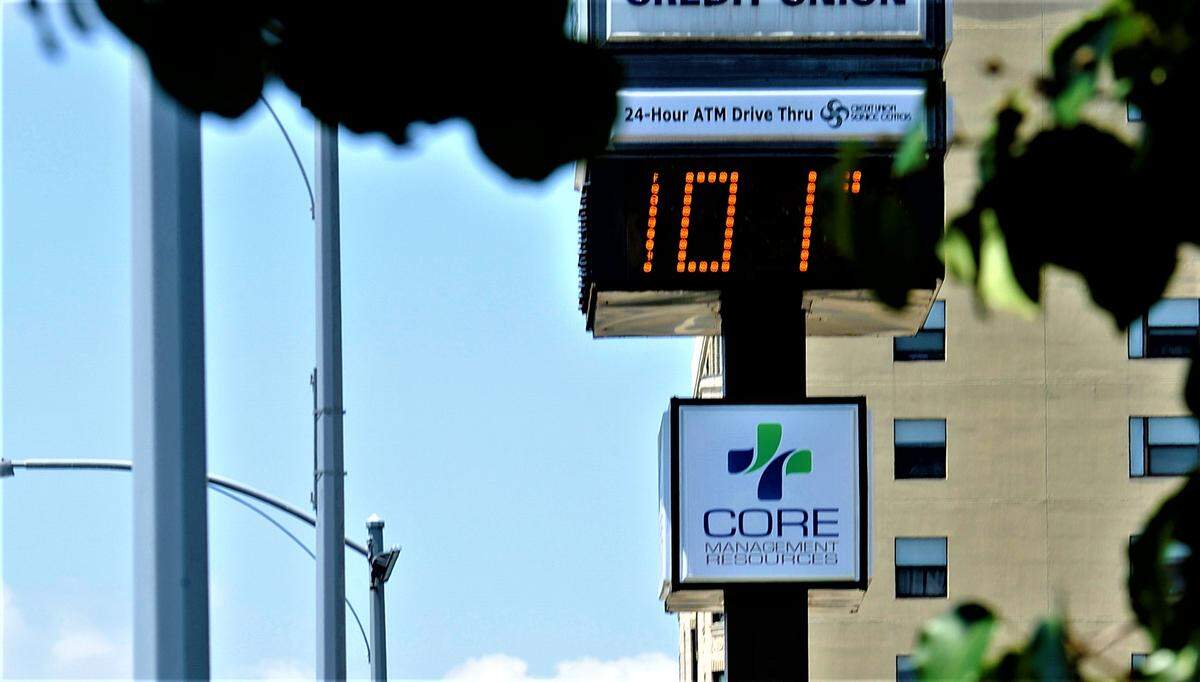
Day 2: No sweat
Fifteen miles east of Valdosta on Highway 94, at Sue’s Country Store, three fans rattle away, doing their best to kick up a breeze in the morning broil.
An indoor thermometer at this Echols County establishment reads 88 degrees at 11 a.m., and the people inside do not particularly care to discuss the weather. Even though on the wall, for some reason, there is a life-size color poster of Willard Scott, the NBC weatherman.
“I try not to talk about the heat,” Sue’s proprietor Buck Moon said. “It don’t bother me either way. But you wait till 4 o’clock. It’ll be 188 in here. I was soaked in here yesterday. It was like somebody dumped water all over me.”
Peering out the store’s screen door, Moon watched the heat wriggling from the highway. “The pavement’s like an oven.”
Thirty-five miles south and east, that pavement slides around the Okefenokee into a sliver of north Florida and the town of Baxter. Two miles from there, northerly up a beach-sand-gray dirt road, a skinny kitten was sucking its mother’s milk for lunch on the front porch of one William McKinley Crews.
Crews, a 6-footer leaner than a dried cornstalk, was resting, sleeping through the heat of the day.
“I lie down most of the time,” he said when a visitor woke him.
As for the heat, he said, “ain’t no use talking about it. If it’s hot, it’s hot.”
On up the road about 45 miles, in the town of Tarboro, some men sat playing cards under an oak tree at the Ponderosa Store, a roadside grocery.
A man there named Walter Hamilton swigged an RC Cola and said, “They tell me that every year the sun drops closer and closer to the earth. It gets hotter and hotter.”
Day 3: Egyptian sun
German minister Johann Martin Bolzius, who settled around Savannah in the middle 1700s, once wrote of the region’s summer weather: For some time there has been a thunderstorm with rain almost every day. ... In this heat, watermelons refresh people during the excessive heat here.
Sweat rags also offer respite in Georgia’s Middle East, over near the South Carolina Low Country.
In the town of Guyton, along Highway 17, a man who said his name was Head swabbed his neck with a maroon cloth. There at Thompson’s Grocery at noon on a Tuesday he mentioned how the heat was God’s will.
“What can you do about it?” he said. “I love this kind of heat.”
“You love this weather?” asked a woman walking by.
“Oh, yeah,” Head said, gesturing to the heavens. “The big man up there made it for us.”
Ten minutes up the road in Egypt, some men installing a pay phone discussed summertime survival.
“It’s always worser at the beginning of the summer,” Jeff Nesmith said. “I tell you, I’ve been out here when you try to breathe and you just can’t get a breath. It’s killer. You get hot as hell. You start to see stars.”
“That,” his co-worker, Rick Mock, joked, “is after you’ve had a 12-pack.”
Or after you have driven 663 miles through south Georgia soup and had enough of the humidity, rolled up the car windows and cruised the 137 miles home in air-conditioned comfort.
Note to reader: Too bad summer doesn’t end as abruptly as this story.
This story was originally published July 15, 2021 at 5:00 AM.