
COLUMN: ‘Winter rose’ keeps us going
Winter is a season to be endured. It is three months of short days and long stretches of sniffles and shivers.
A forecast of rain with a high of 42 degrees is fun only if you’re a duck. Or a masochist.
When the skies are as gray as a No. 2 pencil, and the trees are a bare backdrop on the horizon, I want to get down on my knees and thank God for camellias.
They work overtime to color our world from October until March. The beauty of azaleas, dogwoods, day lilies and Yoshino cherry trees is fleeting. But camellias are nature’s LED lightbulbs. They shine at a time when not much is blooming. They lift our spirits during the colorless gap when the flowers, shrubs and grass don’t bother to put on any make-up.
“The winter rose,’’ said Matthew Israel.
Matthew has worked at the American Camellia Society at Massee Lane for nine years and now serves as executive director.
Massee Lane is a stone’s throw off Highway 49, about 5 miles south of Fort Valley. However, I usually don’t have to travel far to find Matthew. A couple of times a week, I can look out my kitchen window and see his truck parked in the alley next to my house.
His parents, George and Pam Israel are the former mayor and first lady of Macon. They have been our neighbors for the past 14 years. Our backyards have enough camellias to supply an entire high school prom with corsages.
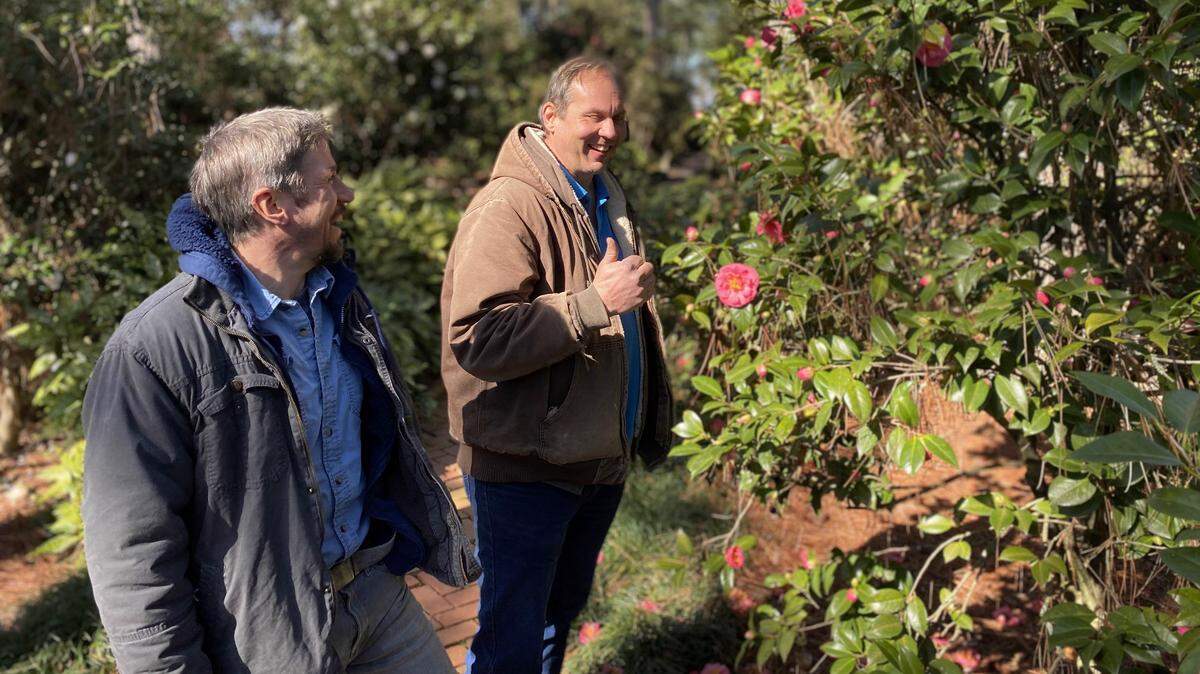
William Khoury, the society’s superintendent of gardens, and Matthew recently gave me and my wife a tour of the formal garden at Massee Lane. It covers almost 10 acres of the 160 acres and features more than 1,000 varieties of camellias.
Delinda and I have been to the American Camellia Society many times. It is one of our favorite places. But this was a special visit … despite the frigid temperatures. When you’re surrounded by such beauty, you don’t feel the deep chill nearly as much.
“Camellia Days” is an ongoing garden event at Massee Lane from January through March. The “Festival of Camellias” is celebrated every day in February, which is prime time for camellias.
The American Camellia Society has been headquartered on the Massee Lane property since 1968, but its roots are in Macon. The first public camellia show in the United States was held at the former Burden Smith & Co. department store on Third Street on Feb. 5, 1932. (Burden Smith once was the city’s oldest department store, closing in 1978 after 112 years in business.)
There is a Georgia Historical Society marker to commemorate the event in Third Street Park, near the intersection of Cherry Street. Not only was it the first public show in the U.S., it also was the genesis for the Azalea and Camellia Society of America, which was founded 13 years later – on Sept. 29, 1945 – across the street at the Dempsey Hotel. The society was organized to promote interest in camellias and establish nomenclature to help identify the thousands of varieties. There are more then 20,000 varieties worldwide.
Camellias originated in Southeast Asia and have been around for centuries. They were introduced in the U.S. in the late 1700s, and visitors from nearly every state (except Alaska and Hawaii) and many countries find their way to the American Camellia Society – in the heart of peach country -- to take in the beauty.
Southerners have a particular affinity for camellias, which grow in our yards for generations. (It’s the state flower of Alabama.) They are like our family trees, which may explain why we saw so many varieties named after families and friends as we walked along the brick paths in the formal garden.
Willie Snow Ethridge, a former Telegraph feature writer and the author of 16 books, once described a similar kinship in a newspaper story she wrote after the first public camellia show in Macon almost 90 years ago.
“Camellias are not just flowers,’’ Ethridge wrote in February 1932. “They are antiques. They have histories and legends and romances twined about them. They have genealogies.’’
Ed Grisamore teaches journalism at Stratford Academy in Macon. His column appears on Sundays in The Telegraph.