
A COVID-19 ‘war effort’: An inside look at the mask-making movement in Middle Georgia
Tracey Garner has been social distancing for the past four years while her husband, John, was going through treatments for brain cancer.
In the past month, Tracey said she and John have noticed several changes as they traveled to different hospitals for treatment amid the new coronavirus outbreak.
“Each time we were in these places, we were seeing more and more and more restrictions,” she said. “We started seeing hospitals that were really, really full to people being encouraged to not be around each other.”
Tracey is a member of a sewing group in Atlanta, and she noticed they group was starting to make masks for Atlanta hospitals, including Piedmont Atlanta Hospital, where John receives treatment.
As she started making masks with the Atlanta group to give back to the hospitals that have helped them, she started worrying about Middle Georgia because she thought the virus would most likely come to the area.
“We talked to the Atlanta group and said, ‘We support what y’all are doing, but we’re going to have to take care of Central Georgia,’” she said. “They were totally in agreement.”
Tracey’s group joined with a Warner Robins sewing organization to form the Sewing for Middle Georgia Facebook group; members make masks to donate to hospitals and healthcare facilities in Middle Georgia.
“It’s really easy to get very upset and very, very concerned, and if you can do something to be a positive part of your community, you actually can have a lot of stress relief,” Tracey said. “You, also, can be part of a solution, and even though this is just a very tiny, tiny part of what’s going on, it gives those of us at home – that are crafters, that want to do something but don’t know what to do – it gives us something that we can do.”
Starting a movement
Tracey’s group has become a source of mask information for people in Middle Georgia; when Tracey reached out to another organization for information about making masks for a specific hospital, they referred her to her own group, she recalled with a laugh.
“What’s driving this is the need to get information to people quickly and succinctly, so they can make the best informed decisions for themselves,” she said.
Tracey has seen a lot of misinformation about what materials to use and how to construct masks, so she wants to provide accurate information to people so they can protect themselves and help others.
The Facebook group allows mask makers to discuss strategies, share information and find solutions.
“We have people who are military spouses, and so we have a drop off location that’s on the base, and they’re talking about how to make masks with the colors that are needed for the military,” she said. “But I’m not military. If people weren’t sharing that within the group, I would have had no idea.”
People in the group have made video tutorials, sketches of mask patterns and posted articles about the best materials to use.
“This group is actually all about community and sharing, and so I don’t think of the group as my group because it’s so much bigger than that and it’s so different than what I expected it to be. I didn’t expect this at all, and I’m really excited for… once we no longer are having to do the masks, this is going to be a great group,” Garner said.
Dealing with a terminal illness during the outbreak
Tracey said she is so grateful for the other administrators in the Facebook group, including Anna Jane Lilley, Sandy Kusuda, Sabrina Potter, Rowena Tanner and Catherine Lonard, because she is a full-time caregiver to her husband.
John has one of the rarest forms of brain cancer Tracey said when he was diagnosed in 2016, he was given 60-90 days to live.
“We’ve been extremely fortunate for John to have done as well as he has done this entire time,” she said.
Although Tracey and John don’t face the same type of stress most people are feeling right now because they were already socially distancing, she said she is still worried about John’s upcoming doctor’s appointments.
“We’re currently having a discussion with the doctor in Atlanta… on how important is it for us to look at the tumor right now?” she said.
John has had about a quarter of his brain removed, Tracey said. Although he can still walk, talk and make jokes, she said he gets terrible migraines sometimes, and he forgets certain things.
“Like yesterday, I actually sent the other admins in the group a message, and I said, ‘I’m going to be out of pocket most of today because I’m slightly freaked out with John, but thank you for your help.’ And, that’s how we live our lives.
“It’s going to sound horrible, but we have more of a community now than we did before COVID, but it’s because people are having to communicate and live more like what we’ve been living like,” she said. “The point is that people can have community even if you cannot physically touch each other.”
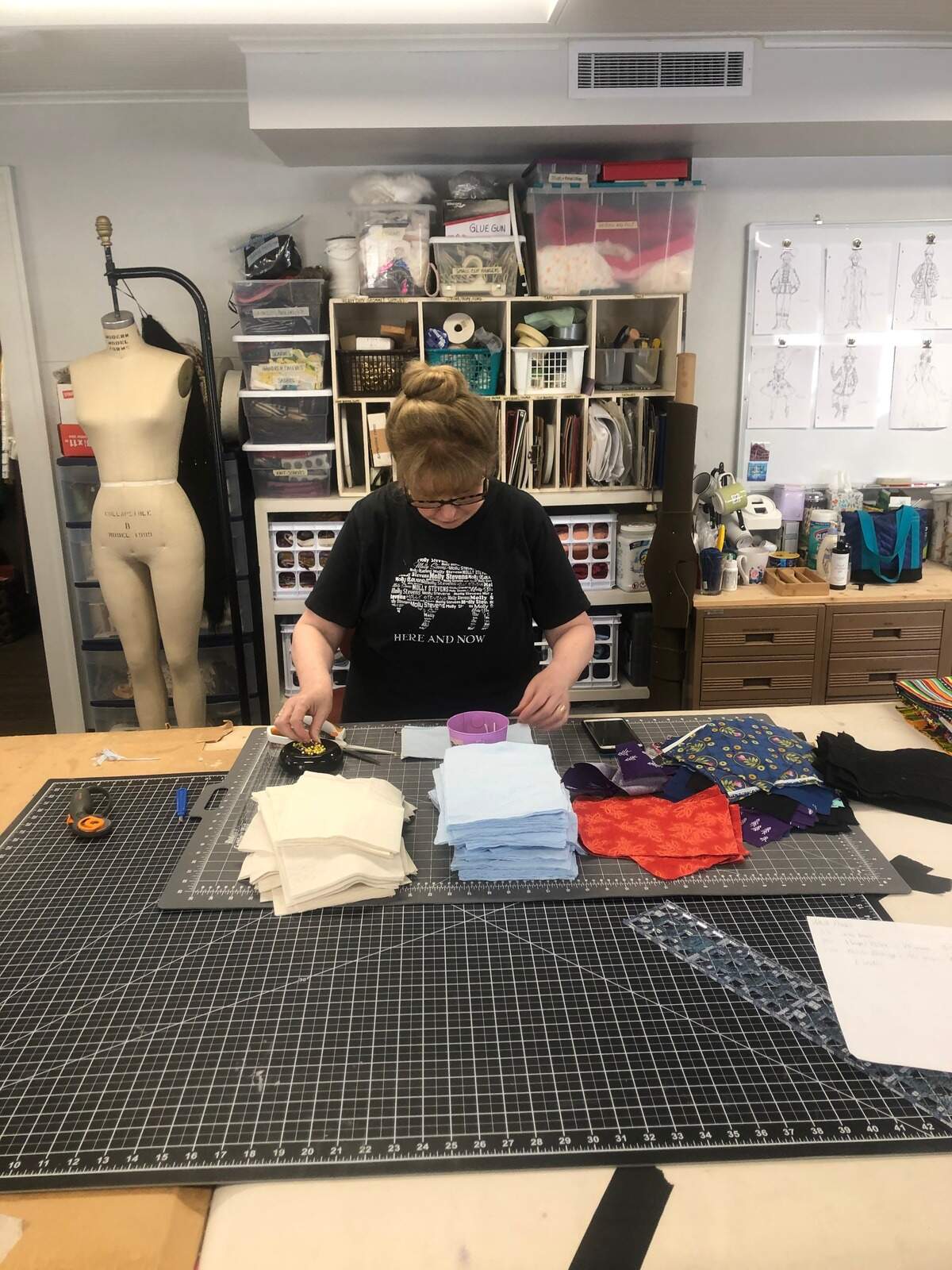
‘A community coming together in a war effort.’
Sewing for Middle Georgia has more than 400 members, and those members include the costume designers for Mercer University’s theater program and Theatre Macon and a group of Mennonite women in Montezuma.
Although Tracey wasn’t sure about the exact number of masks the group has produced, she said she knows they have made more than 1,000.
Shelley Kuhen, costume designer for Theatre Macon and Mercer University’s theater program, said she works with two other people at Mercer to produce masks because their work area is large enough for them to stay six feet away from each other at all times.
“It feels like a community coming together in a war effort. It reminds me of the stories my mother used to tell me about during World War II and the different groups of women how they did things for the war effort. That’s what it feels like, like we’re part of the war effort,” she said.
The group at Mercer is making covers for N95 surgical masks so the hospitals can use them to prolong the life of the N95 masks, she said.
As of April 3, they alone had produced 300 mask covers, she said.
“Sometimes it feels like we are a drop in the bucket because some people are making tremendous amounts of masks,” she said.
The Mennonite women in Montezuma are running out of supplies because they are producing so many masks for area hospitals and could use donations of spare cotton fabric and T-shirts, she said.
“We’re fighting this battle together, and it’s one way we can do it and feel like we’re just contributing,” she said. “It doesn’t just keep you safe from the disease. It helps keep you from spreading it to other people.”
How to get involved
Crystal Bentzel, a member of the group, said she hadn’t sewn for 25 years when she decided to join, and now, her and her two children have made more than 120 masks.
“It feels good just to be helping others right now even if it’s in a smaller capacity,” she said. “Even if I had sat down on a sewing machine for the first time, I think anybody can easily figure out how to do this.”
Bentzel said it took her a few hours to make her first mask because she was watching tutorials and taking her time, but now, she can make one about every 20 minutes.
People who are interested in joining the movement either by making masks, donating materials or in other ways can join the Facebook group at www.facebook.com/groups/658755918273559.
People can also donate money to the group through Joann Fabric and Craft Stores. Visit www.joann.com, purchase a digital gift card and forward the digital code of the gift card to donation4middleGAmasks@gmail.com.
“If anybody has 100% cotton laying around that they’re not using, we would love donations for that because a lot of the members were paying for things out of pocket to help others,” she said. “Even if you don’t sew, there’s other ways to help contribute to the group.”