
$250K spent on traffic lights and crosswalks that lead nowhere at this I-75 interchange
The state has spent more than $250,000 to install traffic signals and crosswalks at each of the four entrance and exit ramps on Bass Road at Interstate 75 in north Macon, but there are no sidewalks connecting them.
Striping on the pavement creates a designated path for pedestrians that doesn’t really lead anywhere, and plans to add sidewalks appear to be years away.
The new crosswalk upgrade even includes mats of truncated domes, which look like brick-colored, flat Legos, and are designed to signal sight-impaired pedestrians that the road is near.
At the top of the I-75 north exit, the right side of the crosswalk ends near a drainage ditch and the left side stops at the six-foot grassy shoulder near the overpass.
If one were crossing that ramp and headed over the bridge, there is only a scant two feet of shoulder to walk on as vehicles whiz dangerously close by.
The Georgia Department of Transportation says it is outfitting the crosswalks with pedestrian safety measures to allow people to push a button to stop traffic and allow them to safely cross.
GDOT District 3 Communication Officer Penny Brooks said it’s the department’s standard practice to install “pedestrian accommodating facilities” when traffic signals are installed.
New right-turn lanes were added to the ramps, which necessitated upgrading the signals that led to the safety improvements.
“Our engineers want to make sure that if someone happens to walk to the intersection (it can happen even if there’s no sidewalk), they have a designated way to safely get through the intersection,” Brooks stated in an email response to a Center for Collaborative Journalism inquiry.
A few years ago, the Federal Highway Administration and the National Highway Transportation Safety Administration collaborated to create 2018 statewide performance targets to increase safety.
“Flexibility in future federal funding allocations will depend on whether the state meets these targets and improves the ongoing trend of pedestrian fatalities and serious injuries,” the Pedestrian Safety Action Plan stated.
The goal is to achieve an 80 percent reduction in pedestrian and bicycle fatalities and serious injuries in 15 years, but are federal and state planners putting the money where it is needed most?
Contracts for the signals and pedestrian enhancements at the Bass Road ramps total $258,000, Brooks said.
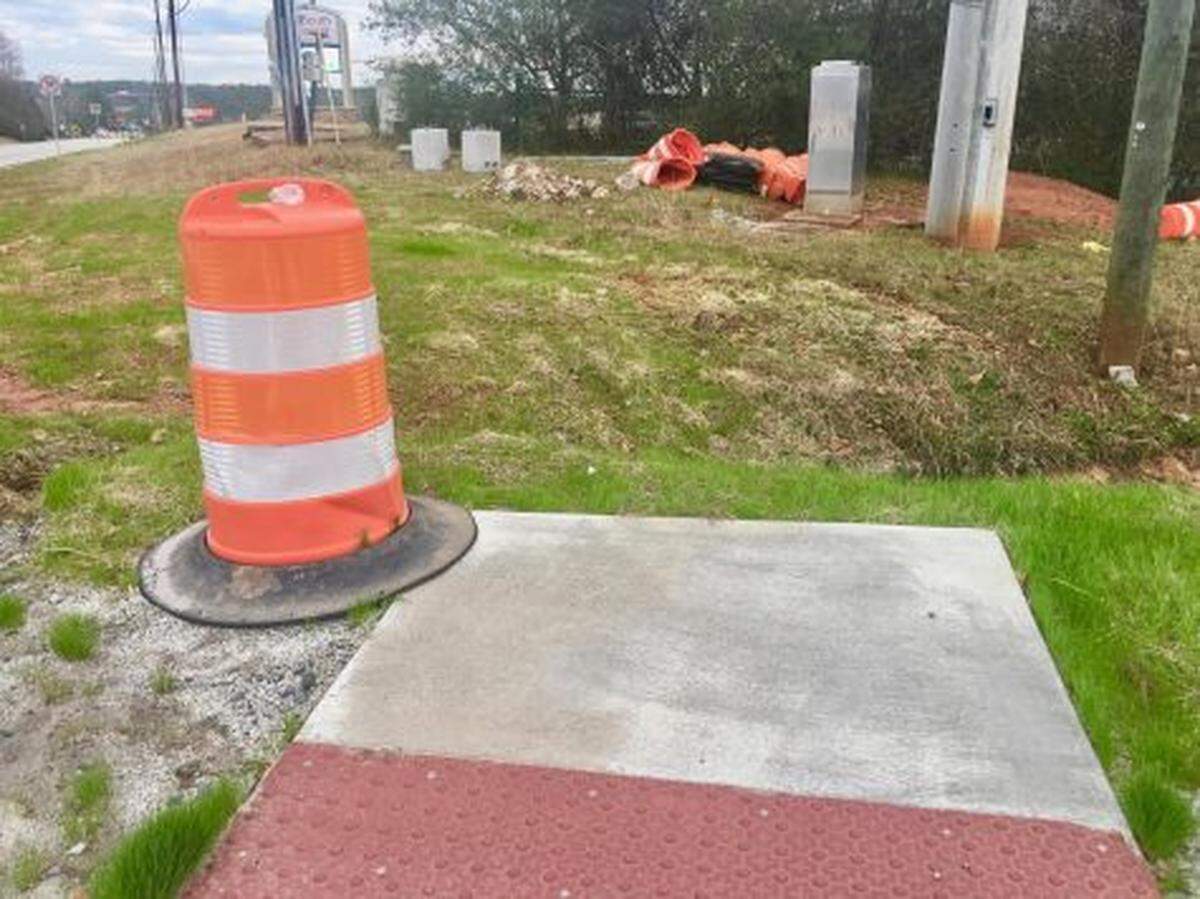
As drivers sit at the red light, they have no doubt noticed the enhancements that include concrete islands at the top of the ramps.
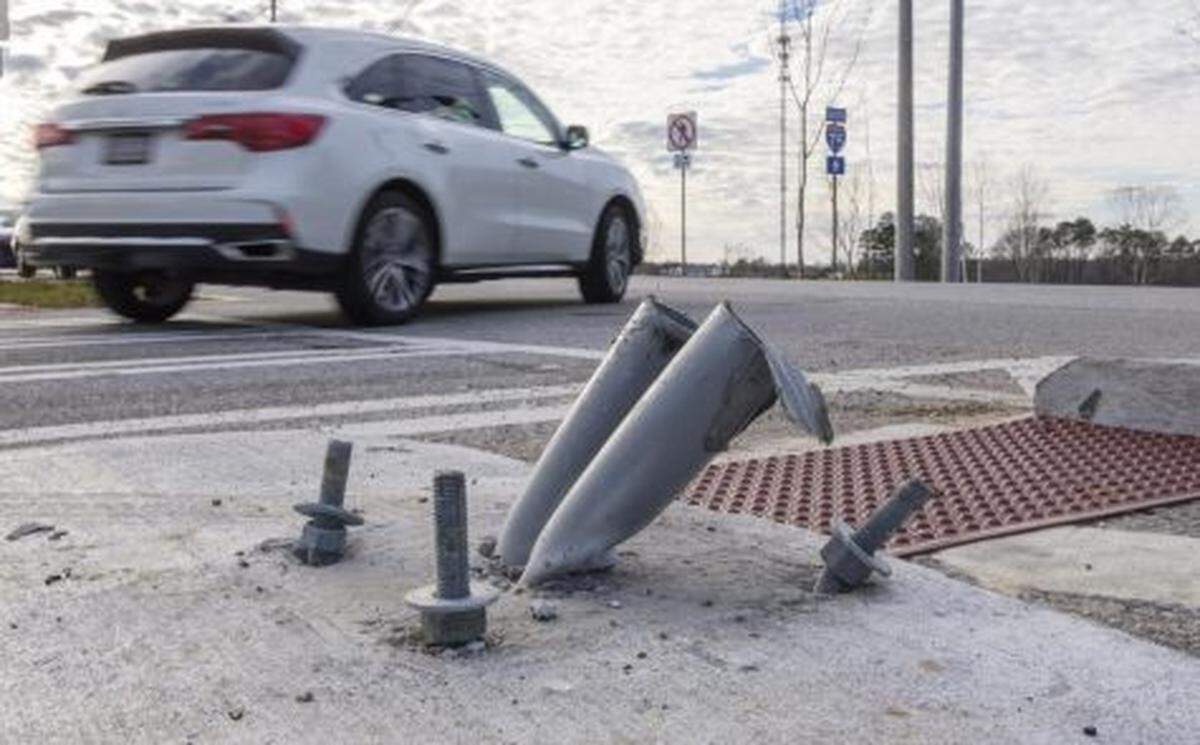
Judging by tire marks over one of those islands, the new equipment on the northbound exit caught at least one motorist off guard. The base for the signal box pole was dislodged and the plastic electrical conduits it once protected are now bent.
At peak times, about 900 vehicles per hour come through that area, according to 2018 data, which is before the new North Macon Plaza opened at Starcadia Circle.
Last year, a $36 million widening project was approved for Bass Road from New Forsyth Road to Providence Boulevard with Macon-Bibb County committing $5.4 million in SPLOST funds for property acquisition and the state funding the rest of the project.
The new crosswalks and Bass Road pedestrian safety were a topic of discussion at the January meeting of the Citizens Advisory Committee of the Macon Area Transportation Study, or MATS.
Vice Chair John Ricketson, who represents Monroe County on the regional board, said: “They’re putting them in now just so they can tear them out.”
Long-range plans include building a new bridge over the interstate, which will almost certainly require reworking the entrance and exit ramps.
The widening project is still years down the road with a projected launch of 2026.
Brooks said the future project might include sidewalks then but “there is nothing definite about that yet.”
Some members of the MATS Citizen Advisory Committee were adamant about making pedestrian safety a priority in the road design.
Committee member Lee Martin, a vocal proponent of designing safer roads, wants the MATS Policy Committee to urge GDOT to include more crosswalks, sidewalks and a median as more lanes are added.
“I’m not saying Bass Road shouldn’t be widened. I’m just asking that it be done in the safest possible manner,” Martin told the committee earlier this month.
Macon-Bibb County Planning and Zoning Executive Director Jim Thomas said the hotels, shops and restaurants on both sides of Bass Road make it prime for heavy pedestrian activity.
Martin fears engineers will not include traffic calming measures, like medians, in the design.
“From Providence to New Forsyth as a five-lane road, I think, is going to be a disaster,” Martin said. “I just want it to be safe, unlike Gray Highway.”
East Macon-Bibb County Commissioner Elaine Lucas, who spearheaded the Pedestrian Safety Review Board in response to a spike in fatalities, has been advocating for GDOT to do more to make state roads safer for people to bike and walk.
She was surprised to learn a quarter of a million dollars was spent to enhance the Bass Road crosswalks when other areas of the county where pedestrians are more prevalent seem to be ignored, like Pio Nono Avenue and Gray Highway where several people were killed in recent years.
Macon-Bibb County traffic engineer Nigel Floyd told the review board this week that GDOT has just completed a Road Safety Audit on the west side. They studied Mercer University Drive from Dellwood Drive, which is west of Log Cabin Drive, to Bloomfield Road near Macon Mall.
Another audit of Eisenhower Parkway led to a new pedestrian hybrid beacon crossing at C Street near Murphey Homes that went live this week and upgrades to the intersections of Bloomfield Road, Oglesby Place and Macon Tech Drive.
In the audits, which are generally conducted twice a year in each GDOT district, engineers walk the corridor and identify potential safety hazards.
“They’re coming back with several suggestions to make it safer,” Floyd told the committee about the most recent audit.
Plans could include a traffic light at Atwood Drive where people often cross, but Floyd thinks that might be too much.
“We’ve studied that intersection in the past and it doesn’t warrant a traffic signal,” he said. “”You don’t have enough traffic on Atwood to warrant stopping traffic on Mercer University.”
Floyd was aware of the new crosswalks at Bass Road and has seen other isolated areas on state roads that have similar upgrades.
“You ride through rural areas where there’s a crossing but nothing else around it,” he said. “It really doesn’t make sense.”
Contact Civic Reporting Senior Fellow Liz Fabian at 478-301-2976 or fabian_lj@mercer.edu.
This story was originally published January 27, 2020 at 5:00 AM.