
‘It’s not going anywhere.’ A look back to 2004, 10 years after Middle Georgia flood
Editor’s note: This story originally appeared in The Telegraph and on macon.com in July 2004.
On a Saturday in the middle of June 1994, an atmospheric ripple rolled off the coast of Senegal in western Africa. Four thousand miles away, in Georgia, two weeks of rain had just busted a spring-long drought and rescued corn crops. The soil was moist.
Even so, after the driest spring in eight years, forecasters called for a dry summer, one that would probably imperil peanuts and soybeans. However, a retired university professor in Athens named Gayther Plummer, the state’s climatologist, wasn’t so sure.
Outdoors he could still smell the organic decay of leaves that almost always baked off when summer came calling.
For decades, Plummer had studied the region’s weather patterns. He concluded that the season would probably be on the wet side. Of course on June 18, Plummer had no idea that a soup of low pressure soon to ride the Atlantic Ocean’s trade winds would, in two and a half weeks, render his prediction accurate beyond belief.
Or that the trough of unstable air trawling north of the equator would lap up enough of the Caribbean and Gulf of Mexico to pour out Georgia’s wettest summer on record.
No one knew.
In Macon, meteorologists stationed in a big-windowed office beneath the control tower at Middle Georgia Regional Airport settled in for another summer of watching
Midwestern rainmakers budge their way southeast only to be sheared into oblivion.
The culprit: a hot-season dome of high pressure called the Bermuda High.
It ballooned in the western Atlantic each summer and spread out over an entire quarter of the country. It was, in essence, a giant umbrella with a penchant for keeping the South dry.
But by mid-June, wet weather in the region had all but eliminated the year’s rainfall deficit. Front-hauling westerlies sailed north for the summer. The tranquil pool of steamy air left behind turned the Southeast into a tropical-weather welcome mat.
Out at sea, a loose-knit cluster of clouds was already looking for a place to wipe its feet.
‘Keep your fingers crossed’
Earlier that month, next to an op-ed column hailing the 50th anniversary of D-Day, an editorial in The Telegraph declared, “The hurricane season is officially upon us.”
The editorial further mentioned how the Georgia Emergency Management Agency was revising its coastal evacuation plan. The commentary noted that directing residents farther inland would protect them from “the threat of winds.”
But the editorial failed to mention tropical cyclones’ deadliest ingredients: rain, rain and more rain. The oversight is common. Violent winds make for instant, sexy TV. By the time the horrors of flooding sink in, it is usually bright and sunny outside.
“Sound” was the word the Macon newspaper used to describe the state’s storm-readiness alterations. “But they aren’t likely to be in place until October. Keep your fingers crossed!”
Twenty-five days later, on June 30, the barge of low pressure that had just cruised the Atlantic cobbled itself into the first tropical depression of the season.
This was after spawning a day or two of thunderstorms in the Virgin Islands.
The storms petered out as the low-pressure wave washed into the Bahamas.
But on June 29 the system erupted in thunderstorms again and spilled 10 inches of rain across parts of Cuba. A weather-reconnaissance plane was dispatched by the National Oceanic and Atmospheric Administration.
What had, in the words of the National Weather Service, up to then been an “uneventful weather system” was soon deemed to be circulating ever so slowly. Still, the blob of clouds remained notably aimless until it cleared Cuba.
But then it became an atmospheric octopus of wind and rain, feasting on the warm Gulf of Mexico, swinging to the northwest and whipping itself into sailing shape.
At 7 p.m. July 1, a wind-spun turbine christened Tropical Storm Alberto was born.
‘It’s just sitting right over us wobbling around.’
Some forecasters assumed a gradually intensifying Alberto would sweep toward New Orleans, slingshotting off the entrenched Bermuda High. The high’s airflow, it seemed, would fan the storm on a southeast-to-northwesterly track.
Imagine a clockwise-spinning merry-go-round, in essence a wheel of high pressure, swatting the encroaching Alberto on a course toward Louisiana and Texas.
On the first day of July, a holiday-weekend Saturday, one meteorologist told a Fort Lauderdale newspaper, “It’s not a threat to Florida.” His prediction was steeped in data from the National Hurricane Center. But a Weather Service branch office indicated that the storm’s trajectory would likely arc much farther east and swoop ashore around Mobile.
Early the next day, the forecasts merged. For by then it was clear: Alberto was roaring toward the Florida Panhandle.
On July 3 at 10 a.m., Alberto packed near-hurricane-force, 65 mph winds when it ran aground near Destin, Fla. It hit land 40 miles up the beach from
Panama City and slammed on the brakes, grinding north toward Montgomery.
Alberto’s remnants slogged into west-central Georgia like a water-logged mop.
Already that month, close to an inch of rain had fallen in Macon. Then on Tuesday, July 5, Alberto, robbed of the upper-air winds to drive it north, bogged down just south of Hartsfield Atlanta International Airport. Alberto’s soggy remains experienced what air travelers had for years come to loathe: an Atlanta layover.
A Weather Service meteorologist told The New York Times, “If you can imagine a top spinning on a flat surface, you can visualize what this storm is doing. It’s just sitting right over us wobbling around. It’s not going anywhere.”
While Alberto’s tropical leftovers waited for a stir from aloft, its spongy tentacles were well on their way to flinging nearly a foot of rain on Macon.
Like a sprinkler someone stuck in the ground and forgot to turn off, the rain, in relentless waves, drenched a swath of the midstate for more than 36 hours.
At times it rained sideways.
At others it dropped straighter than an oil leak.
It rained so much, people got tired of hearing it.
Racing waters devour houses
Out at Lake Tobesofkee, the melon-green, twin-flumed dam sucked down docks and trees. But it was only by chance that it could.
A company hired to upgrade the floodgates had just finished reworking one gate the Friday before. Had the work not been completed, keeping the swollen lake from overwhelming the dam would have been impossible.
Much the way a bathtub’s overflow drain keeps water from rising too high, Tobesofkee’s tandem floodgates combined to keep the lake from escaping.
Without both gates draining it, the lake’s high water would have in all likelihood drowned the spillway, caving the earthen levee surrounding the dam and spilling Tobesofkee’s guts.
The resulting lakewater avalanche would have raced southeast to the Ocmulgee River, devouring houses and hunks of interstate in its path.
Still, the 42-by-42-foot dam gates, which slide up and down like garage doors to let water flow beneath them, were pushed to the limit. At about 10 a.m. on the 5th, water coursing under the gates shoved them wide open, stripping the cable-driven mechanism that controlled them.
When the floodgates shot up, an unmanned pontoon boat, used by dam repairmen to ferry parts, was yanked under. Seconds later, a plume of surging spillwater spit the boat 25 feet in the air and into the rapids below the dam. Onlookers stared awestruck as the craft drifted away in the whitewater milkshake that Tobesofkee Creek had become.
Emergency crews heaved sandbags on top of the yard-thick gates to weigh them down and sink the doors. But that took time. Some houses on the creek were flooded.
Throughout the night of the 5th, in blinding rain, crews struggled to maintain some semblance of control over the lake. Runoff from as far away as Barnesville nudged Tobesofkee higher.
Rain-weary engineers and volunteers on the scene resorted to gallows humor.
Punch drunk from lugging sandbags and dripping wet --- their sarcasm beyond that --- a few began mimicking the Bill Murray character from “Caddyshack.” The demented greenskeeper, pressed into caddying for a golfer playing the round of his life in a torrential downpour, says, “I don’t think the heavy stuff’s gonna come down for quite a while.”
Trouble was, for the rest of Macon and Bibb County, even heavier stuff was on the way.
And nowhere was it more evident than on the faces of the men peering into Lake Tobesofkee’s throat. Some pondered scenarios for which way they’d run if the dam burst.
Perched on catwalks a few feet above the floodgates, they couldn’t help looking down at the rising water.
Heads bowed, they looked like they were praying.
Water service was doomed
The sun peeked out on the morning of the 6th, and inside the emergency-management bunker next to Macon City Hall, then-Mayor Tommy Olmstead made an announcement.
It was a call the roiled Ocmulgee had already made. The river had swamped the sandy bend that housed the county’s waterworks. Water service was doomed.
“We’re gonna go ahead and turn it off,” Olmstead said.
The spiraling dregs of Alberto had, the evening before, finally met their match. A ridge of pressure across the Appalachians threw up an upper-level road block. The mountain of air wider than Tennessee butted the rains back toward Alabama. Alberto’s advance across that state two days earlier resembled the spine of a cursive L. After the system stalled below Atlanta and unleashed steady downpours, it gradually reversed course.
It backtracked in a curlicue, trudged west and died July 7 over central Alabama.
The night before it rained itself out, the storm uncorked a spectacle of natural disaster that few folks in Macon had ever witnessed. A block from Interstate 75 in south Macon, people in houses along the banks of a glorified drainage ditch, Rocky Creek, were wading in their living rooms.
At 8:45 p.m., a man and his girlfriend rode into the submerged parking lot of Pio Nono Plaza, which stretched from a Bank South up on Pio Nono Avenue down to a tire shop next to Rocky Creek Road. Witnesses said the water couldn’t have been more than a foot deep, but the couple’s Chevy pickup floated away in it. The truck swooshed into a ditch and was swallowed whole in an 8-foot-round culvert that ran beneath Rocky Creek Road. The motorists’ bodies were pulled from the water the next morning.
Out at Tobesofkee, where water eventually crept within inches of the lake’s brim, the dam held. While some residents downstream were rescued from rooftops when water buried their houses, no homes washed away and no one died.
‘Maybe he’s looking for his house.’
To the east at Central City Park, the Ocmulgee bathed Luther Williams Field. There was half a foot of water in the Macon Braves’ locker room.
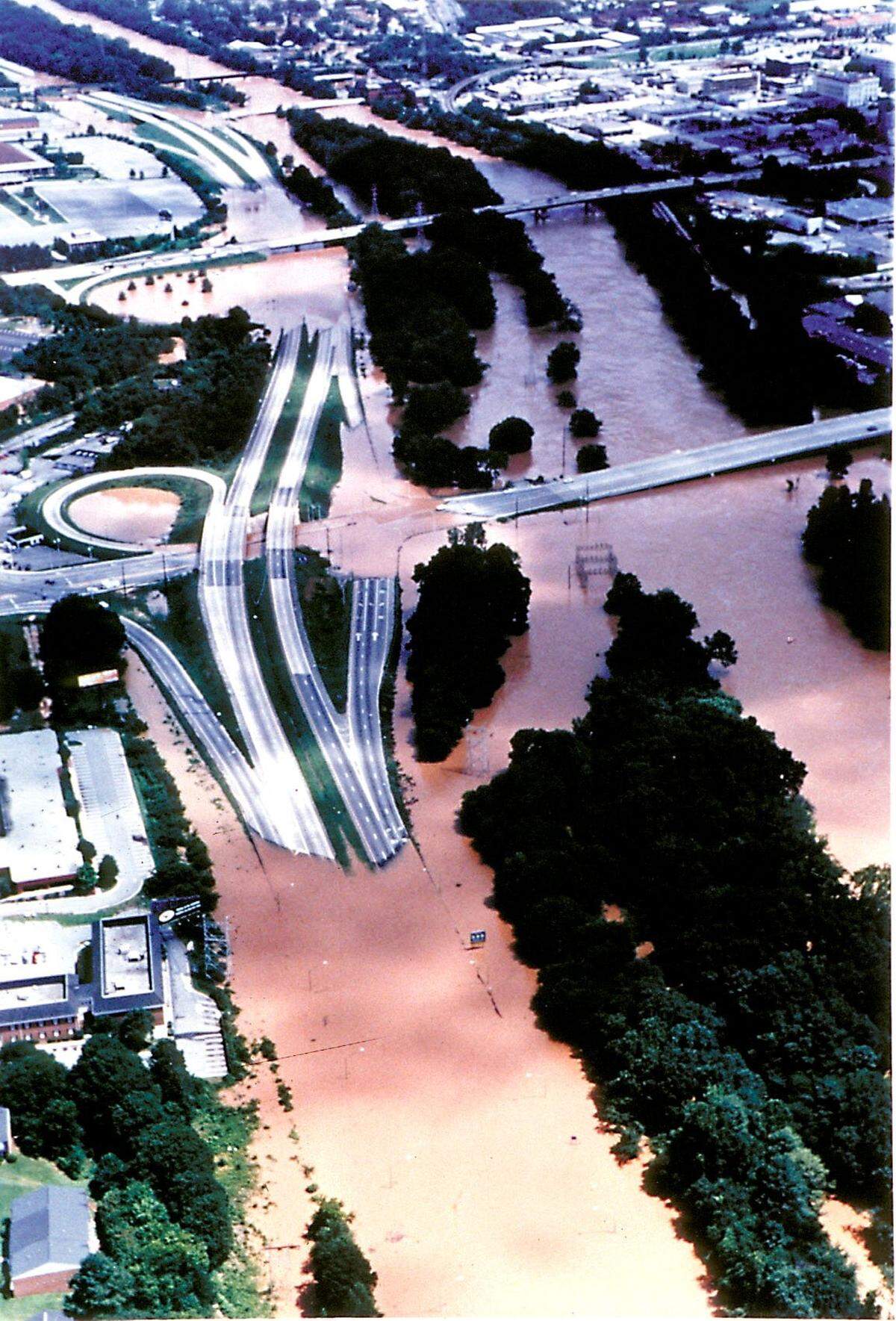
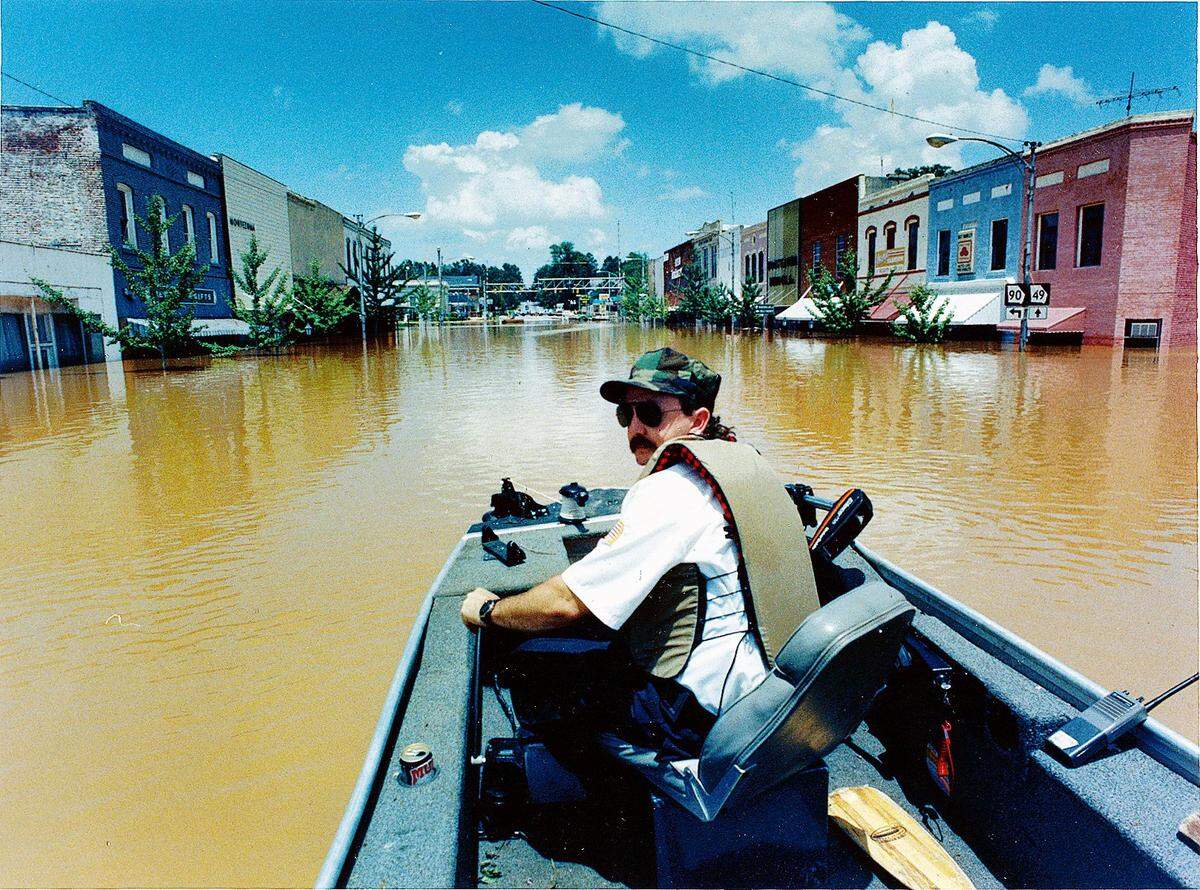
The turbulent Ocmulgee flooded low-lying stretches of Interstate 16 and I-75, silencing the superhighways’ drone. At the foot of downtown, the river rushed under the Otis Redding Memorial Bridge and hissed like an ocean.
The Ocmulgee surged to an estimated 35 feet, to nearly twice its normal flood stage. Riverside Drive was the river in spots. Water gushed into a steakhouse, a seafood restaurant, a car lot and a Denny’s parking lot. The river streamed through and deposited an eerie ghost-town calm on an entire strip of businesses near the Pierce Avenue interchange.
A few miles north, up at Arkwright Road, the Ocmulgee climbed over the bridge leading to the River North subdivision. When it did, a man in a 14-foot aluminum motorboat was undeterred by the rapids and the bridge’s protruding railings.
The submerged bridge trapped house parts and tree limbs.
Boater Guy Fried could easily have turned and gone back up river. But he figured that wouldn’t be as much fun.
So he scouted for the best spot to zip across the clogged bridge. Dozens of onlookers watched him, a videotape showed. They wondered what he was up to.
“Maybe he’s looking for his house,” a woman said.
No sooner than she spoke, a strand of power lines dangling above the bridge flopped into the water. The electric pop of sparks on water made another woman cry, “Get out of the water, mister!”
Fried, the 39-year-old owner of a waste-disposal company, guided his boat into a patch of treetops about 100 yards upstream, then gunned his 25-horsepower engine and raced straight at the bridge. He and his boat vaulted over a logjam and, in what Fried has since referred to as “a ‘Dukes of Hazzard’ jump,” landed on the other side of the bridge.
“He’s crazy,” someone watching said.
During the jump, something punched a hole in the bottom of Fried’s boat. He stuffed a rag in the hole and kept on going.
Unlike three men who, the very next day, nearly drowned when their search-and-rescue Hovercraft flipped over in the river, Fried later explained that he wasn’t on any mission. “I was just sightseeing.”
“It didn’t start out that it was gonna be a thrill-seeking, jump-over-the-bridge kind of day,” he said. “But what do you do when you’re going downriver and there’s a bridge in your way? I had to get over that bridge some kind of way. ... It was a beautiful, sunshiney, floody day.”
Life with no running water
With the skies clearing, Macon’s taps ran dry.
More than 150,000 people began adjusting to life without running water.
The coming days would flow together and puddle into a blur of body odor and bottled water.
Tankers that normally hauled milk trucked in fresh water.
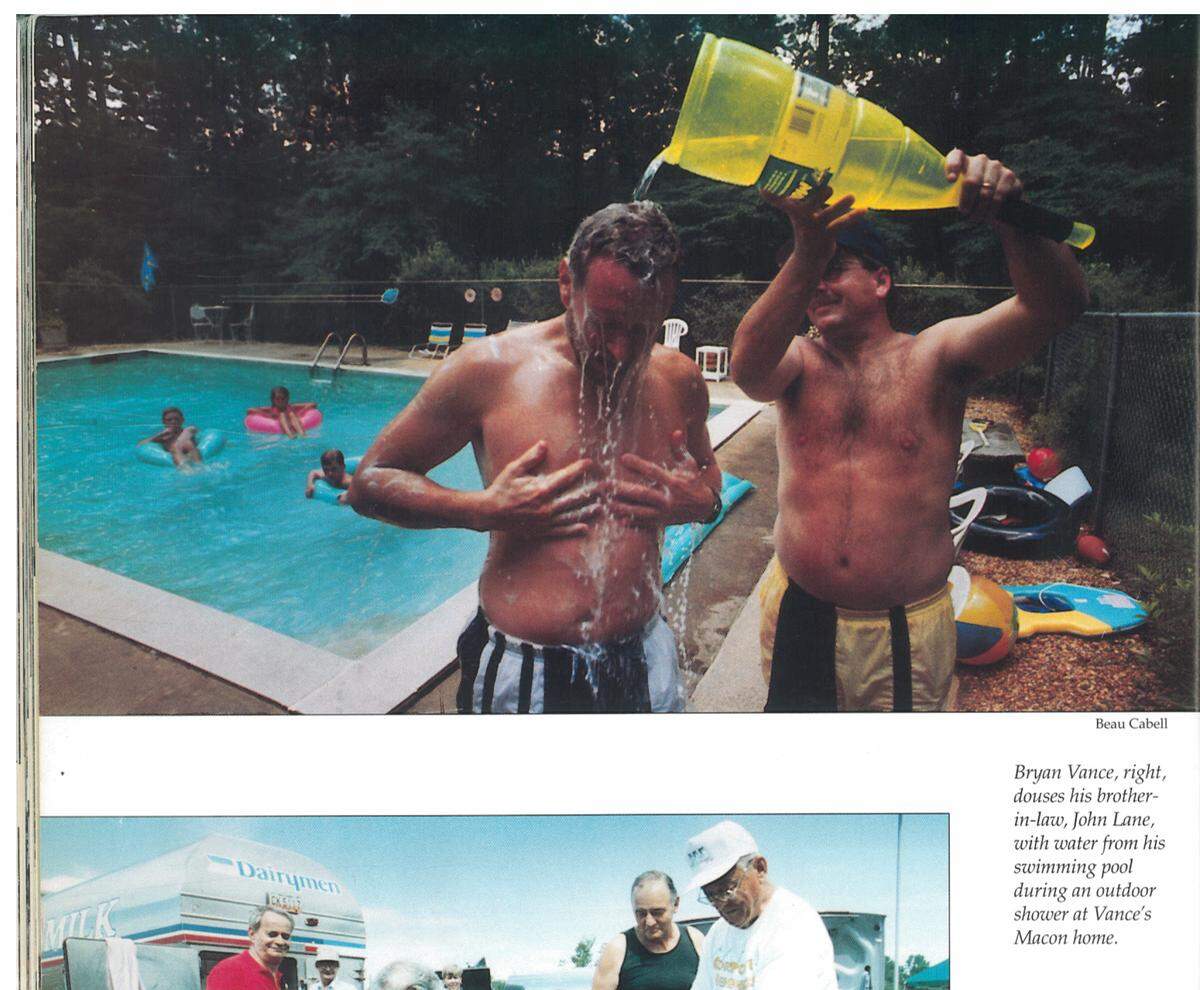
Residents showed up at water-distribution spots across the city with buckets, barrels and pretty much anything that would hold liquid. Water had become more precious than air conditioning. To preserve it, Lake Wildwood’s clubhouse pool banned cannonballs.
The very perks of Southern existence were put on hold. A sign behind the counter at the Nu-Way on Hillcrest Boulevard read: “No refills on tea until the water is back to normal.”
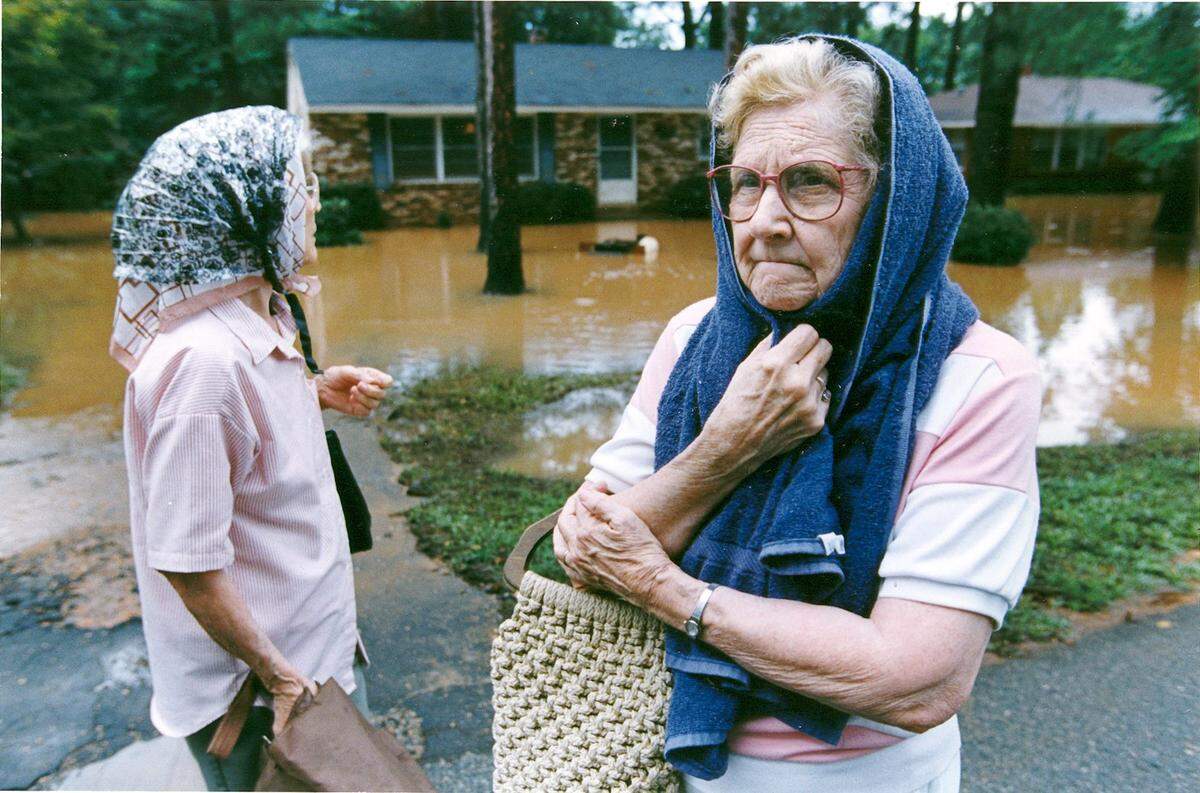
Meanwhile, those whose houses flooded began tearing up carpet fouler than forgotten Easter eggs. A woman down the hill from Rice Mill Road saw Rocky Creek lap right into her bedroom and soak her mattress until it was as immovable as a filled-up kiddie pool.
“It’s all enough to make you drink,” she told a reporter. “People’s nerves are getting on edge with no food, no water, and you can’t get clean.”
All the perishables at the Piggly Wiggly down on Rocky Creek Road had to be tossed when the store flooded. The parking lot smelled like dead meat.
A man who used buckets of river water to flush his toilet lifted the tank cover one day to find a salamander squirming inside.
The inconvenience was too much for another Macon man. He took up residence at a Warner Robins motel after someone snuck onto his front porch and stole a 20-gallon trash can full of water. “Didn’t they used to hang people for that?” the man wondered.
The Macon Water Authority told residents to expect dry taps for at least a week, then two, while water-plant workers scooped thigh-deep sludge from flooded purifying pools. To make do, folks rinsed off in rainwater. Others rigged showers with downspouts and spaghetti strainers.
Amid the abundant rain, ingenuity reigned --- and on the grandest of scales.
For a time it appeared the major arteries between Macon and Warner Robins would be cut off indefinitely. The Echeconnee Creek bridge on U.S. 41 below the airport was impassable.
Downstream at Ga. 247, the two-lane, southbound bridge linking Bibb and Houston counties was also washed out. The northbound bridge, however, was still standing, and the hope was to route both north and southbound traffic over it.
But transportation officials informed then-Bibb County Sheriff Robbie Johnson that there were too many roadblocks elsewhere. There weren’t enough orange traffic cones left to fashion a viable single-lane stretch of Ga. 247 between the counties.
Johnson said something had to give, that too many people used the highway to get to Robins Air Force Base.
It just so happened that I-75 through Bibb County was in the process of being widened.
Among the areas under expansion was the Hartley Bridge Road corridor not far from where I-75 joined I-475. Side-by-side reflector barrels lined the freeway.
The sheriff gathered some of his deputies and said, “You reckon they’d notice if every other barrel went missing?”
Bibb deputies in patrol cars hauled barrels through the night, and before long traffic on Ga. 247 was flowing to and from the Air Force base.
“People had to get to work,” Sheriff Johnson said. “The base had to stay open.”
‘I Survived the Flood’
But the sheriff couldn’t please everyone. The flooding made national news. A kook from Philadelphia apparently heard about Georgia’s troubles. He dialed up the Bibb sheriff’s office and introduced himself as the brother of man running for governor of Pennsylvania. The caller told a switchboard operator, “You tell Robbie Johnson that God does punish people, because this flood shows that he’s punishing Robbie Johnson.”
So maybe the flood was one of biblical proportions. Early on in the high-water hysteria, a man was heard sloshing through the flooded intersection at Riverside Drive and Martin Luther King Jr. Boulevard, yelling, “Macon is hell! Macon is hell!”
Yes, high water had come, but Macon was anything but condemned. Rather, the people who lived here, spared destruction for the most part, were marooned in a surreal working vacation. It was as though the breezy seemliness of coastal life had washed 180-odd miles inland.
“I Survived the Flood” T-shirts were as plentiful as off-brand Evian. Portable toilets were as ubiquitous as Waffle Houses. People got to know their neighbors. They hardly had a choice.
A dozen days into the water outage, at 2:15 on a Sunday morning, a man tooled up to a water-giveaway station on Riverside Drive.
“The bars just closed,” the late-night customer said. “I smell like smoke and I’ve got to get some water to take a bath so I can go to church in the morning.”
The distribution point was set up in front of an abandoned Kmart. The place was open around the clock. Volunteers there and at others like it greeted customers from all walks.
A palpable sense of solidarity was most evident at those emergency water stations.
Perhaps it was the shared hardship, an out-in-the-open acknowledgement of vulnerability. For whatever reason, Macon took on a communal glow.
In much the way the heavens had already, people opened up.
Churches opened their doors.
An Ohio company donated two tons of dog food.
The mall closed at 7 each night.
And at least one man forgot his anniversary.
Water flowed
When water again flowed to most of the city July 23, electrical engineer Fred Utick crawled into bed around 3 a.m.
He’d been on duty at the waterworks for more than a day and a half without sleep.
He’d helped repair the starters that cranked the riverside plant’s massive pumps.
Finally home early that Saturday morning, he was quiet not to disturb his wife.
But she was still awake.
“Dear,” she asked, “do you remember what yesterday was?”
“Hon,” Utick said, “I’m so tired I can hardly remember my own name.”
His wife jogged his memory. “It was our anniversary,” she said.
But in the end she didn’t mind so much. Running water can work wonders on a marriage. And a city.
For 18 days, most parts of Macon had endured a running-water drought that few cities its size, if any, ever have.
When the spigots ran clear, Mayor Olmstead told a reporter, “I’m really elated. ... You can flush the commode, you can wash your clothes and you can take a shower. It’s awfully pretty.”
Weeks later, on a Saturday in September, the town hosted a tribute to relief volunteers at Central City Park. There were hamburgers, hot dogs and, of course, bottles of water.
There were jugs of water, too.
But not for drinking.
Not that day.
Instead, firefighters saved the gallon-jugs for something special.
Near the park’s gazebo, they erected a 144-gallon salute.
The jugs were arranged on the lawn to express the appreciation of a community, the gratitude of an entire populace that had stood powerless when the supply of its most drinkable resource saw a river run through it.
You haven’t lived through a flood until you have seen 12 dozen jugs of water spell out one giant T-H-A-N-K Y-O-U.
EDITOR’S NOTE: Some information in this story was gleaned from Telegraph coverage of the 1994 flood, from a National Weather Service study of Tropical Storm Alberto, and with assistance from Weather Service hydrologist Jim Noel and retired Weather Service meteorologist Gary Davey.
This story was originally published July 2, 2019 at 5:20 PM.