
$2 million in taxes helped pay for this bridge. But few members of the public use it
A year and a half into its operation, the Mercer Landing pedestrian bridge is almost exclusively used by Mercer University students, despite having been primarily paid for with more than $2 million in public funds on the grounds that it would improve safety for both Mercer and the general public.
The bridge spans Mercer University Drive, connecting Mercer’s main campus on one side with the Lofts at Mercer Landing, a privately-owned, student-oriented housing development. Through a special funding mechanism, the public contribution to the project was paid by nearby taxpayers.
In a continuous 16-hour period during a recent fair-weather weekday, student reporters from Mercer’s Center for Collaborative Journalism counted how many people crossed the bridge and interviewed as many as were willing.
Out of the 104 individual crossings observed, the only people using the bridge who reporters were able to confirm were unaffiliated with Mercer were two women using the steps to exercise and four high school students who ate their lunch on the bridge to enjoy the view.
Nearly everyone else using the bridge told reporters they were Mercer students crossing to and from campus and the adjoining Lofts, where most said they lived. Many said they are shocked when they encounter someone on the bridge who does not seem to be a student.
Mercer junior Skyler Woodard said that if she sees a “stranger” on the bridge, she turns the other way.
“It is sort of weird because I’m like, this is sort of like my house. Like, this is my front yard,” Woodard said. “What are you doing in my front yard?”
During the same observation period, which extended from 7 a.m. to 11 p.m., reporters counted 167 crossings in which people either used the surface crosswalks that run parallel to the bridge or jaywalked across Mercer University Drive.
One of those people crossing on the street instead of using the bridge was Antonio Hunter, who said he used to work for Mercer’s custodial services contractor and hasn’t been on the bridge since he worked the grand opening event in 2016.
“I don’t see the purpose of the public using it. I guess if they’re gonna take pictures, but that’s about it,” Hunter said.
A bridge for ‘student and public transit’
Macon-Bibb County commissioners were first pitched the idea of paying for the bridge in a 2014 presentation by Mayor Robert Reichert, Mercer University President Bill Underwood and Lofts developer Jim Daws. A resolution advancing the project sponsored in 2015 by Reichert stated: “Macon-Bibb County believes that the construction of a pedestrian bridge to serve this area is a critical piece of infrastructure needed to allow safe student and public transit across one of this community’s busiest thoroughfares.”
Mercer University Drive is one of the most dangerous streets in Macon for walkers, with 11 pedestrian-related crashes occurring there in 2016 and 2017, including one fatality, according to figures provided by the Macon-Bibb County Planning & Zoning Commission. The closest of those incidents happened about a mile away from the bridge.
Despite some initial reservations, commissioners ultimately approved financing construction costs with a tax-allocation district, or TAD, which is a mechanism designed to encourage private investment within a specific area. From the time the TAD is established, the taxes generated by increases in property value above the initial baseline are set aside to be spent on infrastructure serving the district. The more that property owners build and improve in the district, the more tax money will be invested back into the area.
The Mercer Landing bridge was financed with tax revenue from the Second Street Corridor TAD, a 2-mile-long area extending along Mercer University Drive from Pio Nono Avenue to Little Richard Penniman Boulevard, and then along Second Street, around which it encompasses a dozen downtown blocks between Oglethorpe and Plum streets.
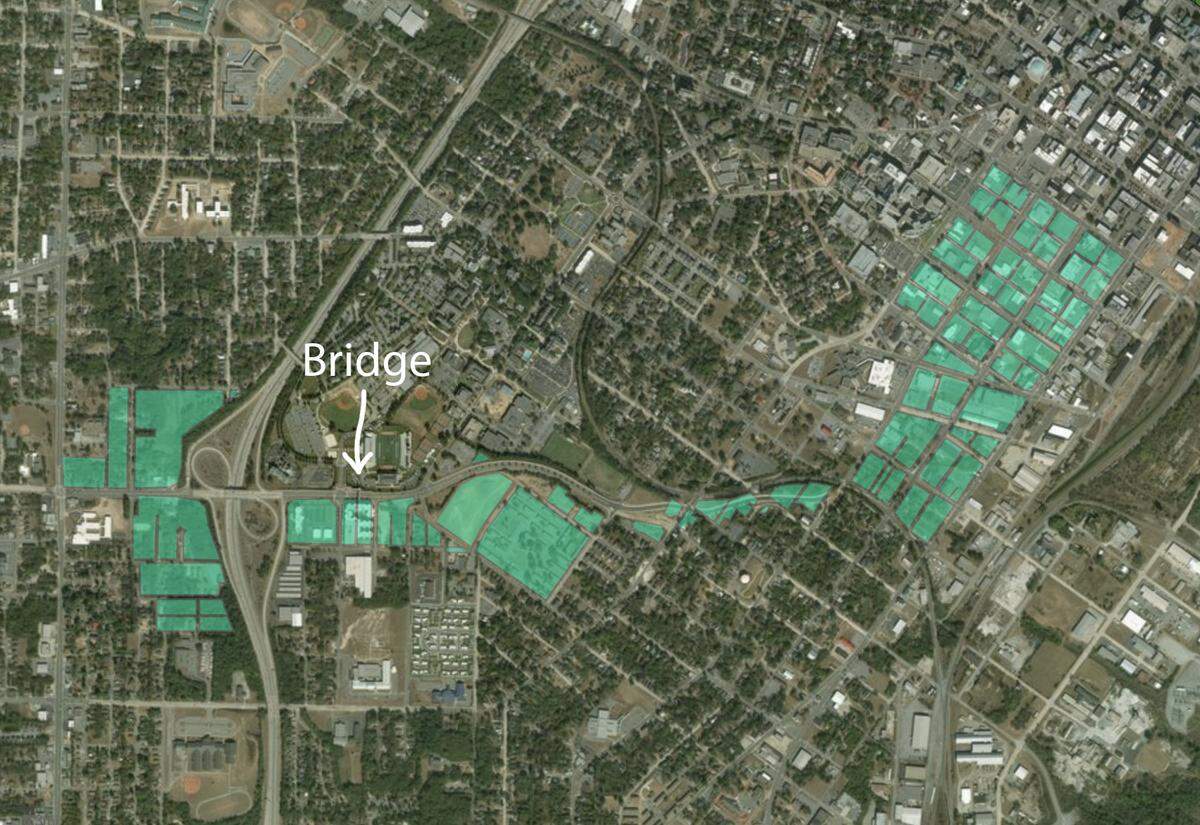
Of the project’s final $2.9 million cost, taxpayers contributed just over $2 million from bonds issued in anticipation of the TAD revenue, while Mercer paid $861,711 and Daws’ company, Sierra Development Group, paid $44,459, according to figures provided by Macon-Bibb County government spokesman Chris Floore.
The bridge “wasn’t built with funds from taxes on people’s homes that live, for example, in neighborhoods 10 miles away,” Floore wrote in an email. “The additional funds from the property value increase couldn’t go into our general fund; they had to be used in that area.”
Floore acknowledged that the tax revenue might have gone into the general fund had local government not established the TAD in the first place, but countered that Sierra Development might not have made its revenue-generating investments in the area had it not had the incentive of the TAD and the bridge.
Buyer’s remorse
Commissioner Elaine Lucas said she would not have voted in favor of the bridge plan if she knew then what she knows now about how the bridge is being used.
“We could have used all of those millions of dollars to do some true pedestrian safety type features in there that would've been more effective than erecting a multimillion dollar bridge that is pretty, but it's not serving a function,” Lucas said.
Tim Booker, a resident of the predominantly black and low-income neighborhood near the Lofts building, said he never uses the bridge and never sees his neighbors using it either.
“I thought the bridge was designated for only Mercer students because it connects to the Lofts,” Booker said.
Instead of connecting directly to public sidewalks on either side of Mercer University Drive, the south end of the bridge leads directly into the second floor of the Lofts building. To get up and down from that end, pedestrians must first enter the building’s vestibule, and there are no signs indicating the general public is welcome.
Nonetheless, Mercer senior Geoffrey Johnson said he feels uncomfortable with how easy it is to access the building.
“I do not appreciate that the Lofts leave that door at the top of the bridge unlocked for people just to walk into the building,” Johnson said. “I feel like that might be a safety issue,” he added, though he noted that a key card is required to get past the building’s vestibule and into the apartments.
Macon’s ‘Eiffel Tower’?
When presented with the findings of this report, Reichert said Macon residents are still benefiting from the bridge, even if they don’t physically use it.
“They are certainly benefiting from the economic impact, from the aesthetic impact,” Reichert said. “It's reaching out into a neighborhood that desperately needs development and redevelopment and jobs.”
Mercer vice president and spokesman Larry Brumley said the bridge, outfitted with a partially-decorative lighting display that cost $58,788, is an aesthetically appealing “signature bridge” that can be considered a gateway into downtown Macon.
In what he acknowledged was an “extreme example,” Brumley compared the bridge to the signature landmark of Paris.
“How many people who have seen the Eiffel Tower actually went up to the top of the Eiffel Tower? And yet they do selfies in front of it, take pictures of the Eiffel Tower because it’s something that’s aesthetically pleasing,” he said.
Brumley said he believes it is unfair to judge the effectiveness of the bridge when it has only been open for a year and a half.
“I really believe, in the years to come, the bridge will get more use as more people are living over there, working over there, shopping over there,” Brumley said.
This article was reported by students in Adam Ragusea’s investigative reporting class at Mercer University. Additional reporting was contributed by Jaya Alaan, Vanessa Alva, Austin Barrett, Matthew Causey, Jiali Chen, Drew Daws, Taylor Drake, Noemi Griffin, Adelia Henderson, Melissa Henriques, Paige Hill, Laurel Huster, Mitch Jaugstetter, Dylan Malamala, Jayla Moody, Kyle Mullins and Megan Rosinko.
This story was originally published April 29, 2018 at 8:00 AM with the headline "$2 million in taxes helped pay for this bridge. But few members of the public use it."