Data centers are transforming Georgia Power’s future. What’s the risk?
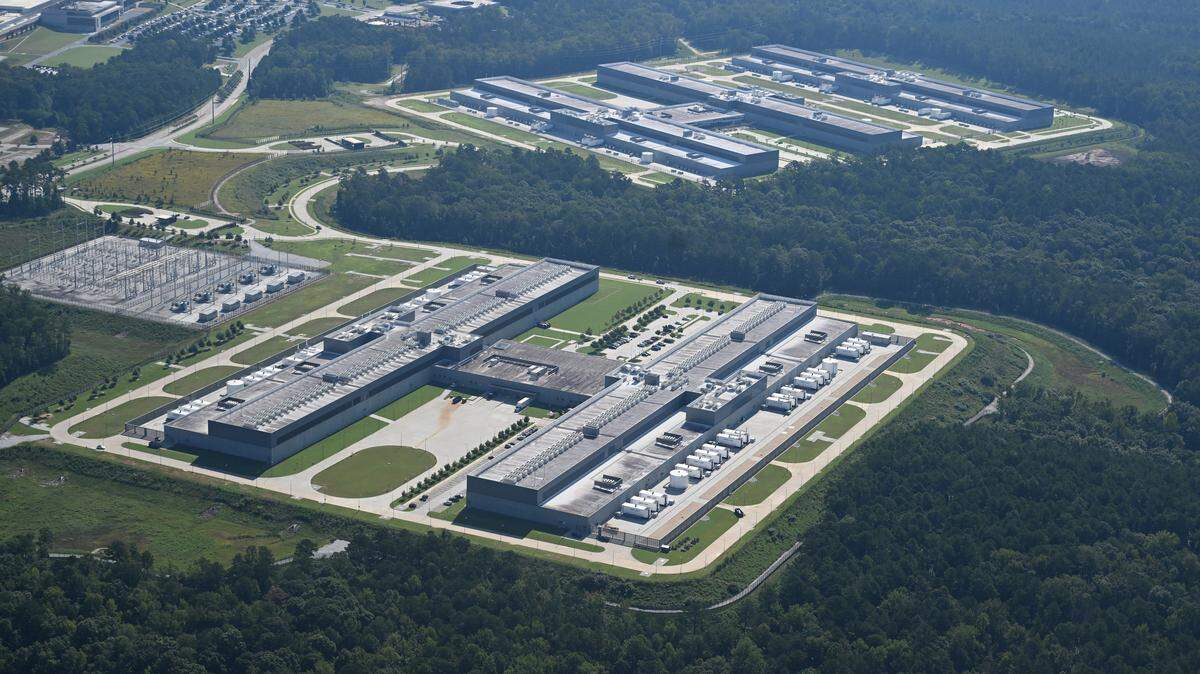
In the past six months, Georgia Power has gotten approval to build nearly 10,000 megawatts of new generation capacity and search for up to 6,000 more — a potential addition that could more than double the company’s generation capacity.
It’s almost entirely driven by data center demand.
As of this spring, Georgia Power has committed a total of 15,600 MW of electricity demand to 32 large-load customers, at least 26 of which are data centers, according to the company’s most recent quarterly report. Of the 32 projects, 21 have already broken ground, according to an April news release from the company.
To put that in perspective, Georgia Power’s total generation capacity at the end of 2024 was roughly 14,800 megawatts, serving around 2.8 million customers, according to the company’s own Facts & Figures document.
“The scale of this (expansion) is just unlike anything that’s ever been done before,” said Bob Sherrier, senior attorney with the Southern Environmental Law Center. “And to barge ahead with this much energy spending, this much customer money, for an industry that has not proven itself yet is very, very risky for existing customers.
“It’s shocking. Frankly, it’s scary.”
What is the concern?
In June, the Georgia Public Service Commission approved the process for Georgia Power to source between 2,000 and 6,000 megawatts, which is “driven almost exclusively by load growth,” said Georgia Power spokesperson Matthew Kent.
But the 4,000-megawatt range is itself a signal of how uncertain the load growth picture is, according to Sherrier.
“A 4,000 megawatt range is almost a joke,” he said. “It’s so huge … the uncertainty that’s there right now is so huge.”
The average residential customer uses 11,871 kilowatt-hours per year, according to Georgia Power’s Facts & Figures sheet. At that rate, 4,000 megawatts could power about 2.9 million homes. Georgia Power has roughly 2.45 million residential customers total, which means 4,000 megawatts is roughly enough electricity to power every residential customer on Georgia Power’s system.
Data centers are a new enough industry that no one knows what demand will look like in 10 or 20 years, Sherrier said, yet the power plants being built to serve them will still be running in 40.
But the commission’s approval came with conditions and warnings.
When approving the June request, the commission unanimously adopted conditions recommended by staff, including a requirement that in 2027 when Georgia Power submits its request on what resources get built, the company must file an updated, long-term resource plan alongside it.
PSC staff warned that as data centers account for a larger share of Georgia Power’s total capacity, “the ability to mitigate the risks to existing customers may face additional challenges.” PSC also reserved the right to object to certifying any new capacity without signed contracts from large-load customers to back it up.
The primary risk is stranded assets — infrastructure built for customers who never materialize or leave the state before construction costs are paid off, according to Tom Krause, PSC spokesperson. To prevent that risk, Krause said the PSC has required minimum contract terms, termination provisions and promises from Georgia Power to absorb financial shortfalls without passing the cost to ratepayers.
Georgia Power said its contracts already include protections.
Large load customers pay upfront for all local infrastructure costs and are locked into long-term agreements with minimum bill requirements and termination payments. These provisions ensure existing ratepayers don’t absorb the cost if a data center leaves, according to Kent.
But the rules give Georgia Power significant discretion: the company can require data centers to sign contracts of up to 15 years rather than the standard five and can impose minimum bill requirements if a facility uses less power than projected, but it does not have to do either, according to Patrick King II, Georgia director of climate and energy at the Natural Resources Defense Council.
Without a rate case last year, regulators and advocates also never received a cost of service study, the document that would show what it actually costs to serve data centers compared to residential and commercial customers, King said. That review is not expected until 2028, by which point most contracts will already be signed.
“The rules are better than nothing, but because there’s a significant lack of transparency on a number of metrics, I can’t comfortably say that ratepayers are being protected from data center costs,” King said.
King also raised questions about the load projections themselves. Data centers shopping for power tend to submit bids in multiple states at once, meaning the same facility may be counted toward projected demand in Georgia, North Carolina and Virginia simultaneously.
“We know that a number of data centers are being double and triple counted among utilities,” he said.
Comparing Georgia’s approach to other states is difficult, King added, because most utilities outside Northern Virginia have not faced load growth at this scale, and there are no established standards yet for how regulators should respond.
The fuel mix is still taking shape
The regulatory decisions authorizing the expansion have come in rapid succession, but the electricity resources across both initiatives are set to come online between 2027 and 2033.
The 9,900 megawatts certified by the Georgia Public Service Commission in December is largely new natural gas generation. The up to 6,000 megawatts could be natural gas, battery storage or renewables paired with battery storage, which is determined through a competitive bidding process.
Sherrier expects the next round to look similar to December. Georgia Power significantly reduced the credit it gives to battery storage in its resource planning last year, he said, effectively tilting the bidding process in favor of gas.
“It reverses the trend of decreasing greenhouse gas emissions to where our energy grid will now be increasing for the first time in a long time,” he said.