Feds back Georgia Power project with largest energy loan in U.S. history
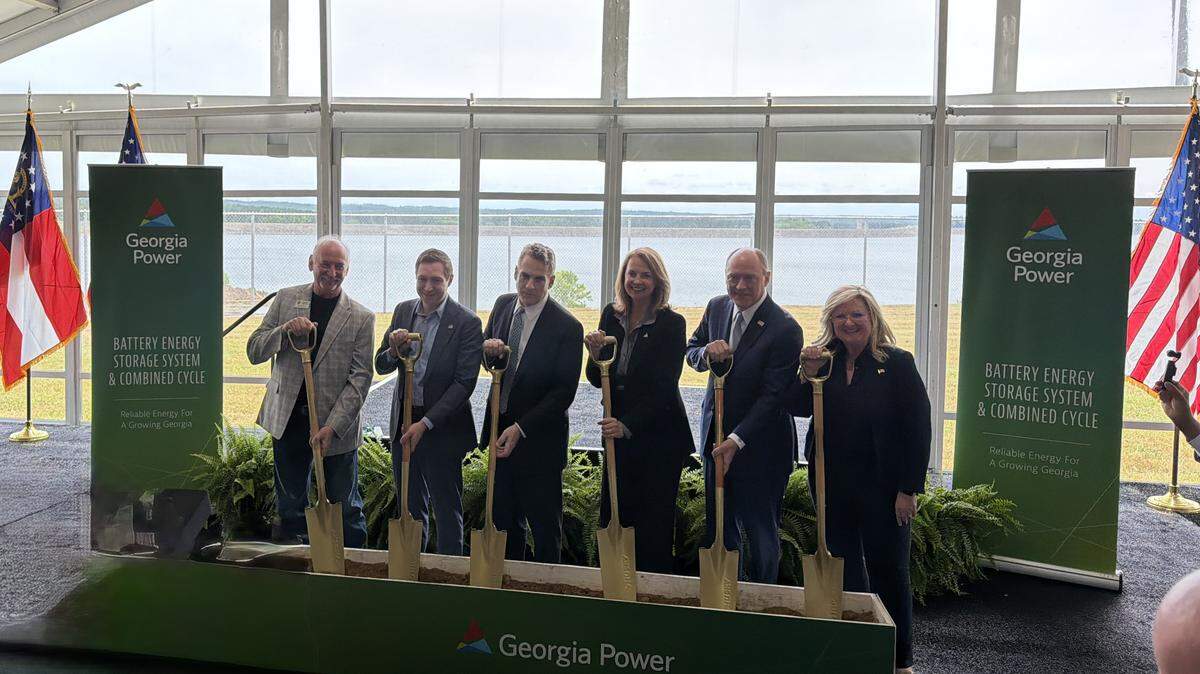
Georgia Power became one of the first utilities in the nation on Thursday to break ground using the largest federal energy loan in U.S. history.
The project will add two new 750-megawatt combined cycle natural gas units and 500 megawatts of battery storage at Plant Wansley in Heard County, about an hour north of Columbus, Ga.
The $26.5 billion federal loan, which is the largest single federal loan outside emergency times in American history, according to James P. Danly, deputy secretary of energy at the Department of Energy, will finance six gigawatts of nuclear capacity, five and a half gigawatts of natural gas, three and a half gigawatts of battery storage, one gigawatt of hydropower and 1,300 miles of new transmission lines across the two states.
Combined, the investments will result in 16 gigawatts of new generation across Georgia and Alabama.
The two new 750-megawatt units at Wansley could power roughly 1.5 million homes.
“Plant Wansley was not yesterday, honey — it’s tomorrow,” said Public Service Commissioner Tricia Pridemore.
A power plant transformed
Plant Wansley has been a fixture in Heard County for 50 years. The site’s two original coal units — each capable of producing nearly 1,000 megawatts — ran from the late 1970s until August 2022, when the Georgia Public Service Commission approved their retirement.
Natural gas combined cycle units that had been operating alongside the coal units since 2002 continued running, keeping the plant an active part of Georgia’s grid. What Thursday’s groundbreaking adds is something new entirely: two larger, modern natural gas units and a significant battery storage system.
“We felt like we had lost something. We felt like we were really going downhill, and it was hard for our county,” said Heard County Commissioner James Perry, who lives just across the road from the plant and watched the old stacks come down. “But here in Heard County, we are so happy that you have invested in our future, in our home.”
Details of the loan
The federal government lent Southern Company the money at a lower interest rate than it could get from a private lender. That means the company spends less on interest — more than $300 million a year in savings that would otherwise show up as higher electricity bills. Over roughly 30 years, that adds up to $7 billion in savings for customers in Georgia and Alabama, according to the DOE and Southern Company. “Every single year, I will thank President Trump on behalf of Georgia customers for the $300 million of interest savings that this administration has brought to our state,” Pridemore said.
The combination of new generation and ratepayer savings is unusual. Utilities typically face a tradeoff between building more capacity and keeping costs down.
“You’re managing to accomplish both goals at the same time — increasing reliability and decreasing cost,” Danly said.
The loan originated and closed entirely within President Donald Trump’s administration, which declared a National Energy Emergency on its first day in office.
Speaking at the ceremony Thursday, federal officials pointed to a July 2025 Department of Energy study to explain the urgency, saying it found the country’s grid was headed toward a serious reliability shortfall.
The study found that about 104 gigawatts of power plants (roughly three-quarters of them coal, the rest natural gas) are on track to retire by 2030.
The study projected that 209 gigawatts of new generation would replace them, 187 of those gigawatts being wind and solar. But those forms are not considered firm, dispatchable generation — which can be adjusted based on user demand for electricity — available around the clock.
At the same time, electricity demand is surging. Data centers driven by the explosive growth of AI are projected to require an additional 50 gigawatts of capacity by 2030 adding further pressure. Without course correction, the study warned, the risk of blackouts could increase by a factor of 100.
“Under President Trump’s leadership and that of Secretary Wright, we return to common sense energy policies in which we can focus on energy addition, not subtraction,” Danly said. “So instead of having unreliable, intermittent resources as the primary focus of the federal government, what we want is affordable, reliable, secure energy.”
However, critics argued the DOE’s report overstated the problem.
The most recent federal energy data showed only about half as many plant retirements actually occurring as the study assumed, according to GridLab, a nonprofit that analyzes grid reliability policy and conducted a direct technical review of the DOE report.
The report’s preferred fix — keeping aging coal and gas plants running past their planned retirement dates — would saddle ratepayers with the costs of plants their owners had already deemed uneconomical, while crowding out newer and cheaper resources, according to Utility Dive, a trade publication that covers the electric power industry.
“This is a success story, and I want to see a million of these replicated across the country,” Danly said. “You should be proud of the fact that you are one of the very first in the process of taking advantage of the department’s newly refocused energy dominance financing.”
Construction at Plant Wansley is now underway, with completion expected in November 2029.
Partners to the project
The project is jointly owned by Georgia Power, the Municipal Electric Authority of Georgia, Dalton Utilities and Oglethorpe Power, along with 41 electric membership cooperatives serving communities across the state.
The Georgia Public Service Commission also played a key role, according to Kim Greene, president and CEO of Georgia Power.
“Georgia Power does very little on its own,” Greene said. “And particularly we are very dependent on the Public Service Commission.”
In December 2025, the commission approved Georgia Power’s unprecedentedly large 10 gigawatt expansion plan. Just a month later, the commission approved a rule requiring data centers consuming more than 100 megawatts to pay transmission and distribution costs as their construction progresses, with new contracts submitted to the PSC for review.
“Those contractual protections, and how we ensure that we’re able to serve these customers in a way that will protect all of our customers, is so important — and it’s something that our commission was really ahead on and really saw the opportunity and saw the need,” Greene said.
Those protections mirror what Trump formalized nationally in March as the Ratepayer Protection Pledge, in which Amazon, Google, Meta, Microsoft, OpenAI, Oracle and xAI agreed to build, buy or fund their own generation and pay for all grid infrastructure upgrades required by their data centers.
“He insisted that the major consumers of electricity bear the proper cost for the infrastructure for which they’re going to benefit, and in the process insulate the regular ratepayer from the cost,” Danly said.
However, not everyone is convinced those protections go far enough.
The Southern Environmental Law Center sued the PSC over Georgia Power’s broader 10-gigawatt grid expansion — of which Plant Wansley is a part — arguing Georgia Power never proved all the new capacity was needed. The plan is roughly 60% natural gas, and the groups contend that building gas plants to serve data centers that have not yet signed contracts puts billions in long-term costs at risk of falling on residential customers.
“Commissioners chose to put this $60 billion risk on the backs of everyday Georgians, not Georgia Power,” Bob Sherrier, a staff attorney for the Southern Environmental Law Center, said in a press release. “They had the chance to meaningfully protect existing customers, and they did not.”
Latitude Media, an energy industry publication, separately reported that the White House ratepayer pledge has no enforcement mechanism, with one analyst saying it “just tells hyperscalers to sort out their own power problem however they want, and calls it ratepayer protection.”