Georgia Power’s $912M storm damage debt could soon be on your bill
Georgia Power is looking to recover nearly a billion dollars in storm damage from customers and a federal tax credit after extreme storms have left the company with mounting debt.
Over the past 30 years, Georgia Power has set aside hundreds of millions of dollars to address storm damages, but a warming climate has led to more extreme storms, causing more costly damage.
In order to address the debt, Georgia Power must come before the Public Service Commission to get approval for the company’s first-ever storm damage recovery case. The company intends to ask for more funds for storms, which would increase rates for customer monthly bills.
In February, Georgia Power asked the commission for permission to grow its funds for storm damage from the current annual $31.4 million to $101 million in order to address its mounting debt, which has now reached $912 million.
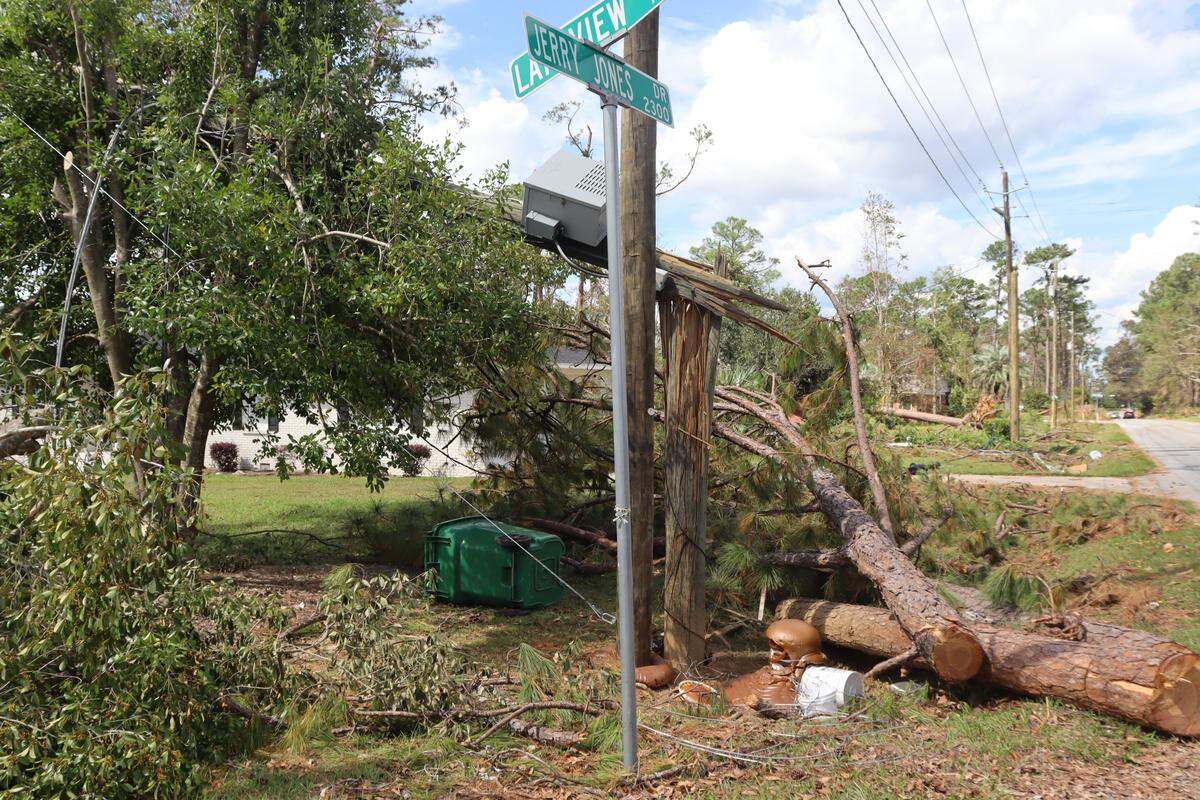
Damage from Hurricane Helene alone is responsible for $781 million of the debt.
“The increase in Georgia Power’s storm balance was primarily related to Hurricane Helene which was the most destructive storm in the company’s history with 12,200+ power poles, 1,500+ miles of power lines and nearly 5,000 transformers damaged or destroyed,” according to Alicia Brown, spokesperson for Georgia Power.
In order to fully recover, the company is asking for additional funds of $228 million over the next four years to address Hurricane Helene-specific damage, growing the annual total storm-related damage fund request to $329 million.
The company is asking to raise rates by 2.2% across the board. In its testimony to the PSC, the company said a “typical” customer using 1,000 kWh per month would see a $4.42 increase on their monthly bill.
This combined proposal could increase residential customers’ base rate anywhere from $3.50 per month to as high as $6.60 per month depending on how much energy the customer uses, starting June 1 through May 31, 2030.
The ratepayers are only on the hook for paying a portion of this debt. Still, Brionté McCorkle, Executive Director of Georgia Conservation Voters, called this storm damage recovery request a big ask, given some customers have experienced significant damage to their homes from unprecedented storms.
“By allowing the power company to pass those costs directly to customers, the commissioners who approve this proposal are locking us into a cycle where Georgians pay twice: once through higher bills and again through more severe storms,” said McCorkle.
The other portion of the debt would be relieved through what are called Production Tax Credits.
In the last few years, the power company received federal tax credits for producing carbon-free nuclear energy. In their storm damage recovery case testimony in February, Georgia Power pitched using $65 million in credits, a quarter of the total Project Vogtle credits, to help relieve the debt.
Before turning to that option, the company said it explored two other funding sources. Its insurance policy excludes damage to power lines and poles — the bulk of storm-related damage — so no claim was filed. The company also looked at FEMA disaster assistance but did not qualify because that program is limited to non-profits.
What led us here?
Major storms wiping out the power company’s reserve faster than it gets replenished has been a theme in its recent history. By the end of 2018, the storm damage reserve reached a $415.8 million deficit, primarily from Hurricanes Matthew, Irma and Michael, according to Georgia Power’s 2019 rate case testimony.
That storm damage reserve number has grown significantly over time — $3.6 million per year in 1996, around $9 million in the early 2000s, $63.5 million in 2022 and now $101 million in 2026, according to several PSC filings from Georgia Power testimonies.
In addition to Hurricanes Helene, Idalia and Debby in 2023 and 2025, weather events like tornadoes and winter storms have racked up costly damages, the Feb. testimony reads.
Hurricane Helene was the most powerful and damaging hurricane in Georgia Power’s history. It clocked wind speeds of above 100 mph hundreds of miles inland.
Hurricanes strengthen from a warmer ocean, and rising temperatures are the strongest signs of a warming planet, said Andrew Pershing, lead scientist and director of Climate Central, a climate science communications group.
Human-caused climate change is exacerbated by burning fossil fuels like coal or gas, which release carbon dioxide and methane into the atmosphere. The trapped gases create the greenhouse effect, warming oceans and fueling more intense storms, according to the Intergovernmental Panel on Climate Change Sixth Assessment Report. The IPCC is a United Nations body made up of thousands of climate scientists from around the world that review climate research.
“Our analysis shows that climate change made every hurricane in 2024 stronger,” Pershing said. “Even a small shift in windspeed translates to a big increase in damage. For example, the 10 mph increase in the maximum winds of Hurricane Helene likely increased the damage from that storm by 50%.”
Even before Hurricane Helene, climate change was showing up in hurricane strength since 2019. Pershing co-authored a study that found sea surface temperature increasing is speeding up hurricanes.
“During five recent North Atlantic hurricane seasons (2019–2023)...human-driven sea surface temperature shifts have already driven robust changes in 84% of recent observed hurricane intensities,” and, the hurricanes were “8.3 meters per second faster than they would have been in a world without climate change.”
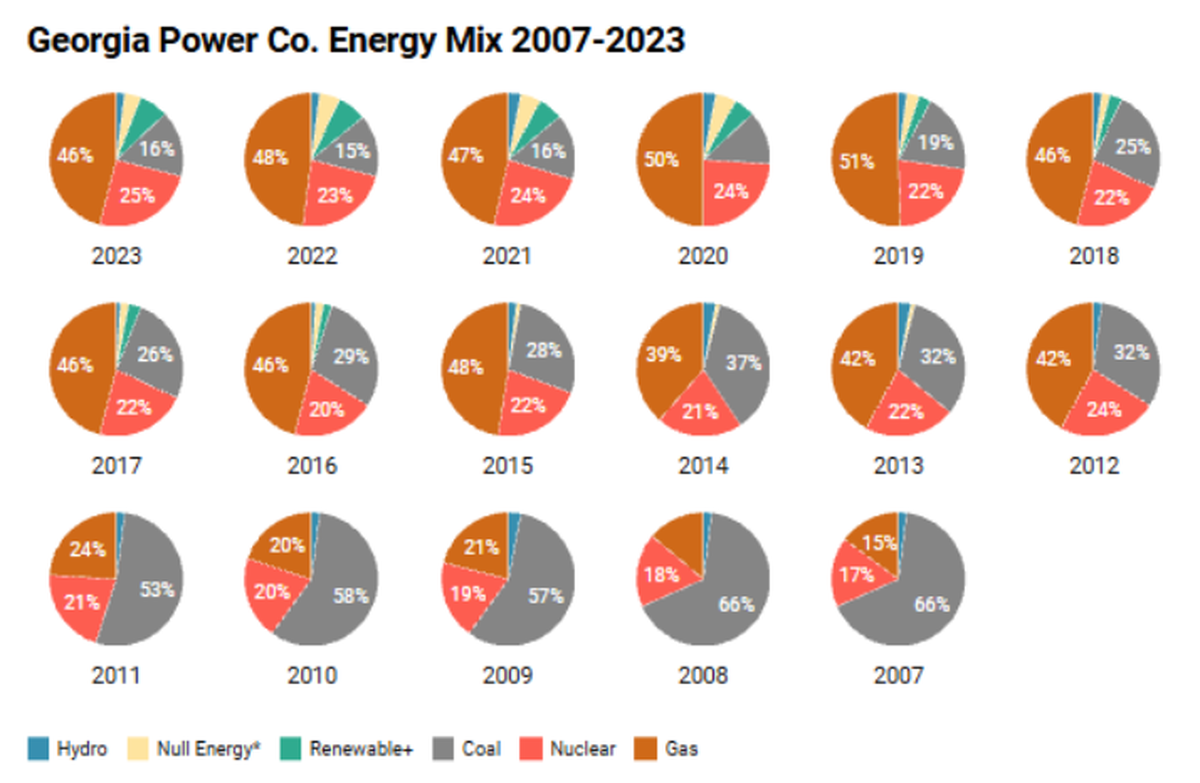
Georgia Power has been burning coal since 1884, when they opened the Georgia’s first coal plant in Atlanta, according to a research data base, EBSCO. Although the company has used carbon-free power like hydroelectric dams since the late 1800s and then nuclear power in the 1970s, coal was continually used.
In 2023, WABE reported that Southern Company, the parent company to Georgia Power, knew that carbon emissions were contributing to climate warming as early as 1985, from the company’s own research foundation called the Electric Power Research Institute. In the 1980s, the power company also funded a disinformation campaign about climate change.
Additionally, Southern Company paid more than $62 million to groups that campaigned against climate science from 1993 to 2005, according to the Energy Policy Institute’s 2022 findings.
Fast-forward to December 2025, the largest power request in U.S. history was granted to Georgia Power by the PSC to add 10 gigawatts of energy to the electric grid, 60% of which was natural gas, at a price tag of $50-60 billion.
“Georgians will have to pay for the gas, then burn that gas, which will result in more carbon emissions, more extreme storms, and more costs,” McCorkle said.
What about frozen rates?
After six rate increases in two years, the PSC froze base rates for customers for three years starting in 2025. But, this freeze came with a caveat. Storm recovery funds could still be subject to change due to Hurricane Helene’s significance.
“Last year, when Georgia Power announced a three-year base rate freeze, they were banking on the fact that most people don’t fully understand what makes up their power bill,” McCorkle said. “Base rates are only one part of what people pay each month. Storm recovery charges, fuel costs, and other riders can still drive bills up even when ‘rates’ are technically frozen.”
Georgia Power filed the storm damage recovery request at the same time as a separate fuel cost adjustment.
The fuel cost case is a recovery from the price of fuel, namely gas and coal, that has waxed and waned from geopolitical tensions since 2022.
Georgia Power is pairing that decrease with the storm cost increase, resulting in a slight drop monthly bills, even as the portion of the bill dedicated to storm recovery is going up significantly.
Throughout April and May, the storm damage recovery case will be heard in tandem with the fuel cost recovery case.
Editor’s Note: Georgia Power opened the state’s first coal power plant in 1884. A previous version of this article included the wrong year.
This story was originally published March 25, 2026 at 12:02 PM.